Façade Balcony
Barcelona, Spain
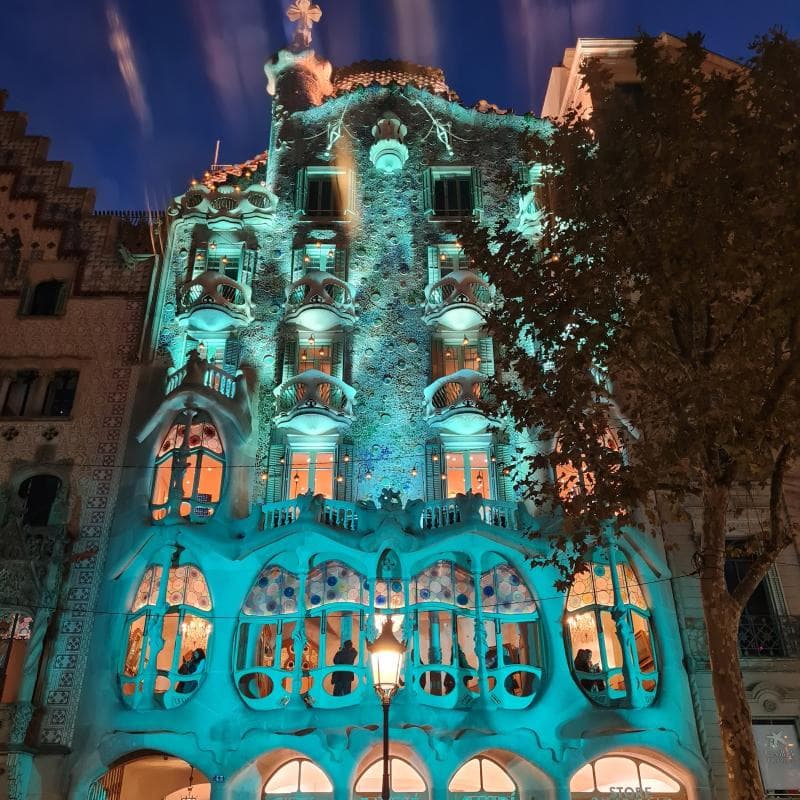
Explore the captivating Façade Balcony of Casa Batlló in Barcelona, Spain. Discover Gaudi's unique 'mask' balconies and the enchanting stories they tell.
Overview
The Façade Balcony of Casa Batlló, nestled on Barcelona's elegant Passeig de Gràcia, is not merely a structural element but a captivating introduction to Antoni Gaudí's fantastical world. It is an integral part of the building's iconic exterior, renowned for its fluid, organic forms and vibrant symbolism. These distinctive balconies are instantly recognizable, contributing significantly to Casa Batlló's whimsical, almost living appearance. They invite onlookers to pause and decipher the stories woven into their unique shapes, setting the stage for the architectural marvel within.
History & Cultural Background
Casa Batlló, originally an uninspired 1877 building, underwent a radical transformation between 1904 and 1906 under the masterful hand of Antoni Gaudí. Commissioned by the wealthy textile industrialist Josep Batlló, who sought a house that would distinguish itself from the surrounding modernist buildings on the 'Block of Discord', Gaudí was given complete creative freedom. Instead of demolishing the existing structure, Gaudí chose to renovate it entirely, adding new floors and completely redoing the main apartment and, crucially, the façade. This period marked Gaudí's mature architectural phase, where his innovative genius and distinct Modernisme style truly flourished, drawing inspiration from nature, Catalan legends, and his unique artistic vision.
What Makes It Special
The balconies of Casa Batlló are unlike any others, earning the structure nicknames such as 'The House of Masks' or 'The House of Bones'. Crafted from cast iron, their undulating, wavy shapes and irregular profiles often curl in on themselves, fixed to the stone façade at just two points, giving them an appearance of floating. The majority feature two distinct openings, resembling the eyeholes of a carnival mask, often closed with golden corrugated iron plates. Some interpretations also see them as skull-like, contributing to the building's eerie yet captivating charm. The bases of these balconies are typically shell-shaped, further reinforcing Gaudí's profound marine inspiration. The upper balcony, located in the attic, stands apart with its smaller size and tulip-bulb shape, adding another layer of organic variation. These elements, combined with the façade's shimmering trencadís mosaic, create a dynamic and ever-changing surface that comes alive with the shifting light, evoking waves or dragon scales.
Stories, Fun Facts & Local Details
The Façade Balcony is central to many popular interpretations and nicknames of Casa Batlló. The 'House of Bones' moniker stems from the bone-like appearance of the columns on the ground, main, and first floors, which support the gallery and windows, and the skull-like imagery of the balconies themselves. Perhaps the most famous legend associated with the entire façade, including the balconies, is that of Saint George and the Dragon, the patron saint of Catalonia. In this interpretation, the iridescent, scaly roof represents the dragon's back, pierced by the cross-tipped tower symbolizing Saint George's sword. The balconies, in this context, are sometimes seen as the skulls or masks of the dragon's victims, adding a dramatic narrative to the architectural design. Gaudí himself drew immense inspiration from the sea and natural forms, which is evident in the wavy lines, organic textures, and marine color palette of the façade and its balconies. The building's unique aesthetic was a bold statement, reflecting Josep Batlló's desire for a house that truly stood out, even leading to a friendly rivalry among the era's leading modernist architects on the 'Block of Discord'.
Visitor Perspective
For visitors, encountering the Façade Balcony of Casa Batlló is an immediate and immersive experience. Its whimsical and otherworldly appearance instantly grabs attention, often described as something out of a fairytale or a living organism. The play of light on the ceramic and glass mosaic (trencadís) of the façade causes it to shimmer and change colors throughout the day, giving the balconies a dynamic backdrop. Standing on Passeig de Gràcia, one can spend considerable time admiring the intricate details of each balcony, imagining the stories they tell, and appreciating Gaudí's boundless creativity. The lack of straight lines and the fluid forms contribute to a sense of movement and wonder. It's a testament to Gaudí's genius that even from the street, the Façade Balcony offers a profound glimpse into his artistic philosophy, blending functionality with a deeply symbolic and emotional architectural language. It truly embodies the spirit of Catalan Modernism and remains an unforgettable sight in Barcelona.
Coordinates: 2.165, 41.391889
View on Google Maps💬 How Travelers Describe This Place
Based on community votes
Must See
670Photogenic
620Unique
594Beautiful
166Interesting
83
Traveler Stories
Discover memorable experiences shared by travelers who have visited this place.
No traveler stories yet.
Be the first traveler to share what made this place memorable.

Tour
By
Spot
Discover amazing places around the world. Your journey starts here.
Explore
© 2026 TourBySpot. All rights reserved.