Exterior Square
Zagreb, Croatia
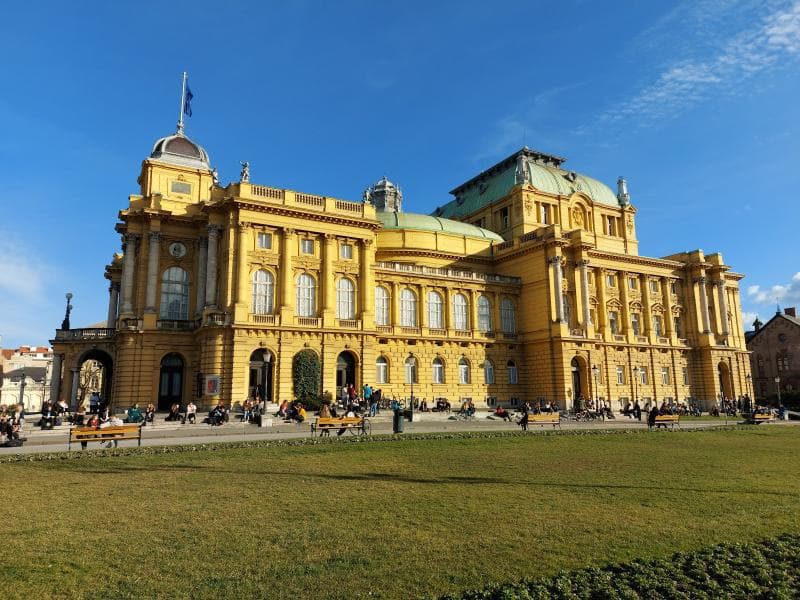
Explore Republic of Croatia Square, home to the Croatian National Theatre in Zagreb, Croatia. Discover its history, stunning architecture, and iconic sculptures.
Overview
Stepping into the Republic of Croatia Square, known locally as Trg Republike Hrvatske, offers an immediate immersion into Zagreb's vibrant cultural heart. Often informally referred to as the 'Exterior Square' surrounding the magnificent Croatian National Theatre, this grand public space is much more than just a thoroughfare; it is a focal point where art, history, and daily life beautifully converge. The square is a vital component of Zagreb's Lower Town, distinguished by its elegant architecture and lush green surroundings, serving as a testament to the city's rich heritage and artistic spirit.
At its very core stands the Croatian National Theatre (HNK Zagreb), an architectural masterpiece with a distinctive bright yellow façade that immediately captures the eye. This square is a starting point for cultural exploration, inviting visitors to appreciate both the grandeur of the theatre and the artistic treasures scattered throughout its expanse, making it a must-visit destination for anyone seeking to understand the soul of Zagreb.
History & Cultural Background
The Republic of Croatia Square itself has a fascinating history, having taken its present form largely between 1856 and 1964. It is a crucial part of what is known as Lenuci's Horseshoe (Lenucijeva potkova), an ingenious late 19th-century urban plan by engineer Milan Lenuci that created a U-shaped belt of squares and parks framing Zagreb's city center. The square has undergone several name changes throughout its past, reflecting the political shifts in Croatia, but its current name proudly affirms national identity.
The genesis of the Croatian National Theatre on this site is equally steeped in history. While a professional theatre existed in Zagreb since 1834, the idea for a grand, purpose-built structure gained momentum after an 1880 earthquake damaged the existing theatre. The impetus for its construction was further solidified by an impending visit from Austro-Hungarian Emperor Franz Joseph I. Designed by the renowned Viennese architectural duo Ferdinand Fellner and Hermann Helmer, who were responsible for over 40 opera houses across Central and Eastern Europe, the theatre building officially opened in 1895. Its Neo-Baroque design was considered fitting for such a significant cultural institution, instantly elevating Zagreb's status on the European cultural map.
What Makes It Special
The Croatian National Theatre building itself is the undisputed star of the square. Its resplendent Neo-Baroque architecture, with its golden-mustard paint job, brilliant white columns, and oxidized-green copper roofing, makes it one of Zagreb's most iconic landmarks. The facade is adorned with intricate sculptures and ornate details, hinting at the artistic wealth contained within its walls.
In front of the theatre, visitors are greeted by Ivan Meštrović's evocative sculpture, 'The Well of Life' (Zdenac života), created in 1905 and installed in 1912. This bronze fountain, depicting intertwined nude figures reaching for water, is widely considered one of Meštrović's finest works, inviting contemplation on human existence and the cycle of life. Beyond the theatre and its fountain, the square is surrounded by other significant cultural and educational institutions, including the University of Zagreb's administrative building and Faculty of Law, which itself houses another Meštrović sculpture, 'History of Croats'. The Museum of Arts and Crafts, one of Europe's first institutions of its kind, also graces the square's western side. This concentration of historical and cultural entities within a beautifully landscaped setting creates a unique urban ensemble.
Stories, Fun Facts & Local Details
The 'Well of Life' sculpture holds a compelling story; Meštrović designed it to be displayed in Split, but it found its permanent home in Zagreb, where its intimate portrayal of human figures around the source of life offers a profound contrast to the official grandeur of the theatre. It's said that the figures in the fountain represent the natural cycle from birth to death, with young characters full of joy and an old man gazing sadly into the well. Interestingly, the sculpture was placed in a recessed cavity, partially hiding the nude figures, possibly to avoid controversy at the time of its installation.
Another fascinating detail from the theatre's opening concerns Emperor Franz Joseph I. During the inauguration, he symbolically struck a block with a silver hammer to mark the building's completion—a hammer that is now exhibited in the Zagreb City Museum. The square itself has witnessed spontaneous social gatherings, especially during recent years, evolving into a vibrant, informal meeting spot for young people, showcasing its dynamic role beyond its official functions. This blend of formal cultural performances inside the theatre and informal public life outside makes the square a truly living space.
Visitor Perspective
For any traveler, the Republic of Croatia Square offers a rich sensory experience. The imposing yellow facade of the Croatian National Theatre, particularly striking when illuminated at night, transforms the square into a theatrical backdrop itself. Whether you're attending a world-class opera, ballet, or drama performance, or simply strolling through, the atmosphere is imbued with a sense of history and artistic endeavor.
Take your time to walk around, admire the architectural details of the theatre, and contemplate the allegorical figures of 'The Well of Life'. The surrounding parks and green spaces provide a tranquil escape, inviting a moment of reflection amidst the bustling city. The square's location within Lenuci's Horseshoe also means it's seamlessly connected to other beautiful parks and squares, offering a pleasant walk through Zagreb's 'Green Ring'. It's a place where you can feel the pulse of Zagreb's cultural identity, connect with its past, and observe its present, making it an unforgettable part of your Croatian journey.
Coordinates: 15.97, 45.80944
View on Google Maps💬 How Travelers Describe This Place
Based on community votes
Photogenic
826Unique
800Must See
589Interesting
387Beautiful
90
Traveler Stories
Discover memorable experiences shared by travelers who have visited this place.
No traveler stories yet.
Be the first traveler to share what made this place memorable.

Tour
By
Spot
Discover amazing places around the world. Your journey starts here.
Explore
© 2026 TourBySpot. All rights reserved.