Exterior Facade
Lviv, Ukraine
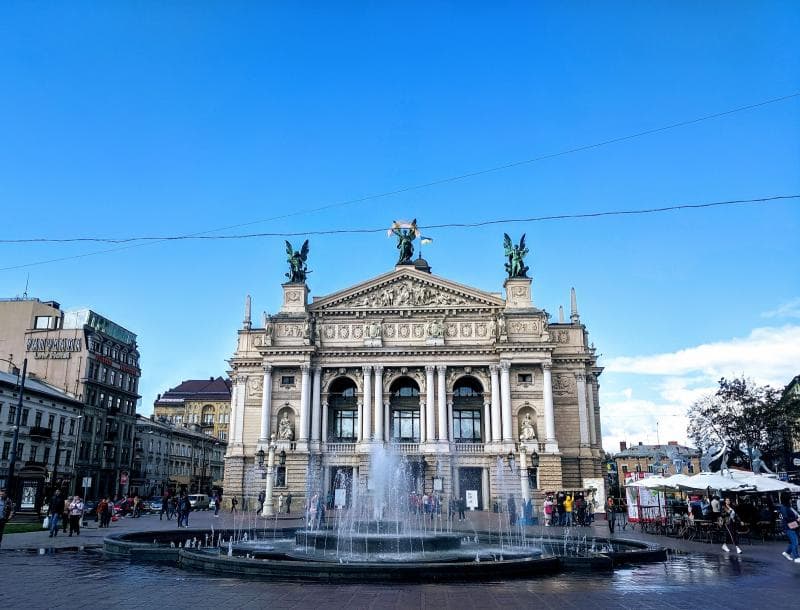
Explore the exquisite exterior facade of the Lviv Opera House in Lviv, Ukraine. Discover its Neo-Renaissance architecture, intricate sculptures, and fascinating history.
Overview
The exterior facade of the Solomiya Krushelnytska Lviv National Academic Theatre of Opera and Ballet, commonly known as the Lviv Opera House, stands as a magnificent testament to late 19th-century European architecture. Located in Lviv, Ukraine, this grand edifice captivates observers with its opulent Neo-Renaissance and Neo-Baroque styles, drawing comparisons to iconic opera houses in Paris and Vienna. Its intricate detailing, rich sculptural program, and commanding presence at the end of Svobody Avenue make it an unforgettable landmark and a symbol of Lviv's cultural heritage.
History & Cultural Background
The Lviv Opera House was constructed between 1897 and 1900, a period when Lviv was the capital of the autonomous province of Galicia within the Austro-Hungarian Empire. The ambitious project was spearheaded by the renowned architect Zygmunt Gorgolewski, who also served as the director of the Lviv Applied Art school. A significant challenge during construction was the site's location on the marshland of the submerged Poltva River. Gorgolewski ingeniously solved this by enclosing the river underground and, for the first time in Europe, utilizing a reinforced concrete foundation to support the massive structure. The theater officially opened its doors on October 4, 1900, with the premiere of Vladislav Zhelensky's opera 'Janek,' quickly establishing itself as a premier cultural institution.
What Makes It Special
The facade is a masterclass in architectural and sculptural artistry. It is adorned with a profusion of elements typical of Renaissance Revival and Neo-Baroque styles, including numerous niches, stately Corinthian columns, elegant pilasters, and decorative balustrades. The sculptural program is particularly striking, featuring allegorical figures that celebrate the arts. Above the main cornice, visitors can admire statues of eight Muses. Higher still, a prominent ten-figure composition symbolizes 'The Joys and Miseries of Life.' The facade culminates in a dramatic bronze triad: winged figures representing Drama and Comedy, positioned to either side of the central figure of Glory, who holds a golden palm branch aloft. These magnificent sculptures were the work of prominent Lviv artists such as Antoni Popiel, Tadeusz Barącz, and Petro Viytovych. Additionally, two cartouches bearing the coats of arms of Lviv are held by statues of boys, and a large lion's head, a symbol of the city, adds a distinctive local touch.
Stories, Fun Facts & Local Details
One of the most captivating stories surrounding the Lviv Opera House concerns its innovative foundation. The decision to build on top of a buried river was so audacious that a local legend emerged, claiming architect Zygmunt Gorgolewski committed suicide a year after its completion, fearing the building would sink or crack. However, historical records confirm that Gorgolewski died of natural causes in 1903, several years after the theater's successful opening. This pioneering use of a reinforced concrete base was indeed a groundbreaking engineering feat for its time in Europe. The building's enduring beauty and historical significance are further underscored by its depiction on Ukraine's 20 Hryvnia banknote, a true mark of national pride and recognition.
Visitor Perspective
Approaching the Lviv Opera House, one is immediately struck by its grandeur and intricate details. Take a moment to gaze upwards, observing the classical columns, the expressive allegorical figures, and the bronze statues that crown the building, each telling a part of its artistic story. The facade is not merely a wall; it is an open book of history, mythology, and the triumphs of human creativity. Standing before it, one can easily feel transported to a bygone era of elegance and artistic flourishing, appreciating the meticulous craftsmanship that makes this Ukrainian architectural jewel so captivating.
Coordinates: 24.02624, 49.84405
View on Google Maps💬 How Travelers Describe This Place
Based on community votes
Beautiful
747Must See
399Unique
302Photogenic
172Interesting
79
Traveler Stories
Discover memorable experiences shared by travelers who have visited this place.
No traveler stories yet.
Be the first traveler to share what made this place memorable.

Tour
By
Spot
Discover amazing places around the world. Your journey starts here.
Explore
© 2026 TourBySpot. All rights reserved.