Exterior Courtyard
Tallinn, Estonia
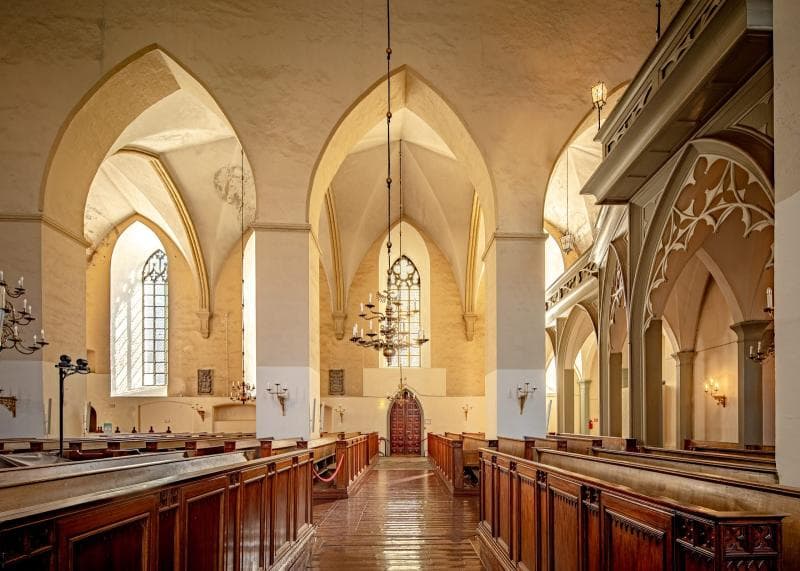
Explore the historic exterior grounds of St. Olaf's Church in Tallinn, Estonia. Discover its medieval history, former cemetery, and iconic Gothic architecture.
Overview
Nestled within the enchanting Old Town of Tallinn, Estonia, stands St. Olaf’s Church, known locally as Oleviste kirik. While its towering spire often captures immediate attention, the exterior grounds surrounding this majestic Gothic structure offer a tranquil and historically rich experience for any curious traveler. These grounds, though not formally dubbed an 'Exterior Courtyard' today, represent centuries of Tallinn’s urban and spiritual life, inviting visitors to pause and reflect on the city's enduring legacy.
St. Olaf’s Church has long been an iconic landmark, its immense height once dominating not only Tallinn's skyline but also serving as a crucial navigational beacon for sailors approaching the Baltic Sea. The exterior, characterized by its striking Gothic elements, provides a dramatic contrast to the bustling medieval streets, offering a sense of peace and historical depth.
History & Cultural Background
The history of St. Olaf's Church dates back to at least 1267, when it was first mentioned in historical records. However, it is believed that a church dedicated to the Norwegian King Olav II Haraldsson, the patron saint of seafarers, stood on this site even earlier, potentially serving a thriving Scandinavian merchant community in the 12th century.
The current structure underwent significant expansion in the 14th and 15th centuries, ultimately achieving a monumental status. The area around the church held profound significance; historical accounts indicate that the church was surrounded by a cemetery, a common feature of medieval European churches. This sacred burial ground once occupied the space where Oleviste Street now runs, providing a solemn connection to generations of Tallinn's past inhabitants. The exterior walls themselves bear witness to centuries of change, from periods of Catholic worship to Lutheran traditions after the Reformation, and its current role as an active Baptist church since 1950.
What Makes It Special
What truly distinguishes the exterior of St. Olaf's Church, beyond its architectural grandeur, is the tangible connection it provides to Tallinn's layered history. The very ground you walk upon was once a hallowed cemetery, a silent testament to the lives and legacies of medieval Tallinn's citizens. While no visible grave markers remain today, understanding this past transforms the surrounding space from a mere pathway into a historical landscape.
The church's exterior also features architectural details that tell a story of resilience. The tower, for instance, has been repeatedly struck by lightning and ravaged by fire, necessitating numerous reconstructions. Yet, each time, the citizens of Tallinn rallied to restore their beloved landmark, preserving its imposing presence. Observing the robust buttresses and the intricate stonework, one can appreciate the medieval craftsmanship that allowed this structure to endure through centuries of tumult.
Stories, Fun Facts & Local Details
The lore surrounding St. Olaf's Church extends fascinatingly to its exterior. One of the most enduring local legends concerns the church's mysterious builder, named Olaf, who tragically fell to his death from the spire upon its completion. It is said that when his body hit the ground, a toad and a snake crawled out of his mouth, a rather macabre detail depicted in an old wall-carving near the Chapel of Our Lady.
Another intriguing 'fun fact' often shared among locals is the unofficial rule that no new building in Tallinn's city center should exceed the height of St. Olaf's spire. While perhaps more myth than regulation, it underscores the church's symbolic importance and its lasting dominance over the city's architectural identity. During the Soviet occupation, the church's spire also served a clandestine purpose, being utilized by the KGB as a radio tower and surveillance point, adding a layer of Cold War intrigue to its already rich narrative.
Visitor Perspective
Approaching St. Olaf's Church today, the exterior grounds offer a poignant introduction to its grandeur. Taking a moment to consider that this space was once a bustling marketplace and a sacred burial site adds depth to the visit. Imagine the generations who have walked these same paths, lived their lives, and found their final resting place within these historic boundaries.
From the exterior, you gain a full appreciation for the sheer scale and architectural ambition of the church. The soaring spire, whether viewed from a distance or from directly below, is a marvel of medieval engineering. While the primary draw for many is the panoramic view from the observation deck high in the tower, the quiet contemplation offered by the exterior grounds is equally rewarding. It's a place to feel the pulse of history, to connect with the past lives of Tallinn's residents, and to admire a structure that has witnessed and survived centuries of the city's unfolding story.
Coordinates: 24.7476, 59.4413
View on Google Maps💬 How Travelers Describe This Place
Based on community votes
Unique
995Photogenic
839Beautiful
603Must See
581Interesting
388
Traveler Stories
Discover memorable experiences shared by travelers who have visited this place.
No traveler stories yet.
Be the first traveler to share what made this place memorable.

Tour
By
Spot
Discover amazing places around the world. Your journey starts here.
Explore
© 2026 TourBySpot. All rights reserved.