Excavation Areas
Phnom Penh, Cambodia
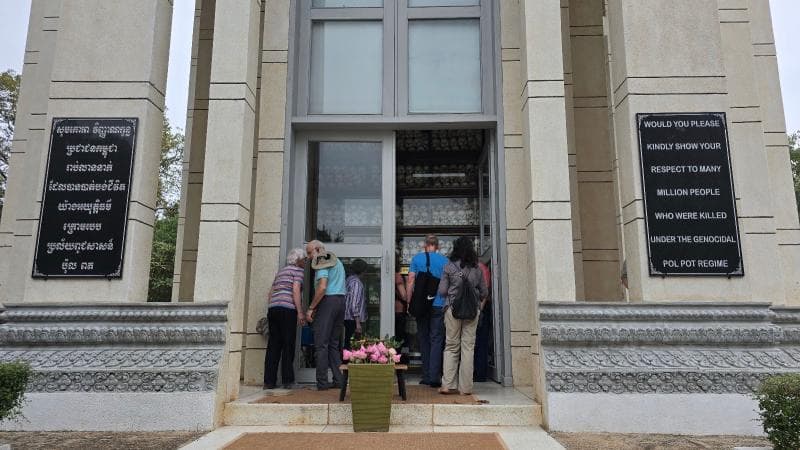
Explore the Excavation Areas at Choeung Ek Genocidal Center in Phnom Penh, Cambodia, a solemn site of mass graves from the Khmer Rouge regime.
Overview
The Excavation Areas within the Choeung Ek Genocidal Center, often recognized grimly as 'The Killing Fields,' offer a profoundly moving and somber journey into Cambodia's tragic past. Located approximately 15 to 17 kilometers south of Phnom Penh, this site was once a serene orchard and Chinese cemetery. However, between 1975 and 1979, it was transformed into one of the Khmer Rouge regime's most notorious extermination centers.
Today, Choeung Ek stands as a powerful memorial and educational institution, reminding visitors of the atrocities committed during the Cambodian genocide. The most prominent feature of the site is a towering Buddhist stupa, housing the remains of thousands of victims exhumed from the mass graves.
History & Cultural Background
The Khmer Rouge, led by Pol Pot, ruled Cambodia from 1975 to 1979, aiming to establish a radical agrarian socialist society. Their regime systematically targeted intellectuals, professionals, ethnic minorities, and anyone perceived as a threat to their communist ideology. An estimated 1.7 to 3 million Cambodians perished during this brutal period due to execution, starvation, forced labor, and disease.
Choeung Ek became a primary execution ground for prisoners transported from the infamous S-21 (Tuol Sleng) interrogation and torture center in Phnom Penh. The regime, often seeking to conserve precious ammunition, typically executed victims using crude tools such as pickaxes, hoes, and bamboo sticks, rather than bullets. The site's remoteness and its existing use as a cemetery provided a deceptive cover for the mass killings that occurred there.
What Makes It Special
The heart of Choeung Ek's impact lies within its Excavation Areas – the stark remnants of the mass graves that scarred the landscape. After the fall of the Khmer Rouge, investigations revealed over 129 mass graves across the site. Of these, approximately 86 to 89 have been excavated, yielding the remains of around 8,895 to 17,000 individuals.
Many graves were intentionally left undisturbed as a sign of respect, preserving the solemnity of the site. Visitors to Choeung Ek are often struck by the tangible evidence of the past: fragments of bone, teeth, and clothing pieces continue to surface from the earth, particularly after heavy rains. These chilling artifacts serve as direct and unfiltered reminders of the lives brutally ended here. Reports detail specific graves, such as one holding 166 headless bodies, believed to be Khmer Rouge soldiers accused of treason, and another containing the bodies of 100 women and babies. The very soil bears witness to the harrowing methods of execution, where countless lives were extinguished by blunt force trauma.
Stories, Fun Facts & Local Details
The term 'Killing Fields' itself, now globally recognized, was popularized by Cambodian journalist Dith Pran, a survivor of the Khmer Rouge regime, who used it to describe the numerous mass execution sites throughout the country.
Among the most agonizing areas is the 'Killing Tree,' against which infants and children were brutally bludgeoned to death. Today, visitors often leave bracelets and tokens of remembrance at its base. Another chilling detail is the presence of a tree that once had loudspeakers attached, used to blast revolutionary songs and drown out the screams of victims during executions.
The central memorial stupa, a poignant symbol, is said by some to have 17 levels, a number possibly referencing April 17, 1975, the date Phnom Penh fell to the Khmer Rouge. In traditional Khmer Buddhist belief, spirits of those who die violently are thought to linger, preventing reincarnation, which contributes to the solemn atmosphere and, for some Cambodians, a reluctance to visit the stupa directly. Annual memorial ceremonies are held, often on May 9th, where survivors, officials, and the public gather to pay respects and ensure the memory of the victims endures. The immersive audio guide, integral to the experience, includes not only factual accounts but also powerful testimonies from survivors and even former Khmer Rouge cadres, offering a multi-faceted perspective on the history.
Visitor Perspective
A visit to the Excavation Areas at Choeung Ek is an undeniably profound and often overwhelming experience. Travelers consistently describe it as incredibly moving, harrowing, and deeply reflective. It is an essential 'dark tourism' destination for those seeking to confront and understand the modern history of Cambodia.
To show respect for the victims and the solemnity of the site, visitors are advised to dress modestly, covering shoulders and knees, and to maintain a respectful silence throughout their visit. The included audio guide is considered indispensable, providing vital historical context and personal stories that bring the silent landscape to life. The physical remnants—the visible depressions of mass graves, the fragments of human remains occasionally found on the paths—serve as raw, tangible reminders of the immense human cost. Choeung Ek is situated about 15-17 kilometers from central Phnom Penh and is easily accessible via tuk-tuk or taxi. For a more comprehensive understanding of the genocide, many recommend combining a visit to Choeung Ek with the Tuol Sleng Genocide Museum (S-21), which served as the regime's primary interrogation center.
Coordinates: 104.90194, 11.48444
View on Google Maps💬 How Travelers Describe This Place
Based on community votes
Beautiful
710Must See
156Interesting
102Photogenic
102Unique
87
Traveler Stories
Discover memorable experiences shared by travelers who have visited this place.
No traveler stories yet.
Be the first traveler to share what made this place memorable.

Tour
By
Spot
Discover amazing places around the world. Your journey starts here.
Explore
© 2026 TourBySpot. All rights reserved.