Evolution Displays
Frankfurt, Germany
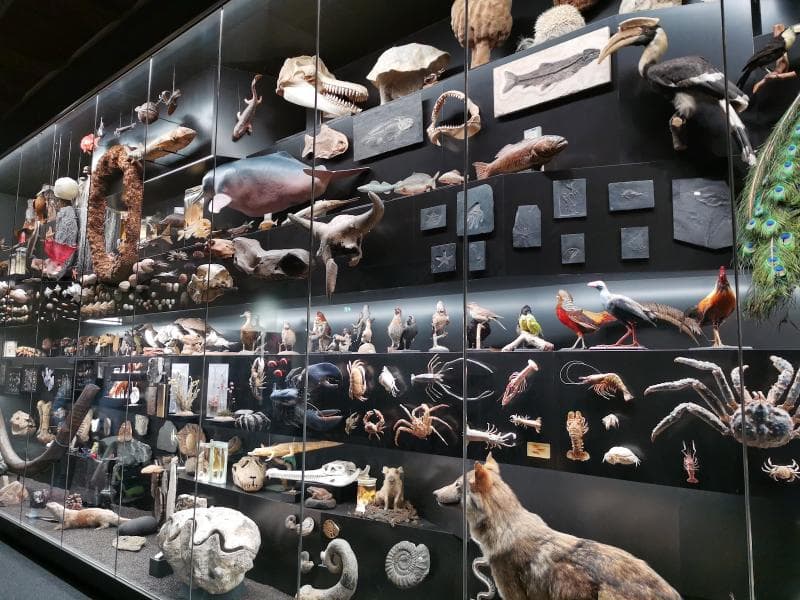
Explore the wonders of evolution at Frankfurt's Senckenberg Natural History Museum, home to vast dinosaur exhibits and human ancestry displays.
Overview
The Senckenberg Natural History Museum in Frankfurt, Germany, stands as one of Europe's largest and most significant natural science museums. It is a place where the grand narrative of life's evolution unfolds, from the earliest organisms to the biodiversity we see today. The museum's extensive collections and exhibits are dedicated to showcasing the changes of the Earth and the evolution of various life forms over billions of years, making the concepts of evolution tangible and accessible to all visitors.
Visitors are invited on a journey through geological time, exploring paleontology, biodiversity, and the dynamic processes that have shaped our planet. The museum's approach is not merely to display specimens but to tell the story of scientific discovery and the ongoing research conducted by the Senckenberg Society for Nature Research.
History & Cultural Background
The Senckenberg Natural History Museum is named after Dr. Johann Christian Senckenberg, a Frankfurt physician who, in 1763, bequeathed his fortune to establish a foundation for the public good. This foundation ultimately led to the establishment of the Senckenberg Society for Nature Research in 1817 and the opening of the museum to the public in 1821.
The museum's neo-baroque building, constructed between 1904 and 1907, was strategically placed near the Johann Wolfgang Goethe University. Since its inception, the Senckenberg Society has been a vital scientific institution, conducting worldwide research projects in biology, paleontology, and geology. The museum serves as the public face of this extensive research, bridging the gap between scientific inquiry and public education.
What Makes It Special
What truly sets the Senckenberg Museum apart in its exploration of evolution is the sheer scale and quality of its displays, combined with its integration of cutting-edge scientific research. It boasts one of the most comprehensive dinosaur exhibitions in Europe, featuring an impressive array of fossils and full-scale skeletons, including towering T-Rex and Diplodocus models.
Beyond the prehistoric giants, the museum makes evolution tangible through its 'Human Evolution Exhibit,' which includes lifelike reconstructions of human ancestors like Homo heidelbergensis and Neanderthals, alongside detailed information on human migratory patterns. A unique highlight is the collection of fossils from the nearby Messel Pit, a UNESCO World Natural Heritage Site, showcasing exceptionally well-preserved specimens such as prehistoric horses, some with preserved soft tissues that offer rare insights into mammalian reproductive evolution.
The museum also explores the evolution of the brain, using augmented reality and interactive displays, including a fascinating exhibit about the brain of a famous local soccer player, 'Charly' Körbel, to explain complex perceptual processes and how the brain changes over a lifetime.
Stories, Fun Facts & Local Details
Imagine standing before the only original Diplodocus skeleton outside of the USA, a massive long-necked dinosaur stretching 28 meters. Its air-filled vertebrae meant this giant, despite its size, weighed only about ten tons. The museum's commitment to immersive storytelling is evident in its 'time machine' exhibit, a huge time wheel that uses multimedia to simulate changes of Earth's surface, allowing visitors to glimpse past eras or even imagine the future.
Another engaging detail for visitors is the 'Aha?! Science Lab,' where both children and adults can engage in hands-on experiments and even interact with researchers, fostering a deeper connection to scientific exploration. The museum houses more than 38 million objects, collected over 400 years, making its collections among the largest and oldest in the world—a testament to centuries of dedication to understanding our natural world.
Visitor Perspective
For any curious traveler, particularly those with a fascination for the natural world and the grand saga of evolution, the Senckenberg Natural History Museum offers an enriching and memorable experience. It's a destination where complex scientific concepts are presented in engaging and understandable ways, appealing to all ages.
The interactive exhibits and the sheer scale of the displays, from the enormous dinosaur skeletons that greet you at the entrance to the intricate details of fossilized prehistoric life, ensure there's always something to spark wonder. Whether you're keen to trace the lineage of humanity, marvel at the diversity of ancient creatures, or simply be awed by the planet's history, the Senckenberg Museum provides a comprehensive and deeply human perspective on the continuous, incredible journey of life on Earth.
Coordinates: 8.6567, 50.1167
View on Google Maps💬 How Travelers Describe This Place
Based on community votes
Must See
540Photogenic
252Unique
147Beautiful
114Interesting
19
Traveler Stories
Discover memorable experiences shared by travelers who have visited this place.
No traveler stories yet.
Be the first traveler to share what made this place memorable.

Tour
By
Spot
Discover amazing places around the world. Your journey starts here.
Explore
© 2026 TourBySpot. All rights reserved.