Et'hem Bey Mosque
Tirana, Albania
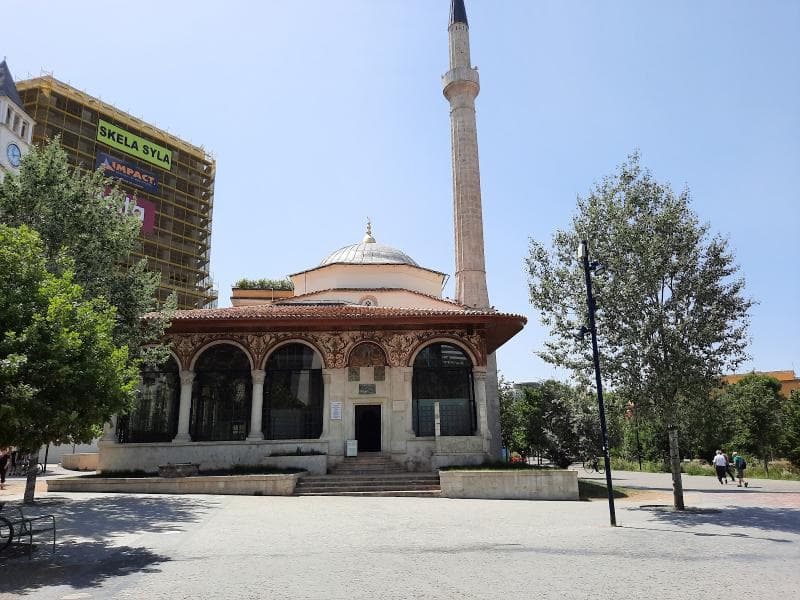
Explore Et'hem Bey Mosque, an 18th-century Ottoman jewel in Skanderbeg Square, Tirana, Albania. Discover its unique frescoes and rich history.
Overview
Nestled in the bustling heart of Skanderbeg Square in Tirana, Albania, the Et'hem Bey Mosque stands as a serene and historically rich testament to Ottoman architecture and Albanian resilience. Known locally as Xhamia e Haxhi Et'hem Beut, this 18th-century landmark is more than just a place of worship; it is a vibrant symbol of the city's spiritual and cultural journey. Its elegant minaret and beautifully decorated facade offer a striking contrast to the surrounding modern urban landscape, inviting curious travelers to discover its layered history.
History & Cultural Background
The story of the Et'hem Bey Mosque is deeply interwoven with the evolution of Tirana itself. Construction began between 1791 and 1794, initiated by Molla Bey, a prominent figure of the influential Toptani family. His vision aimed to elevate Tirana from a provincial settlement within the Ottoman Empire. Following his passing, his son, Haxhi Et'hem Bey, continued and completed the ambitious project between 1819 and 1823, lending his name to the mosque that stands today.
For centuries, the mosque served as a central hub for spiritual, political, and social life in Tirana. However, its most poignant chapter unfolded during Albania's communist era (1967–1990), when the nation declared itself the world's first atheist state. During this period, most religious institutions were either destroyed or repurposed, but the Et'hem Bey Mosque survived due to its recognized artistic and historical value, preserved as a cultural monument. In a powerful act of peaceful resistance on January 18, 1991, tens of thousands of citizens gathered and entered the mosque to pray, defying the ban on religious practice. This pivotal moment marked the symbolic rebirth of religious freedom in Albania and remains a significant milestone in modern Albanian history.
What Makes It Special
The Et'hem Bey Mosque distinguishes itself through its exquisite and uncommon frescoes. Unlike typical Ottoman mosques that primarily feature geometric patterns or calligraphy, the interior and exterior portico of Et'hem Bey are adorned with intricate landscape paintings. These unique murals depict lush scenes of cypress trees, waterfalls, bridges, mountains, and even pavilions and pastoral vistas, a rarity in Islamic religious art.
Architecturally, the mosque reflects a provincial Ottoman classicism, blending traditional design elements with local Albanian artistic expression. It features a harmonious prayer hall covered by a semi-spherical dome and a slender, graceful minaret. Beyond its aesthetic appeal, the mosque's construction incorporates ingenious earthquake-resistant design principles. Its single central dome effectively distributes loads, while thick masonry walls with lime-based mortar allow for flexibility during seismic activity, a testament to the foresight of its 19th-century builders that has allowed it to withstand centuries in a seismically active region.
Stories, Fun Facts & Local Details
One fascinating aspect of the Et'hem Bey Mosque is that it was not commissioned by an Ottoman Sultan, but rather funded by the powerful Toptani family. This act was both an expression of piety and a strategic political move, allowing the family to embed their legacy and influence within Tirana's growing commercial heart. The mosque's location was highly strategic, defining Tirana's city center alongside the Clock Tower, creating a classical Ottoman urban plan where religious sites anchored social and economic life.
The events of January 1991, when thousands gathered to pray, highlight the mosque's deep resonance with the Albanian people. It transformed from a preserved monument into a powerful symbol of defiance and the reclamation of spiritual identity. Recent restoration efforts, completed in April 2021 with support from the Turkish Cooperation and Coordination Agency (TİKA), have ensured its beauty and structural integrity for future generations, bringing its frescoes and foundations back to their former glory.
Visitor Perspective
Visiting the Et'hem Bey Mosque offers a profound experience, inviting travelers to step into a tranquil space that has witnessed centuries of change. Located centrally in Skanderbeg Square, it is easily accessible and a natural focal point for exploring Tirana's historical core, often visited in conjunction with the adjacent Clock Tower.
The mosque is open to visitors outside of prayer times, offering a chance to quietly admire its unique frescoes and serene atmosphere. As a sign of respect, visitors are asked to remove their shoes before entering. Whether you are drawn by its architectural beauty, its compelling history, or its symbolic importance, a visit to the Et'hem Bey Mosque provides a meaningful glimpse into Albania's rich cultural tapestry and enduring spirit. It stands as a vibrant, active place of worship and a treasured cultural heritage site, continually welcoming those who seek to understand Tirana's soul.
Coordinates: 19.81933, 41.3278
View on Google Maps💬 How Travelers Describe This Place
Based on community votes
Beautiful
996Unique
726Interesting
717Photogenic
335Must See
193
Traveler Stories
Discover memorable experiences shared by travelers who have visited this place.
No traveler stories yet.
Be the first traveler to share what made this place memorable.

Tour
By
Spot
Discover amazing places around the world. Your journey starts here.
Explore
© 2026 TourBySpot. All rights reserved.