Estrela Basilica
Lisbon, Portugal
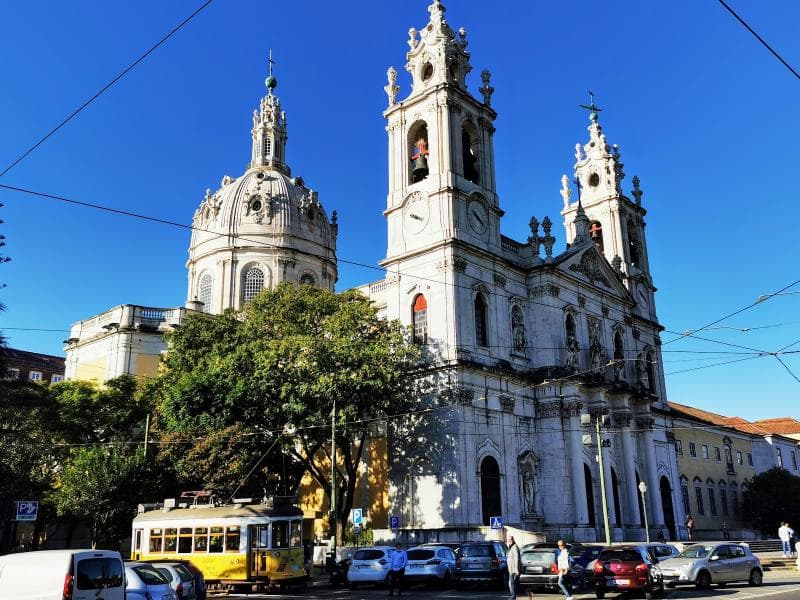
Discover Estrela Basilica in Lisbon, Portugal. Explore its Baroque-Neoclassical architecture, Queen Maria I's tomb, and panoramic city views.
Overview
Perched majestically atop one of Lisbon's seven hills, the Estrela Basilica, formally known as the Royal Basilica and Convent of the Most Sacred Heart of Jesus, stands as a prominent landmark in the Portuguese capital. This architectural marvel, completed in the late 18th century, captivates with its harmonious blend of Baroque and Neoclassical styles. Its imposing white dome and twin bell towers are visible from various points across the city, making it a distinctive feature of the Lisbon skyline. The Basilica is not merely a religious edifice; it is a repository of history, art, and a testament to royal devotion. Conveniently located, it serves as a significant and picturesque stop along the famous Tram 28 route, offering a journey back in time for curious travelers exploring Lisbon’s rich heritage.
History & Cultural Background
The story of the Estrela Basilica is deeply intertwined with the personal history and fervent devotion of Queen Maria I of Portugal. In 1760, as a newly married princess, she made a solemn vow to construct a church if she were to bear a son who would secure the line of succession. Her prayers were answered with the birth of Prince José in 1761. However, it wasn't until 1777, upon her accession to the throne, that Queen Maria I could commission the construction, which commenced in 1779. Architects Mateus Vicente de Oliveira and Reinaldo Manuel de Sousa oversaw the ambitious project. Tragically, Prince José succumbed to smallpox in 1788 at the age of 27, just two years before the basilica's completion in 1790. This immense personal loss profoundly affected the Queen, leading to her finding solace within the very walls she had commissioned. The Estrela Basilica holds the distinction of being the first church in the world dedicated to the Sacred Heart of Jesus, reflecting Queen Maria I's deep religious commitment.
What Makes It Special
The Estrela Basilica distinguishes itself through its unique architectural synthesis and exquisite interior details. The exterior, reminiscent of the Mafra National Palace, boasts a grand Baroque facade adorned with intricate carvings and statues representing allegorical figures such as Faith, Devotion, Gratitude, and Liberality. Its most striking external feature is the magnificent rococo-style dome, flanked by two elegant bell towers, which adds a sense of grandeur to the structure. Inside, visitors are greeted by a breathtaking display of polychromatic marble, primarily in shades of pink, gray, and yellow, laid out in stunning geometric patterns across the floors and walls. The soaring nave leads to the main altar, featuring an altarpiece painting by the Italian Neoclassical artist Pompeo Batoni. One of the basilica's most poignant and significant features is the elaborate empire-style tomb of Queen Maria I, who is laid to rest within her beloved church. Another remarkable highlight is the presépio, an 18th-century nativity scene crafted by the renowned sculptor Joaquim Machado de Castro, comprising over 500 figures made of cork and terracotta, considered one of the largest and most detailed in Portugal.
Stories, Fun Facts & Local Details
Beyond its grand facade and historical significance, the Estrela Basilica is rich with compelling narratives and charming local details. The story of Queen Maria I's vow and the subsequent tragedy of her son's death adds a profound human element to the monument, transforming it from a mere building into a symbol of a mother's hope and grief. The sheer artistry and scale of Joaquim Machado de Castro's nativity scene are a marvel; its 500 intricately detailed figures provide a fascinating glimpse into 18th-century craftsmanship and religious art. Classified as a National Monument since 1910, the basilica is a cherished piece of Portugal's heritage. Directly across from the basilica lies the tranquil Jardim da Estrela, one of Lisbon's most pleasant public gardens. This picturesque park, with its exotic flora, duck ponds, and charming cafe, offers a peaceful respite for visitors after exploring the basilica, embodying a harmonious blend of cultural and natural beauty in the heart of the city.
Visitor Perspective
Visiting the Estrela Basilica offers a multifaceted experience for any traveler. While the main church is generally free to enter, a small fee grants access to the room housing the famous nativity scene and, more notably, to the rooftop and dome. The climb to the roof involves navigating around 112 to 114 steps, but the effort is richly rewarded with breathtaking panoramic views of Lisbon, including the Tagus River, the 25 de Abril Bridge, and the surrounding cityscape. This unique vantage point allows for a closer inspection of the dome's intricate exterior and a different perspective of the basilica's interior. The basilica's prominent location makes it a key stop on the iconic Tram 28 route, one of Lisbon's most popular attractions, allowing visitors to easily combine a visit to this historical gem with a scenic tram ride through the city's historic neighborhoods. Whether seeking historical insight, architectural splendor, or simply a moment of quiet reflection, the Estrela Basilica provides an enriching experience for all who step through its doors.
Coordinates: -9.16055, 38.71318
View on Google Maps💬 How Travelers Describe This Place
Based on community votes
Beautiful
476Unique
465Interesting
276Must See
128Photogenic
126
Traveler Stories
Discover memorable experiences shared by travelers who have visited this place.
No traveler stories yet.
Be the first traveler to share what made this place memorable.

Tour
By
Spot
Discover amazing places around the world. Your journey starts here.
Explore
© 2026 TourBySpot. All rights reserved.