Erasmus Tomb
Basel, Switzerland
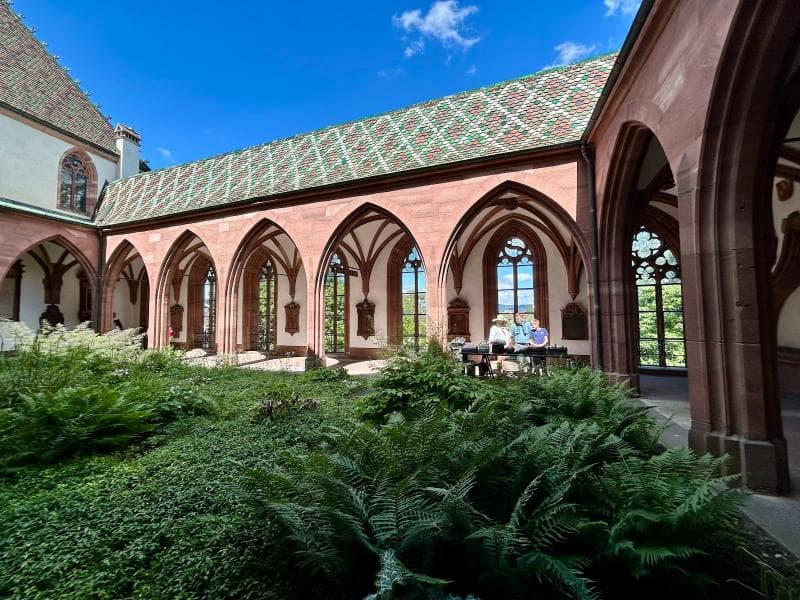
Discover the Erasmus Tomb in Basel Minster, Switzerland, the final resting place of the influential humanist Erasmus of Rotterdam. Explore its history and significance.
Overview
Deep within the venerable walls of the Basel Minster in Basel, Switzerland, lies a site of profound historical and intellectual significance: the Erasmus Tomb. This unassuming yet powerful memorial marks the final resting place of Desiderius Erasmus of Rotterdam, one of the most influential scholars and humanists of the Northern Renaissance. The tomb is not merely a grave; it is a tangible link to a pivotal era of European thought, nestled within an architectural masterpiece. Visitors to the Minster, itself a breathtaking landmark with its red sandstone and distinctive colored roof tiles, often seek out this spot to pay homage to the man whose ideas championed education, tolerance, and reform. It is a quiet corner that speaks volumes about intellectual bravery and the enduring legacy of humanism.
History & Cultural Background
Desiderius Erasmus, born around 1466, was a Dutch humanist, Catholic theologian, and pioneering philologist who spent significant periods of his life in Basel. He found a vibrant intellectual environment in the city, which was then a leading center for printing and scholarship. It was in Basel that his seminal works, including his groundbreaking edition of the New Testament in Greek, were published by Johann Froben. Erasmus died in Basel on July 12, 1536, at the age of nearly 70. Remarkably, despite his lifelong adherence to Catholicism, he was interred in the Basel Minster, which had become a Reformed Protestant church following the Reformation in Basel. His original grave was located in the nave of the Minster, but it was moved to the catacombs during a 19th-century redesign of the church. The epitaph, however, was placed in the left side aisle. It was not until 1974, during archaeological excavations within the Minster, that Erasmus's bones were rediscovered and positively identified. They were subsequently reinterred at the foot of his epitaph in the northern side aisle, uniting his remains with their commemorative stone once more.
What Makes It Special
The Erasmus Tomb stands out for several compelling reasons. Firstly, it embodies a remarkable historical paradox: a devout Catholic buried with honor in a Protestant church. This unusual circumstance reflects Erasmus's unique position during the Reformation—a critic of the Catholic Church who nonetheless refused to fully embrace Protestantism, advocating instead for internal reform and intellectual discourse. His burial here underscores Basel's reputation as a city of intellectual freedom and relative tolerance during a turbulent age. Secondly, the epitaph itself is a work of art and symbolism. Created in 1538 by sculptor Hans Mentzinger, the red limestone slab features a medallion depicting Terminus, the Roman god of boundaries. Surrounding this image is Erasmus's personal motto, 'concedo nulli,' meaning 'I yield to no one'. This motto speaks volumes about his unwavering intellectual independence and his refusal to compromise his scholarly integrity, even amidst intense religious pressures. The epitaph does not portray Erasmus's likeness, but rather his philosophical conviction, making it a profound statement on his life's work. The tomb thus serves as a powerful testament to the triumph of intellectual pursuit over sectarian division.
Stories, Fun Facts & Local Details
One of the most intriguing details surrounding Erasmus's tomb is his personal motto, 'concedo nulli.' This phrase, inscribed on his epitaph, refers to Terminus, the Roman god associated with boundaries and limits, signifying an unyielding spirit. Erasmus adopted this motto early in his career, symbolizing his steadfast commitment to his principles and scholarship, refusing to yield to ignorance or dogma. Basel itself played a crucial role in Erasmus's intellectual life; it was here that he forged a close relationship with the renowned printer Johann Froben, whose printing house was among the most significant in Europe. Their collaboration led to the widespread dissemination of Erasmus's ideas, solidifying Basel's status as a Renaissance publishing capital. The Swiss painter Hans Holbein the Younger, famous for his portraits, also worked for Froben and famously painted Erasmus. The dramatic rediscovery of Erasmus's bones in 1974, almost four centuries after his death and after they had been moved, adds another layer of mystique to his legacy within the Minster. It highlights the church's continuous, evolving history and its commitment to preserving the memory of its most famous resident.
Visitor Perspective
Approaching the Erasmus Tomb within the grand setting of the Basel Minster is an experience that combines reverence with historical curiosity. The Minster, with its soaring Gothic architecture and Romanesque foundations, creates an awe-inspiring atmosphere even before one reaches the specific memorial. Finding the simple, yet elegant, red limestone epitaph in the northern side aisle, knowing the remains of such a towering figure rest beneath, invokes a sense of deep connection to the past. Visitors often pause to reflect on Erasmus's remarkable life, his intellectual contributions, and the turbulent times in which he lived. The quiet solemnity of the space allows for contemplation, imagining the scholar's presence in a city that so greatly influenced his work. It is a moment to appreciate not just the physical tomb, but the enduring spirit of humanism and independent thought that Erasmus embodied. The Minster, with its blend of art, history, and spiritual significance, provides a fitting and powerful backdrop for this important cultural pilgrimage.
Coordinates: 7.59299, 47.556227
View on Google Maps💬 How Travelers Describe This Place
Based on community votes
Unique
853Photogenic
639Beautiful
190Interesting
93Must See
32
Traveler Stories
Discover memorable experiences shared by travelers who have visited this place.
No traveler stories yet.
Be the first traveler to share what made this place memorable.

Tour
By
Spot
Discover amazing places around the world. Your journey starts here.
Explore
© 2026 TourBySpot. All rights reserved.