Entrance Archways
Lviv, Ukraine
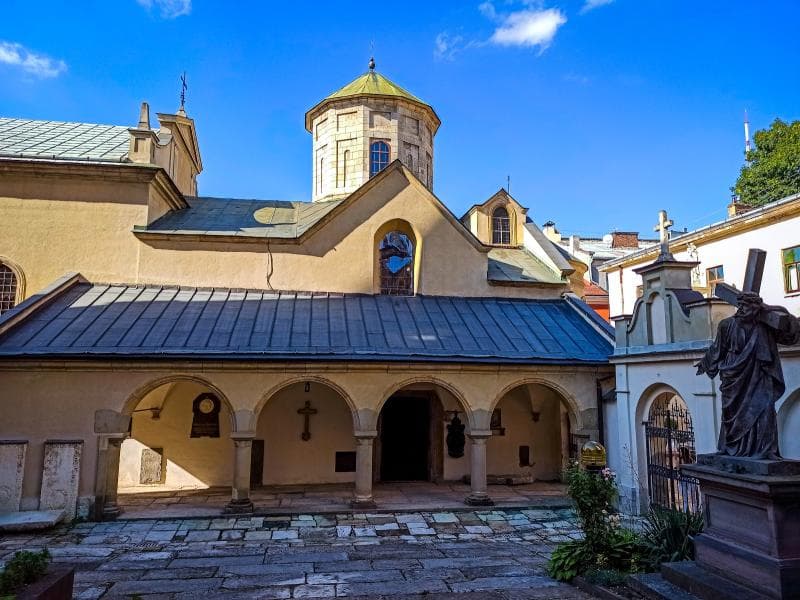
Discover the historic entrance archways of the Armenian Cathedral of Lviv, Ukraine. Explore their unique architecture and rich cultural past.
Overview
The Armenian Cathedral of Lviv, a venerable landmark in Lviv, Ukraine, is more than just a single structure; it is a sprawling complex intricately woven with history and cultural heritage. Its numerous entrance archways are not mere passages but integral architectural elements that guide visitors through centuries of history, connecting bustling city streets to serene courtyards and the sacred interior of the cathedral itself. These archways, varied in their design and age, serve as thresholds, each telling a part of the Armenian community's enduring legacy in Lviv. They represent a fascinating blend of architectural styles, reflecting the cathedral's evolution from its foundational period in the 14th century through subsequent reconstructions and embellishments. Passing through these archways is an essential part of experiencing the profound atmosphere of this UNESCO World Heritage Site, offering glimpses into its layered past and spiritual depth.
History & Cultural Background
The history of the Armenian Cathedral's entrance archways is deeply intertwined with the development of the entire complex, which began in the late 14th century. The cathedral itself was constructed between 1356 and 1363 by architect Doring, modeled after the Cathedral of Ani, the ancient Armenian capital. Early in its existence, in 1437, an arcade gallery was added, originally surrounding the cathedral on three sides, though today only the southern portion remains largely preserved. This initial arcade introduced a distinctive architectural feature, setting a precedent for the importance of arched passages within the complex. Over the centuries, the cathedral endured fires and underwent numerous reconstructions, each leaving its mark on the entrance points. A significant fire in 1527 led to further architectural changes. In 1570, a notable stone portal was incorporated into the passage under the bell tower, leading into the Armenian court, an area rich with history. Later, after a fire in 1778, an archway bearing the date '1779' was constructed as part of the restoration efforts, particularly connecting the eastern courtyard to vul. Lesi Ukrainky. The early 20th century also saw the addition of the main entrance from Krakivska Street, further diversifying the architectural tapestry of the complex's entry points. These ongoing additions and modifications reflect the resilience and adaptability of the Armenian community in Lviv, constantly rebuilding and enriching their spiritual home.
What Makes It Special
What makes the entrance archways of the Armenian Cathedral truly special is their diverse architectural character, serving as a living timeline of the cathedral's history. Unlike a single grand entrance, the complex features a series of distinct arched passages, each contributing to its unique charm. The surviving 15th-century arcade gallery, with its ancient stonework, offers a tangible link to the cathedral's medieval origins. The Baroque gates that lead between the various courtyards, such as those connecting the eastern courtyard to the southern and northern ones, showcase the influence of 18th-century European architectural trends. The stone portal from 1570 under the bell tower stands as a testament to Renaissance craftsmanship. Moreover, the archway dated '1779' commemorates a specific moment of rebuilding and renewal after a devastating fire. The main entrance added in the early 20th century, potentially displaying pseudo-oriental elements or Art Nouveau influences, represents a later stylistic integration. This architectural evolution creates a compelling narrative, where elements of traditional Armenian design blend seamlessly with Gothic, Renaissance, and Baroque styles, making each archway a distinct and significant piece of the larger historical puzzle. The collective effect is a sequence of transitions, each with its own story and aesthetic appeal, inviting visitors to observe the intricate details and imagine the hands that shaped them over centuries.
Stories, Fun Facts & Local Details
The archways of the Armenian Cathedral complex hold subtle narratives and intriguing details. One notable feature is the archway dated '1779', which silently marks the year of significant restoration following a fire that swept through the city in 1778. This date is more than just an inscription; it's a testament to the community's determination to rebuild and preserve their sacred space. As one passes through certain archways, especially into the courtyards, the ground beneath often changes. The southern and northern courtyards, for instance, are paved with ancient Armenian tombstones, relocated from older cemeteries. This unique paving creates a poignant atmosphere, where every step traverses history, and the archways become portals to a past where the living and the departed are intimately connected. The very design of the cathedral, inspired by the Cathedral of Ani, implies a deep cultural story—the longing of a diaspora community to recreate a piece of their homeland's grandeur in a new city. The blend of Eastern and European architectural elements visible in the archways and gates speaks to Lviv's historical role as a multicultural crossroads, where diverse traditions met and merged, creating a distinct architectural language.
Visitor Perspective
For a curious traveler, approaching the Armenian Cathedral means navigating through these evocative entrance archways, each promising a journey into a different dimension of time and experience. The feeling of stepping through a weathered stone archway, perhaps the one under the bell tower with its 1570 portal, is akin to entering a hushed, ancient world, leaving the clamor of modern Lviv behind. The broad entrance gate, approximately two meters wide, from Krakivska Street, offers an inviting initial passage, immediately followed by the sight of 18th-century tombstones laid into the ground, subtly shifting the atmosphere. As you pass through the Baroque gates separating the courtyards, you might notice the intricate carvings or the subtle wear on the stone, reminders of countless individuals who have traversed these same paths over centuries. The archways frame views of the cathedral's robust stone walls, the unique twelve-sided dome, or the tranquil courtyards often paved with ancient Armenian grave markers. This sequence of passages creates a sense of discovery, revealing the complex layer by layer. Observing the varied architectural styles in the archways—from the medieval arcade to later Baroque elements—provides a rich visual narrative of artistic and historical fusion, truly guiding a traveler through the heart of Armenian heritage in Lviv.
Coordinates: 24.03083, 49.84333
View on Google Maps💬 How Travelers Describe This Place
Based on community votes
Beautiful
747Must See
399Unique
302Photogenic
172Interesting
79
Traveler Stories
Discover memorable experiences shared by travelers who have visited this place.
No traveler stories yet.
Be the first traveler to share what made this place memorable.

Tour
By
Spot
Discover amazing places around the world. Your journey starts here.
Explore
© 2026 TourBySpot. All rights reserved.