Emerald Buddha
Bangkok, Thailand
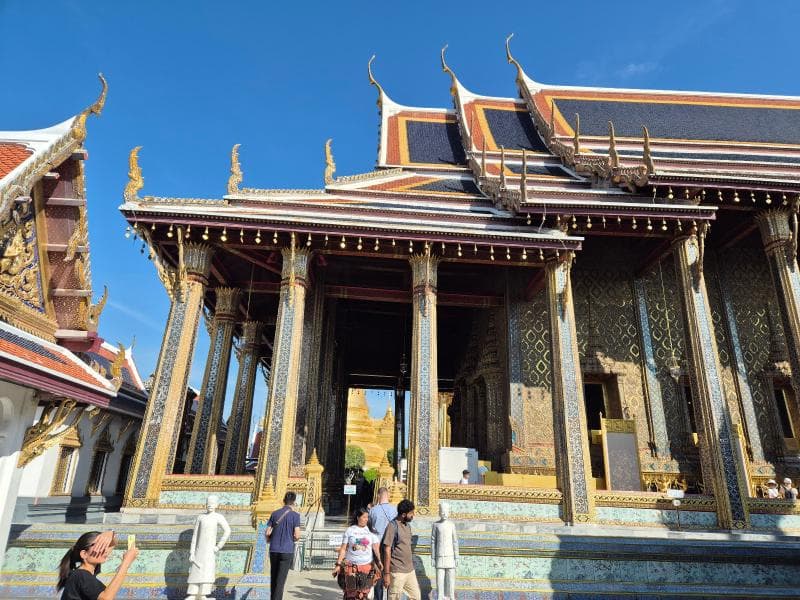
Discover the sacred Emerald Buddha at Wat Phra Kaew in Bangkok, Thailand. Learn its fascinating history, cultural significance, and visitor etiquette.
Overview
Deep within the resplendent grounds of the Grand Palace in Bangkok, Thailand, lies one of the nation's most revered treasures: the Emerald Buddha. Housed in the Temple of the Emerald Buddha, known locally as Wat Phra Kaew, this sacred image is not merely a statue, but the spiritual heart of Thailand and its cherished palladium. Carved from a single piece of semi-precious green stone, often identified as jade or jasper, its name in Thai, Phra Kaeo Morakot, refers to its striking green color rather than the gemstone 'emerald' itself. Though relatively modest in size, measuring approximately 66 centimeters (26 inches) tall and 48 centimeters (19 inches) wide, its spiritual significance is immense. The meditating figure of Gautama Buddha is enshrined high atop an ornate nine-meter pedestal within the Ubosot, or ordination hall, a testament to the profound respect it commands.
History & Cultural Background
The story of the Emerald Buddha is a rich tapestry woven with ancient legends and historical movements, reflecting centuries of Southeast Asian belief and power struggles. Mythical accounts suggest its creation in 43 BCE in Pataliputra, India, by the sage Nagasena, who reportedly had divine assistance from Vishnu and Indra. This legend also prophesied its profound religious impact across five lands.
Its documented history in Thailand begins in 1434 in Chiang Rai, northern Thailand. Legend states that the statue was discovered after a lightning strike hit a chedi at Wat Pa Yia (later renamed Wat Phra Kaew), revealing a stucco-covered Buddha. When the stucco on its nose flaked off, the vibrant green stone beneath was uncovered, leading to its identification as the revered Emerald Buddha. From Chiang Rai, its journey was far from direct. An elephant tasked with transporting it to Chiang Mai famously veered off course towards Lampang, a deviation interpreted as a divine sign, leading to its residence there for 32 years. Eventually, it reached Chiang Mai in 1468, where it was housed in Wat Chedi Luang.
The statue's travels continued across borders. In the mid-16th century, King Setthathirath took the Emerald Buddha to Luang Prabang, and then to Vientiane, Laos, where it remained for over two centuries. Its return to Thailand occurred in 1779 when Siamese General Chao Phraya Chakri (who later became King Rama I, the founder of the current Chakri Dynasty) recovered it during an invasion of Vientiane. Initially placed in Wat Arun in Thonburi, the then-capital, it found its permanent home in 1784. King Rama I meticulously constructed Wat Phra Kaew within the newly established Grand Palace in Bangkok specifically to enshrine this sacred image, solidifying its place as a symbol of the new dynasty's legitimacy and the kingdom's prosperity.
What Makes It Special
The Emerald Buddha holds an unparalleled position in Thai culture and spirituality. It is considered the sacred palladium of the country, believed to bring prosperity and protection to the nation and its people. Its exceptional status is underscored by the unique privilege reserved solely for the King of Thailand: only the monarch is permitted to touch the statue. This royal connection is most visibly manifested in a significant ceremony that takes place three times a year, marking the changing of Thailand's seasons (hot, rainy, and cool). During these auspicious occasions, the King personally presides over the ritual of changing the Buddha's elaborate golden garments. This sacred act is not merely a tradition but a deeply held belief that it invites good fortune and prosperity for the entire country. The intricate details of the statue, carved from a single block of jade, further highlight the ancient craftsmanship and its profound artistic value, adorned with gold and diamonds to enhance its majestic presence.
Stories, Fun Facts & Local Details
Beyond its grand history, the Emerald Buddha is steeped in fascinating stories and cultural nuances. One of the most endearing tales recounts its journey from Chiang Rai to Lampang. When King Sam Fang Kaen of Lan Na sought to bring the statue to his capital in Chiang Mai, the elephant carrying it stubbornly refused, insisting instead on going to Lampang. This act was seen as a divine intervention, leading to the Buddha's 32-year stay in Lampang. Another interesting detail is the historical practice, during the early Bangkok period, of parading the Emerald Buddha through the streets to ward off calamities like plague and cholera. However, King Rama IV, a monarch ahead of his time, discontinued this tradition, believing that diseases were caused by germs, not by evil spirits or the Buddha's displeasure. The journey of the Emerald Buddha, passing through various kingdoms and becoming a coveted prize for rulers, symbolizes its profound perceived power and ability to bestow legitimacy upon those who possessed it. The act of changing its robes by the King remains a powerful and emotionally resonant cultural spectacle, symbolizing continuity and blessing for the nation.
Visitor Perspective
Visiting the Emerald Buddha within Wat Phra Kaew is an immersive cultural experience that offers a glimpse into Thailand's deep spiritual heritage. As the statue is elevated high on its pedestal, visitors observe it from a respectful distance, a tradition that reinforces its sacredness. Due to its sanctity, photography is generally not permitted inside the ordination hall where the Buddha resides. When planning a visit, it's crucial to adhere to the temple's strict dress code: shoulders and knees must be covered as a sign of respect for this holy site. Additionally, footwear must be removed before entering certain areas of the temple complex. To avoid the largest crowds and the heat of the day, it is often recommended to visit in the early morning or late afternoon. The entire Wat Phra Kaew complex, with its dazzling golden chedis, multi-tiered roofs, and intricate mosaics, offers a magnificent display of Thai architectural and artistic genius, making the visit a truly awe-inspiring journey through history and faith.
Coordinates: 100.4925, 13.75139
View on Google Maps💬 How Travelers Describe This Place
Based on community votes
Unique
931Must See
692Photogenic
655Beautiful
491Interesting
266
Traveler Stories
Discover memorable experiences shared by travelers who have visited this place.
No traveler stories yet.
Be the first traveler to share what made this place memorable.

Tour
By
Spot
Discover amazing places around the world. Your journey starts here.
Explore
© 2026 TourBySpot. All rights reserved.