Elevator Platform
Vienna, Austria
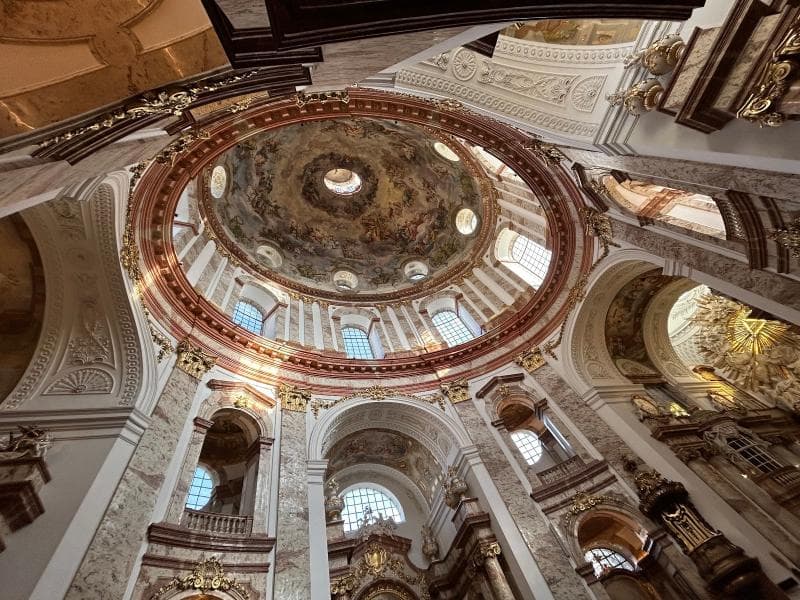
Ascend the Elevator Platform inside Vienna's Karlskirche for an unparalleled, eye-level view of its breathtaking Baroque dome frescoes by Rottmayr. Discover history and art.
Overview
Within the magnificent Karlskirche in Vienna, Austria, lies a unique feature that elevates the visitor experience quite literally: the Elevator Platform. This modern glass and steel installation offers an unparalleled journey into the heart of one of Europe's most stunning Baroque domes. Instead of gazing up from the nave below, visitors can ascend to eye-level with the colossal ceiling fresco painted by Johann Michael Rottmayr. This panoramic lift, permanently installed after restoration work in the early 2000s, was conceived to allow an intimate appreciation of the intricate artwork that adorns the church's dome. It provides a rare opportunity to examine the brushstrokes, colors, and narratives of a Baroque masterpiece from a perspective typically reserved for conservators. The platform rises to a height of approximately 32 to 33 meters, bringing you incredibly close to the celestial scenes depicted above.
History & Cultural Background
The Karlskirche itself is a monument born from a vow. In 1713, after Vienna was ravaged by the last major plague epidemic, Emperor Charles VI pledged to build a church dedicated to Saint Charles Borromeo, the patron saint of plague sufferers. Construction began in 1716 under the visionary architect Johann Bernhard Fischer von Erlach, who imbued the design with a rich tapestry of architectural styles. Sadly, Fischer von Erlach died before its completion in 1739, with his son, Joseph Emanuel Fischer von Erlach, overseeing the final stages. The church is a masterful fusion of Roman, Greek, Byzantine, and Baroque elements, reflecting a 'world history of architecture' in its form. The dome frescoes, 'The Glorification of St. Charles Borromeo' or 'The Apotheosis of St. Charles Borromeo', were completed around 1725 by Johannes Michael Rottmayr, a Salzburg Baroque painter. These frescoes cover an impressive area of 1250 square meters, making them a central artistic feature of the church.
What Makes It Special
The Elevator Platform in Karlskirche is truly special because it transforms a passive viewing experience into an active exploration of art and architecture. Unlike most churches where dome frescoes remain distant, blurred narratives overhead, this lift grants an intimate audience with Rottmayr's monumental work. The sheer scale of the fresco, depicting celestial realms and the saint's journey, becomes profoundly tangible when viewed from mere feet away. You can discern the subtle expressions on angelic faces, the texture of the paint, and the masterful use of light and shadow that once required a telescope to appreciate. This close proximity reveals details, hidden symbols, and even the artist's corrections made centuries ago. It is an experience that connects you directly to the artistic genius of the Baroque era, offering a unique insight into the painter's craft and the theological messages intended for the 18th-century worshipper. The modern glass construction of the elevator, a stark contrast to the Baroque interior, provides a dynamic journey upwards, allowing the fresco to unfold with every meter of ascent.
Stories, Fun Facts & Local Details
The installation of the permanent Elevator Platform has its own fascinating story. During significant restoration work on the dome frescoes in the early 2000s, scaffolding was erected to allow conservators access. Visitors were granted rare permission to climb this temporary scaffolding, and the overwhelming positive response to seeing the frescoes up close was so profound that it inspired the church authorities to install a permanent solution. This decision turned a temporary necessity into an enduring attraction, ensuring that future generations could share in this unique perspective. The Karlskirche itself is often cited as a prime example of Viennese Baroque, a style characterized by lavish decoration, dramatic scale, and an emphasis on light and movement to inspire awe. The church's oval dome, while appearing narrow from the front, opens up dramatically inside, enhancing the illusion of heavenly ascent. While the primary focus of the platform is the frescoes, from the upper vantage point, one can catch glimpses of Vienna's skyline, including the Secession Building and Belvedere Palace, adding another layer to the experience.
Visitor Perspective
For a curious traveler, the Elevator Platform offers an unforgettable highlight of a visit to Karlskirche. The ascent begins within the grandeur of the church's nave, and as the modern glass elevator glides upwards, the vastness of Rottmayr's fresco gradually reveals itself in stunning detail. It's a moment of quiet awe, allowing for contemplation of both artistic skill and historical context. While the lift provides an excellent vantage point for the frescoes, it's worth noting that after the elevator ride, some additional steps are required to reach the highest viewing points. Visitors with a fear of heights should be aware of this unique perspective within the church's interior. Although the ground floor of Karlskirche is generally accessible, the dome elevator experience involves navigating some steps, meaning it is not fully barrier-free for all visitors. Nevertheless, the opportunity to stand eye-to-eye with centuries-old art makes this journey into the dome a truly exceptional part of any Viennese itinerary.
Coordinates: 16.3718, 48.19828
View on Google Maps💬 How Travelers Describe This Place
Based on community votes
Must See
950Beautiful
287Photogenic
255Unique
231Interesting
86
Traveler Stories
Discover memorable experiences shared by travelers who have visited this place.
No traveler stories yet.
Be the first traveler to share what made this place memorable.

Tour
By
Spot
Discover amazing places around the world. Your journey starts here.
Explore
© 2026 TourBySpot. All rights reserved.