Egyptian Sphinx
Split, Croatia
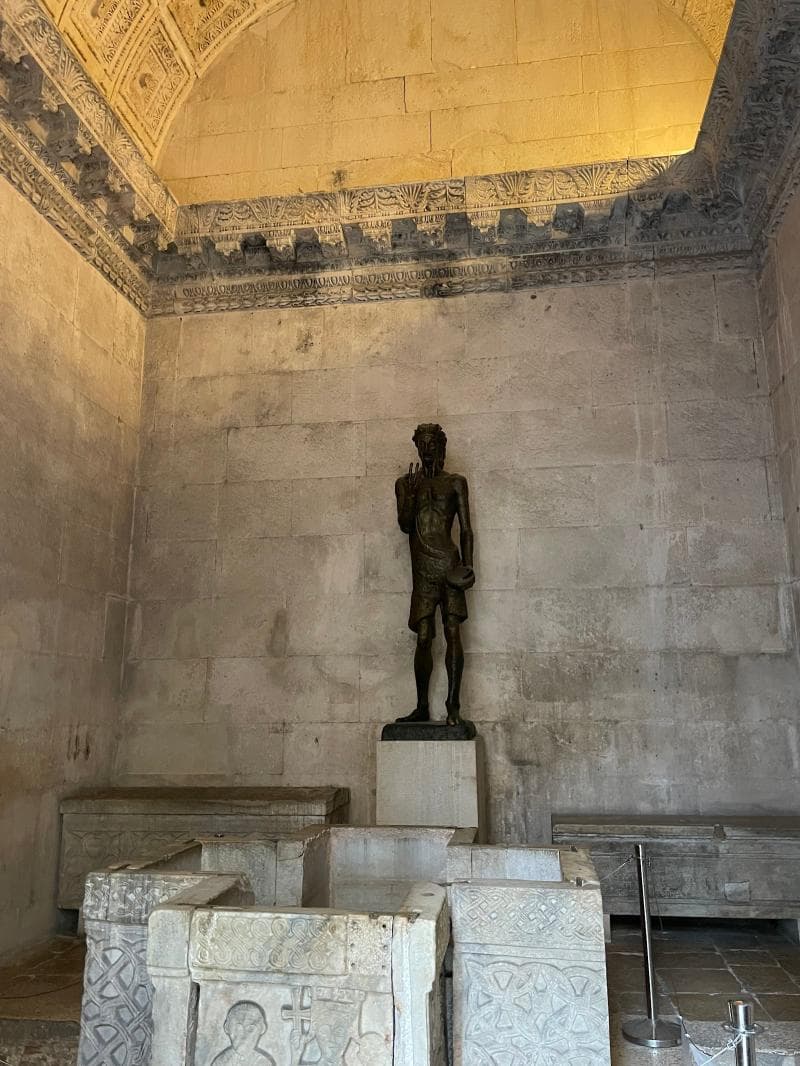
Discover the ancient Egyptian Sphinx guarding Split's Temple of Jupiter, a 3,500-year-old mystery in Croatia's historic Diocletian's Palace.
Overview
Deep within the ancient walls of Diocletian's Palace in Split, Croatia, stands an intriguing relic from a land far away: an Egyptian Sphinx. This silent guardian, carved from dark granite, offers a compelling glimpse into the ancient world's interconnectedness and the grand vision of Emperor Diocletian. While one well-preserved sphinx captivates visitors in the Peristyle, another, equally significant but headless, stands watch just before the entrance to the venerable Temple of Jupiter. This artifact, an original piece of Egyptian artistry, transports visitors across millennia, linking the sun-baked banks of the Nile to the sun-drenched Adriatic coast.
Its presence is a testament to the Roman Empire's vast reach and its emperors' fascination with exotic cultures and symbolic power. Today, as you approach the Temple of Jupiter, this headless sphinx invites contemplation on history's relentless march and the enduring mysteries of ancient civilizations.
History & Cultural Background
The story of the Egyptian Sphinx in Split begins not in Croatia, but in ancient Egypt, dating back to the 15th century BC, specifically to the reign of Pharaoh Thutmose III. This makes the sphinx an astonishing 3,500 years old, predating Diocletian's Palace by over a millennium.
Emperor Diocletian, a native of the region who rose to become one of Rome's most powerful rulers, commissioned the construction of his sprawling retirement palace in Split between 295 and 305 AD. Following a successful campaign in Egypt around 297 AD, Diocletian's fascination with Egyptian culture and its profound symbolism led him to import approximately a dozen sphinxes from Egypt.
These magnificent black granite statues were intended to adorn his imperial residence, particularly to serve as powerful guardians for his mausoleum, which is now the Cathedral of St. Domnius, and other sacred spaces like the Temple of Jupiter. The Temple of Jupiter itself was dedicated to the supreme Roman god, whom Diocletian considered his divine father. However, with the rise of Christianity after Diocletian's reign, many of these 'pagan' symbols were tragically destroyed or defaced, resulting in the decapitation of several sphinxes, including the one found before the Temple of Jupiter. The temple itself was later converted into a Christian baptistery dedicated to St. John the Baptist in the 6th century.
What Makes It Special
The Egyptian Sphinx before the Temple of Jupiter holds a unique allure due to several compelling factors. Firstly, its sheer antiquity is remarkable; at around 3,500 years old, it is significantly older than the Roman structures it now accompanies.
This chronological dissonance creates a powerful dialogue between different ancient civilizations – the deep past of dynastic Egypt meeting the grandeur of imperial Rome, all within the contemporary fabric of a Croatian city. Secondly, its material, dark black granite, stands in stark contrast to the local white limestone of Diocletian's Palace, making its presence visually striking and emphasizing its foreign origin.
The headless state of this particular sphinx is also profoundly symbolic. It is a tangible marker of the transition from paganism to Christianity in the region, reflecting a period of profound cultural and religious transformation where symbols of old faiths were often dismantled.
Despite its missing head, it retains an air of dignified mystery, serving its ancient purpose as a guardian. Its location, flanking the entrance to the Temple of Jupiter, which later became a baptistery, highlights the layered history of this sacred space and the continuous repurposing of ancient sites throughout the centuries.
Stories, Fun Facts & Local Details
The journey of these sphinxes from the temples of Egypt to the heart of Diocletian's Palace is a captivating tale of imperial ambition and cultural exchange. It's believed Diocletian brought them from Luxor in Upper Egypt, specifically from temples like Karnak, after his military successes.
While many sources claim twelve sphinxes were initially brought, only three largely survived the test of time and tumultuous history: the one on the Peristyle, a headless one positioned at the Temple of Jupiter's entrance, and fragments housed in local museums.
The act of decapitating the sphinxes by early Christians was not merely an act of destruction but a symbolic assertion of a new religious order over the old pagan traditions, turning symbols of imperial power into remnants of a bygone era.
It's interesting to note that the Temple of Jupiter, guarded by this ancient Egyptian figure, was so admired that Scottish architect Robert Adam, a prominent figure of the Neoclassical movement, considered it one of Europe's most beautiful monuments. This recognition underscores the architectural significance of the Temple itself, beyond the exotic guardian at its threshold.
Visitor Perspective
Visiting the Egyptian Sphinx before the Temple of Jupiter is an integral part of exploring Diocletian's Palace. It offers a moment of reflection on the incredible sweep of history contained within these ancient walls. As you stand before this weathered statue, you're not just observing a piece of stone; you're connecting with an artifact that has witnessed over three millennia of human civilization.
It's a subtle but powerful reminder that Split's history is deeply intertwined with cultures thousands of miles away. The sphinx provides a rich layer of context to the Roman architecture, making the past feel incredibly tangible. It is freely accessible to view as part of a stroll through the palace, ideally combined with a visit to the Temple of Jupiter itself. This unique combination of ancient Egyptian artistry and Roman imperial architecture, all set within a vibrant modern city, makes the experience truly unforgettable for any curious traveler.
Coordinates: 16.4396, 43.5083
View on Google Maps💬 How Travelers Describe This Place
Based on community votes
Beautiful
804Unique
733Must See
563Interesting
404Photogenic
336
Traveler Stories
Discover memorable experiences shared by travelers who have visited this place.
No traveler stories yet.
Be the first traveler to share what made this place memorable.

Tour
By
Spot
Discover amazing places around the world. Your journey starts here.
Explore
© 2026 TourBySpot. All rights reserved.