Doric Columns
Athens, Greece
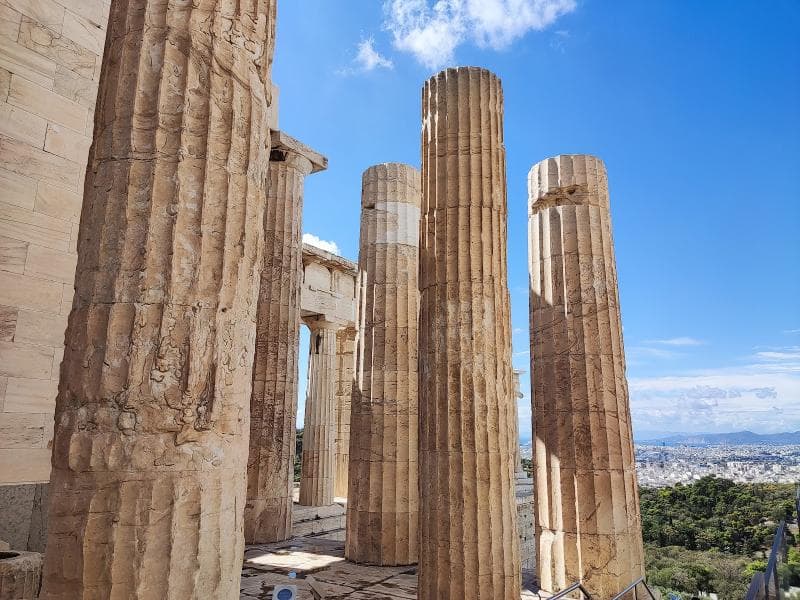
Explore the majestic Doric columns of the Parthenon in Athens, Greece. Discover its ancient history, unique optical refinements, and cultural significance.
Overview
Perched majestically atop the Acropolis in Athens, Greece, the Parthenon stands as a timeless testament to classical Greek architectural prowess, and its distinctive Doric columns are central to its grandeur. Dedicated to the goddess Athena, the city's patron, this ancient temple is not merely a ruin but a profound symbol of ancient Greece, Western civilization, and democracy itself. As you approach this iconic structure, the rhythmic array of its Doric columns immediately captures your attention, defining its powerful and harmonious silhouette against the Athenian sky.
The Parthenon is primarily a Doric octastyle peripteral temple, meaning it features eight columns across its façades and columns along its sides, completely surrounding the inner sanctuary. These columns, robust and elegant, are integral to the temple's unique aesthetic, embodying the strength and simplicity characteristic of the Doric order. Walking among them offers a tangible connection to an era that laid the foundations of so much of our modern world.
History & Cultural Background
The construction of the classical Parthenon we see today commenced in 447 BCE and was largely completed by 432 BCE, during the golden age of Athens, under the leadership of Pericles. Architects Iktinos and Kallikrates, with the celebrated sculptor Phidias overseeing the decorative elements, brought this architectural marvel to life.
The Doric order itself emerged around the 7th century BCE and is considered the oldest and most fundamental of the three classical Greek architectural styles. It developed in mainland Greece, influenced by cultures that valued discipline, community, and resilience, giving rise to its characteristic solidity and practical design. The Parthenon was built using precisely cut Pentelic marble, quarried from nearby Mount Pentelikon, with an estimated 13,400 stones used in its construction.
While serving as a grand temple for Athena, the Parthenon also functioned as the city's treasury, housing the Delian League's funds in its western room. Its purpose extended beyond religious devotion, acting as a powerful declaration of Athenian power and cultural supremacy following their victory over the Persian invaders.
What Makes It Special
What truly sets the Doric columns of the Parthenon apart is not just their age or scale, but the ingenious 'optical refinements' employed by its ancient architects. Far from being perfectly straight, virtually every line in the Parthenon, including its columns, incorporates subtle curves and inclinations designed to counteract visual distortions.
For instance, the columns exhibit 'entasis,' a slight convex bulge in their shafts, making them appear perfectly straight and robust from a distance, rather than tapering unnaturally or appearing concave. The stylobate, the platform on which the columns rest, also rises subtly towards its center, as do all horizontal architectural elements. Furthermore, the columns subtly incline inward, giving the entire structure a sense of organic vitality and stability. These deliberate adjustments create an impression of geometric perfection and harmony to the human eye, a testament to the ancient Greeks' sophisticated understanding of perception and aesthetics.
The Parthenon also uniquely integrates Doric and Ionic architectural elements. While its exterior is predominantly Doric with a frieze of alternating metopes and triglyphs, it features a continuous Ionic frieze on the exterior wall of the cella, and Ionic columns within its interior. This hybridization was rare and contributed to the temple's delicate balance between austere and ornate visual characteristics.
Stories, Fun Facts & Local Details
A remarkable fun fact about the Parthenon's Doric columns is that they are not solid blocks of marble. Instead, they are composed of perfectly carved 'drums' or sections, meticulously joined together. This modular construction, along with metallic joints bonded with lead between the layers, is believed to have contributed to the Parthenon's extraordinary resilience, allowing it to withstand earthquakes for over two millennia.
The Parthenon has 46 exterior Doric columns, with eight on the narrow ends (façades) and seventeen on the longer flanks. This specific configuration was designed to conform to a precise 9:4 ratio that governed many of the temple's proportions, from column spacing to height. The exterior columns are substantial, typically measuring around 6.2 feet in diameter and standing about 34.1 feet tall.
Even the process of constructing these colossal columns was a feat of ancient engineering. Workers used ramps, pulleys, and manual labor to transport, lift, and assemble the massive marble blocks without modern machinery.
Visitor Perspective
For any traveler to Athens, visiting the Doric columns of the Parthenon is an experience that transcends mere sightseeing. Standing before these ancient giants, one can almost feel the echoes of the past. The sheer scale and precision of the architecture evoke a sense of awe and wonder, prompting reflection on the ingenuity and artistic ambition of the ancient Greeks. The way the light plays across the fluted surfaces of the columns, particularly at sunrise or sunset, highlights the subtle curvatures and breathes a sense of life into the stone. It's a moment of profound connection, understanding that these very columns have silently witnessed millennia of history, remaining an enduring symbol of human aspiration and artistic excellence.
Coordinates: 23.7267, 37.9715
View on Google Maps💬 How Travelers Describe This Place
Based on community votes
Beautiful
995Interesting
839Must See
603Unique
388Photogenic
289
Traveler Stories
Discover memorable experiences shared by travelers who have visited this place.
No traveler stories yet.
Be the first traveler to share what made this place memorable.

Tour
By
Spot
Discover amazing places around the world. Your journey starts here.
Explore
© 2026 TourBySpot. All rights reserved.