Dome Structures
Pristina, Kosovo
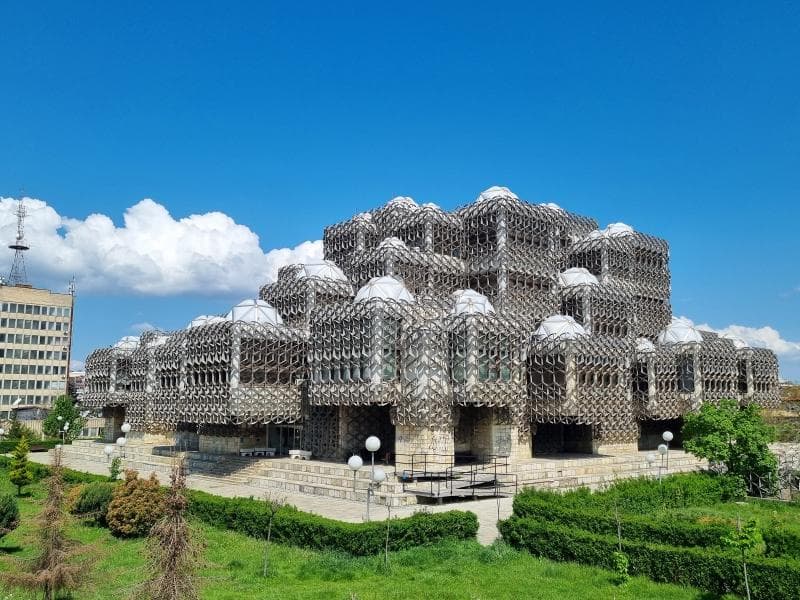
Explore the unique dome structures of the National Library of Kosovo in Pristina, a symbol of architectural synthesis and cultural heritage.
Overview
Nestled in the vibrant heart of Pristina, Kosovo, the National Library of Kosovo stands as a monumental work of architecture, distinguished by its myriad of dome structures. More than just a repository of knowledge, this building, designed by Croatian architect Andrija Mutnjaković, is an emblematic landmark whose unique design has sparked both admiration and debate since its inauguration in 1982. It serves as Kosovo's primary public research library, holding an extensive collection of over 1.7 million volumes, including invaluable historical manuscripts and archives. The library's striking appearance, characterized by a captivating array of white domes and a metallic lattice exterior, offers visitors a profound insight into Kosovo's layered cultural identity and architectural ambition.
The sub-spot of 'Dome Structures' refers to the 99 intersecting white steel dome meshes that clad the reinforced-concrete mass of the building. These domes are not merely decorative; they are integral to the library's design, providing essential natural light to the interior reading rooms and workspaces. Their presence contributes to a distinctive silhouette, making the library instantly recognizable and a compelling destination for those interested in unique architectural expressions and cultural heritage.
History & Cultural Background
The National Library of Kosovo was commissioned in the early 1970s as part of Yugoslavia's investment in Kosovo's cultural infrastructure. Architect Andrija Mutnjaković won the design competition with a vision intended to represent Kosovo's multi-religious heritage, an intentional architectural statement in a region shared by Albanian Muslims, Serbian Orthodox Christians, and other communities. The construction, spanning from 1974 to 1982, culminated in a building that consciously synthesized Byzantine and Ottoman architectural forms, two traditions deeply embedded in the region's history.
Beyond its architectural genesis, the library has endured a turbulent history, mirroring the complex narrative of Kosovo itself. It opened under Yugoslav rule, but its existence has been marked by periods of immense change, including the 1998-1999 Kosovo War, NATO intervention, and Kosovo's 2008 declaration of independence. Throughout these upheavals, the library steadfastly functioned as a guardian of Albanian-language culture and identity, becoming a powerful symbol of resilience and cultural preservation. During the Kosovo War, it was even used to house refugees and, at one point, served as a command center for the Serbian army, a period during which many historical books were sadly destroyed.
What Makes It Special
The dome structures of the National Library of Kosovo are arguably its most defining feature, contributing significantly to its polarizing yet fascinating appeal. There are 99 domes in total, of varying sizes, dramatically covering the building like a series of linked umbrellas or stylized traditional Albanian hats. This reinterpretation of traditional architectural elements with modern techniques and materials creates a profound visual statement. The domes are intricately linked with the metal mesh that wraps the entire building, a design element often likened to filigree, a traditional local craft, or even fishing nets. This combination filters light and creates a unique interplay of light and shadow within the interior spaces.
What truly sets these domes apart is the debate surrounding their symbolism. While Mutnjaković intended them to blend Byzantine and Islamic forms, representing inter-religious coexistence, another widely discussed interpretation connects them to the 'qeleshe' or 'plisi' – the traditional white felt cap worn by Albanian men. This particular interpretation fueled significant controversy among Serbian politicians at the time of its construction, highlighting how deeply architecture can be intertwined with national identity and political discourse in the Balkans. Regardless of the interpretation, the domes are central to the library's status as a unique example of postmodern architectural synthesis.
Stories, Fun Facts & Local Details
One of the most intriguing aspects of the library's domes is how they contribute to the building's overall reputation. For many years, the National Library of Kosovo frequently appeared on lists of the world's 'ugliest buildings.' However, this perception has significantly shifted, with many now reappraising it as a significant work of postmodern architecture and a powerful expression of Kosovo's layered identity. This evolution in perception underscores the building's complex character and its ability to provoke strong reactions.
Inside, the domes contribute to the atmosphere of the main hall, which is adorned with colorful marble mosaics on its floor. The largest dome bathes this central space in abundant natural light, making it a dramatic and memorable area for cultural events and quiet contemplation. The interior design, along with the functionality of the domes in providing light, demonstrates a thoughtful approach to creating spaces that serve both intellectual and aesthetic purposes.
Visitor Perspective
For a curious traveler, approaching the National Library of Kosovo is an experience unlike any other. The sight of the concrete blocks draped in a metallic mesh, topped with dozens of white domes, is undeniably striking. It evokes a sense of wonder and prompts contemplation on the interplay of history, culture, and architectural expression. Walking through its main entrance, visitors are greeted by the grandeur of the interior, where the domes continue to exert their influence by illuminating the large, open spaces.
The library offers more than just visual appeal; it is a living institution dedicated to preserving and promoting Kosovo's documentary and intellectual heritage. Exploring its collections provides a tangible connection to the country's past and present. Whether you are an architecture enthusiast, a history buff, or simply a traveler seeking unique cultural insights, the dome structures of the National Library of Kosovo offer a captivating and thought-provoking experience, truly making it a must-visit destination in Pristina.
Coordinates: 21.16222, 42.65722
View on Google Maps💬 How Travelers Describe This Place
Based on community votes
Must See
948Beautiful
913Photogenic
499Unique
337Interesting
94
Traveler Stories
Discover memorable experiences shared by travelers who have visited this place.
No traveler stories yet.
Be the first traveler to share what made this place memorable.

Tour
By
Spot
Discover amazing places around the world. Your journey starts here.
Explore
© 2026 TourBySpot. All rights reserved.