Doge's Palace
Venice, Italy
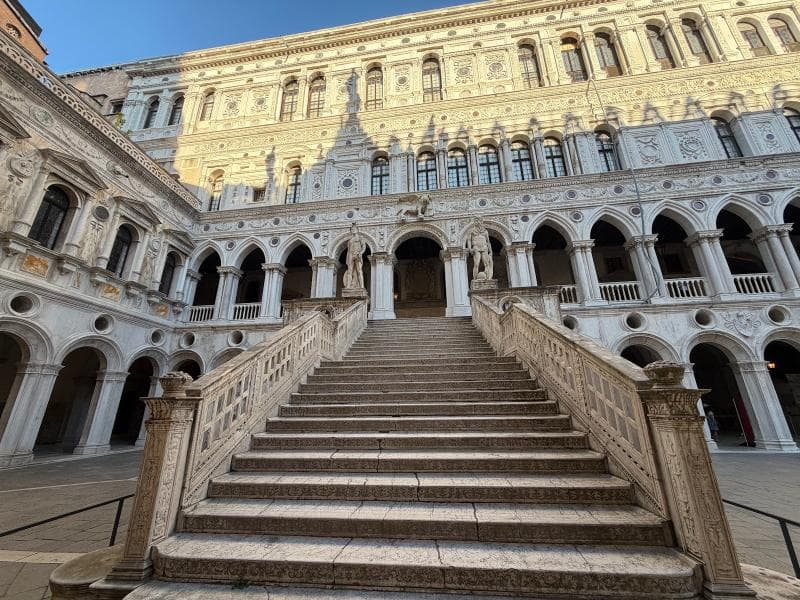
Explore Doge's Palace in Venice, Italy – a stunning Venetian Gothic masterpiece, former seat of power, and museum filled with art and history.
Overview
The Doge's Palace, or Palazzo Ducale, stands as an iconic masterpiece of Venetian Gothic architecture in Venice, Italy. More than just a palace, it was the formidable heart of the Venetian Republic for centuries. This grand edifice served as the official residence of the Doge, the supreme elected authority of Venice, as well as the seat of government, a courthouse, and even a prison. Its unique design and rich history make it an enduring symbol of Venice's power, art, and complex political life.
History & Cultural Background
The origins of the Doge's Palace trace back to the 9th century, when a fortified castle likely stood on the site. Over the centuries, the structure underwent significant transformations, often necessitated by devastating fires. After a fire in the 10th century, a new palace was built in the 12th century under Doge Sebastiano Ziani. However, the palace we largely see today began to take shape with major Gothic reconstructions starting around 1340, initially focusing on the wing overlooking the lagoon. The wing facing the Piazzetta San Marco was completed in its present form from 1424 onwards, notably under Doge Francesco Foscari. This building housed the complex machinery of the Venetian state until 1797, when the Republic fell to Napoleon. After this, its role changed, serving various administrative purposes and housing cultural institutions like the Biblioteca Marciana. In 1923, the Italian State entrusted its management to the Venetian municipality, opening it as a public museum, a role it continues to fulfill today as part of the Fondazione Musei Civici di Venezia.
What Makes It Special
The Doge's Palace is a striking example of Venetian Gothic style, a blend that incorporates Byzantine and Moorish architectural influences, reflecting Venice's historical trade and cultural connections with the East. Its most distinctive feature is arguably its exterior: a seemingly massive upper story supported by a delicate double arcade of slender, almost lace-like Istrian marble columns. The facade, adorned with patterns of pink Verona marble and graceful arching windows, creates an illusion of lightness, a testament to the ingenious engineering and artistic vision of its builders. Inside, the palace boasts monumental spaces like the Sala del Maggior Consiglio (Great Council Chamber), one of Europe's largest rooms, where up to 1,500 patricians would gather to govern the Republic. The Porta della Carta, a highly ornate Gothic gate, served as the ceremonial entrance, leading visitors into the grand courtyard.
Stories, Fun Facts & Local Details
One of the most famous features of the palace is the Bridge of Sighs (Ponte dei Sospiri), built in 1602 by Antonio Contino. It connects the Doge's Palace directly to the New Prison across the Rio di Palazzo. Contrary to romantic notions, the name derives from the 'sighs' of prisoners catching their last glimpse of freedom and beautiful Venice before being incarcerated. The palace has repeatedly faced destruction by fire, with notable incidents in 1483 and 1577, which destroyed precious artworks and led to extensive renovations. Yet, each rebuilding effort only added to its splendor, with artists like Tintoretto and Veronese contributing magnificent masterpieces. The red marble columns on the facade, often admired for their beauty, also hold a darker secret: these were historically used as a place where death sentences were read aloud, an ominous detail for many Venetians of the past. For those seeking deeper insights, the 'Secret Itineraries' tour offers access to rarely seen areas, including the Doge's private apartments and the prison cell famously occupied by Giacomo Casanova.
Visitor Perspective
The Doge's Palace is conveniently located in the heart of Venice, dominating Piazza San Marco alongside St. Mark's Basilica. It's easily accessible on foot from most parts of the historic center or via vaporetto (water bus), with nearby stops such as San Zaccaria or Vallaresso. The public entrance is through the Porta del Frumento, located on the Piazzetta. A visit offers a captivating journey through grand state rooms, ornate courtyards, and the very prisons where the Republic's justice was meted out. Exploring its vast halls filled with incredible art and walking across the iconic Bridge of Sighs provides a profound sense of the historical power and artistic legacy of the Venetian Republic. It truly offers a unique window into a pivotal era of European history.
Coordinates: 12.340556, 45.433611
View on Google Maps💬 How Travelers Describe This Place
Based on community votes
Must See
556Photogenic
540Unique
470Interesting
410Beautiful
254
Traveler Stories
Discover memorable experiences shared by travelers who have visited this place.
No traveler stories yet.
Be the first traveler to share what made this place memorable.
Things to see at Doge's Palace



Tour
By
Spot
Discover amazing places around the world. Your journey starts here.
Explore
© 2026 TourBySpot. All rights reserved.