Courtyard
Venice, Italy
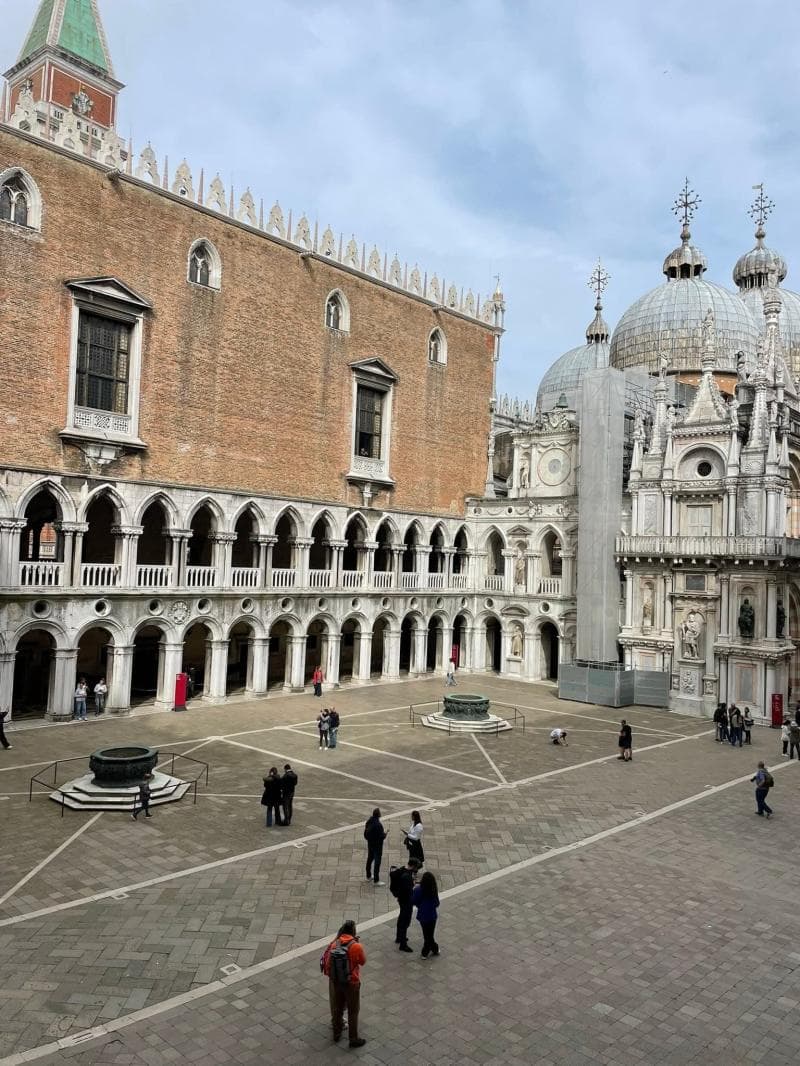
Explore the historic Courtyard of Doge's Palace in Venice, Italy. Discover its Gothic and Renaissance architecture, the Giants' Staircase, and ancient well-heads.
Overview
Stepping into the Courtyard of the Doge's Palace in Venice, Italy, immediately transports visitors to the heart of the powerful Venetian Republic. This central open space, an elegant blend of Gothic and Renaissance architectural styles, serves as a grand introduction to the palace's historical significance. Surrounded by majestic porticoes and intricate loggias, the Courtyard is more than just an entry point; it is a meticulously designed space that once bustled with political activity and ceremonial grandeur. It stands as a testament to Venice's unique artistic and administrative legacy.
Visitors entering through the historic Porta del Frumento find themselves within this impressive quadrangle, gazing upon the various wings of the palace. To the left is the Piazzetta wing, while the Renaissance wing stands to the right, each telling a part of the palace's storied evolution. The northern side of the courtyard is seamlessly integrated with St. Mark's Basilica, which historically served as the Doge's private chapel. Dominating the eastern side is the monumental Giants' Staircase, flanked by colossal statues, and at the center, two ornate well-heads from the mid-16th century add to the Courtyard's rich tapestry of detail.
History & Cultural Background
The Doge's Palace, or Palazzo Ducale, has roots stretching back to 810 AD, when it was conceived as a fortified castle. Over centuries, fires and the evolving needs of the Venetian government led to numerous reconstructions and expansions. The palace as we largely see it today began to take shape around 1340, gradually transitioning from a defensive stronghold to a magnificent seat of power.
The Courtyard itself was a significant part of these transformations. Its design and construction began in earnest around 1483 under the direction of Antonio Rizzo, following a devastating fire in the eastern wing of the palace. Construction continued for several decades, with completion reaching the mid-16th century. This period saw the integration of rich sculptural work and sophisticated architectural elements. The iconic Porta della Carta, a Gothic masterpiece, was constructed between 1438 and 1442 by Giovanni and Bartolomeo Bon, serving as the ceremonial entrance linking St. Mark's Square directly to the Courtyard.
The Giants' Staircase, a prominent feature of the Courtyard, was built in the final years of the 15th century. It became the formal ascent to the Doge's apartments and the heart of government. The subsequent fires, particularly those in 1574 and 1577, necessitated further rebuilding. Despite proposals for a new classical style, the decision was made to reconstruct the palace largely as it had been, preserving its unique Venetian Gothic character and reinforcing the Republic's enduring legacy.
What Makes It Special
The Courtyard's distinctive charm lies in its architectural synthesis. It beautifully marries the robust Gothic style, visible in earlier sections and the Porta della Carta, with the burgeoning elegance of the Renaissance, particularly evident in the eastern wing and its ornate details. This harmonious blend creates an aesthetically captivating environment unlike any other.
At the pinnacle of its grandeur is the Scala dei Giganti, or 'Giants' Staircase'. Guarded by colossal marble statues of Mars and Neptune, sculpted by Jacopo Sansovino, this staircase symbolises Venice's dominion over both land and sea. It was here that newly elected Doges were crowned, taking their oath of office in a public display of the Republic's continuity and power.
Further enhancing the Courtyard's allure are the two exquisite bronze well-heads, dating from the mid-16th century. These meticulously crafted works by Alberghetti and De Conti are richly decorated with complex iconography, reflecting the artistic prowess of the era. The Foscari Arch, with its alternating bands of Istrian stone and red Verona marble, creates a dramatic visual link between the Giants' Staircase and the Porta della Carta, framing the entrance with striking elegance.
Stories, Fun Facts & Local Details
The Courtyard is steeped in fascinating historical anecdotes. The Giants' Staircase, while a place of celebration, also witnessed moments of severe justice; it was reportedly where Doge Marino Faliero was beheaded in 1355 for treason, a stark reminder of the Republic's unwavering authority.
The Porta della Carta, literally 'Door of Paper', earned its name from the adjacent archives of the Serenissima Republic, where official decrees and new laws were once drafted, checked, and archived. This proximity highlights the palace's function as the nerve center of Venetian governance.
Another intriguing architectural detail within the broader palace structure, though visible from the loggias overlooking the Courtyard, were the 'bocche di leone' or 'lion's mouths'. These were slits in the walls where anonymous denunciations of crimes or corruption could be submitted, a unique system for maintaining civic order and preventing dissent. While not directly in the Courtyard, these reveal the intricate systems at play. Near the clock façade, visitors can spot original Roman statues, part of the Grimani collection, which still bear marks of 16th-century restorations.
Architecturally, the Doge's Palace famously subverted conventional medieval fortress design by placing its seemingly lighter loggias on the lower floors and more solid walls above. This was not a structural weakness, but a deliberate statement, signifying the Republic's trust in its citizens and its unique relationship with them, eschewing overt defensive posturing for an image of openness and stability.
Visitor Perspective
For the modern traveler, entering the Courtyard of the Doge's Palace offers an immediate sense of stepping back in time to the golden age of Venice. It provides a rare moment of tranquility amidst the often-bustling city, a serene oasis where one can pause and appreciate centuries of history etched in stone.
The Courtyard is an integral part of the official Doge's Palace museum visit, accessible with a general admission ticket. Many visitors recommend arriving early in the day to experience its grandeur before the larger crowds gather, allowing for a more intimate appreciation of its architectural details and historical resonance. From the loggias above the Courtyard, visitors are treated to breathtaking views, not only of the internal palace structure but also glimpses of the city and the Venetian lagoon beyond. It is a 'must-see' open space, offering an essential introduction to the majesty and mystery of the Doge's Palace and the Republic it once served.
Coordinates: 12.3405, 45.4337
View on Google Maps💬 How Travelers Describe This Place
Based on community votes
Interesting
836Photogenic
797Unique
255Must See
231Beautiful
86
Traveler Stories
Discover memorable experiences shared by travelers who have visited this place.
No traveler stories yet.
Be the first traveler to share what made this place memorable.

Tour
By
Spot
Discover amazing places around the world. Your journey starts here.
Explore
© 2026 TourBySpot. All rights reserved.