Documentation Center
Berlin, Germany
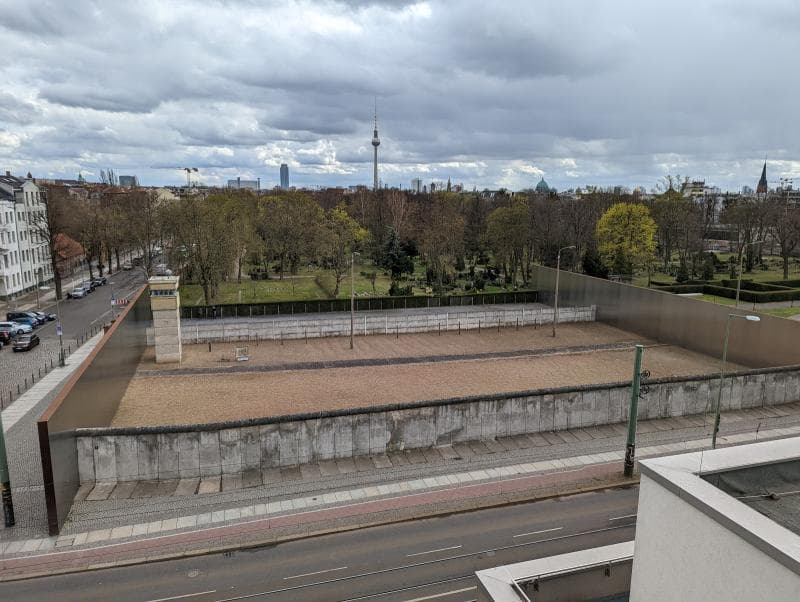
Explore the Documentation Center at the Berlin Wall Memorial in Berlin, Germany, for an in-depth look at the Wall's history, personal stories, and a panoramic view from the observation tower.
Overview
The Documentation Center, an integral part of the Berlin Wall Memorial in Berlin, Germany, serves as a crucial educational and commemorative site. It is located directly opposite the main memorial grounds on Bernauer Straße, a street deeply entwined with the history of the Berlin Wall. This center houses a permanent exhibition titled '1961 | 1989. The Berlin Wall', offering visitors an in-depth understanding of Germany's division and the Wall's construction, existence, and eventual fall. Beyond its comprehensive exhibits, the Documentation Center features a distinctive five-story observation tower, providing a poignant panoramic view over a preserved section of the former border fortifications, including the infamous 'death strip'. Admission to the Documentation Center, like the entire Berlin Wall Memorial, is free, making it an accessible historical resource for all curious travelers.
History & Cultural Background
The Berlin Wall Memorial itself was inaugurated on August 13, 1998, with significant expansions completed by 2014, establishing it as the central site of remembrance for Berlin's division. The Documentation Center specifically opened its doors on November 9, 1999, coinciding with the 10th anniversary of the fall of the Wall. Originally, the building that now houses the Documentation Center was constructed in 1965 as the parish hall of the Protestant Reconciliation Parish, after their church was cut off by the Wall. This history adds a layer of emotional depth, as parish members could look from the first floor towards their inaccessible church in the border strip, fostering a hope for reunification. The center's permanent exhibition meticulously details the political and historical circumstances that led to the Wall's construction in 1961, its enduring presence for 28 years, and the dramatic events that culminated in its collapse. The memorial's location on Bernauer Straße is highly significant due to the numerous dramatic events and escape attempts that occurred there during the Wall's existence.
What Makes It Special
The Documentation Center distinguishes itself through its comprehensive approach to presenting the complex history of the Berlin Wall. Unlike merely displaying artifacts, its permanent exhibition delves into the 'why' and 'how' of the Wall, using a rich array of multimedia displays, historical maps, original documents, and compelling interviews. This multi-faceted presentation ensures a thorough and engaging educational experience. The observation tower is perhaps its most impactful feature, offering a unique, unfiltered view of the original border fortifications, including watchtowers and the barren 'death strip'. This visual connection to the past is incredibly powerful, allowing visitors to grasp the brutal reality of the division in a way that mere descriptions cannot. The center aims to be a place of reflection rather than dramatic effects, providing factual information and fostering historical and civic education.
Stories, Fun Facts & Local Details
Bernauer Straße, where the Documentation Center stands, is steeped in harrowing and heroic tales. In the early days of the Wall's construction, residents in buildings along the street found themselves directly on the border, with their front doors in East Berlin and their windows opening into West Berlin. Many desperate individuals jumped from these windows into safety nets provided by West Berlin firefighters, some tragically losing their lives in the attempt. Eventually, these buildings were evacuated and demolished to create a clear 'death strip'. The nearby Chapel of Reconciliation, built on the former border strip, stands as a symbol of hope and remembrance, on the site where a previous church was destroyed by the GDR regime. The Documentation Center's origin as a parish hall underscores the resilience of the community impacted by the Wall, highlighting how everyday spaces became entwined with monumental historical events. The exhibits also touch upon the approximately 200 GDR citizens who lost their lives attempting to flee across the 'death strip'.
Visitor Perspective
For any traveler seeking a deeper understanding of the Berlin Wall, the Documentation Center is an essential stop. It complements the outdoor memorial grounds by providing the crucial context and narrative behind the physical remnants of the Wall. Visitors are encouraged to start their exploration at the Visitor Center nearby for an overview, then proceed to the Documentation Center to delve into the detailed history. The center is largely barrier-free, with elevators available, making it accessible for people with disabilities and families with small children. Mobile seats can be borrowed for use in the permanent exhibition, ensuring a comfortable experience for all. A typical visit, combining both the outdoor memorial and the Documentation Center, is recommended to last between two to three hours to fully appreciate the exhibitions and reflect on the powerful history presented. The silence and contemplative atmosphere within the center are respected, allowing for profound personal engagement with this significant period of German history.
Coordinates: 13.38972, 52.535
View on Google Maps💬 How Travelers Describe This Place
Based on community votes
Interesting
852Must See
326Beautiful
270Unique
146Photogenic
80
Traveler Stories
Discover memorable experiences shared by travelers who have visited this place.
No traveler stories yet.
Be the first traveler to share what made this place memorable.

Tour
By
Spot
Discover amazing places around the world. Your journey starts here.
Explore
© 2026 TourBySpot. All rights reserved.