Decorative Ceilings
Bucharest, Romania
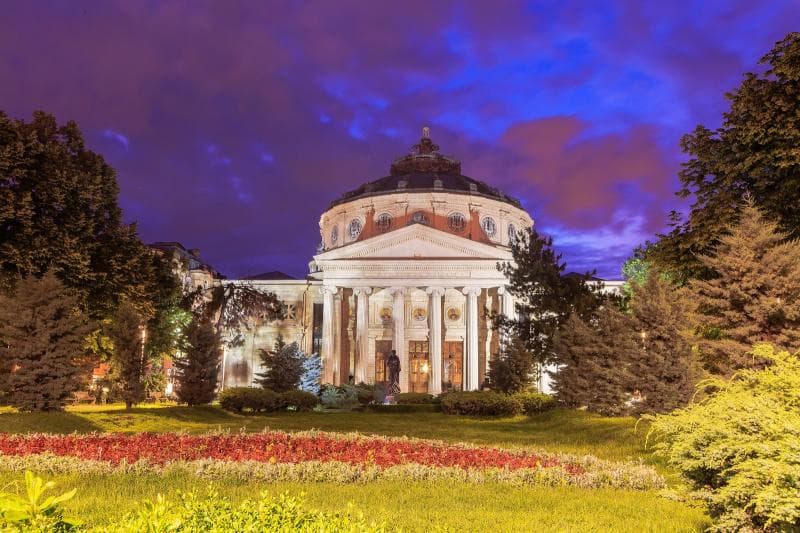
Explore the stunning decorative ceilings and the monumental Grand Fresco at the Romanian Athenaeum in Bucharest, Romania. Delve into Romanian history and art.
Overview
Stepping into the Romanian Athenaeum in Bucharest, Romania, is an immersion into a world where art and history converge, particularly above your head. While the entire neoclassical edifice is a masterpiece, the decorative ceilings, especially the monumental Grand Fresco, captivate visitors with their intricate beauty and profound cultural narratives. This architectural jewel, home to the George Enescu Philharmonic Orchestra, is more than just a concert hall; it's a visual chronicle of a nation's journey, etched and painted across its magnificent overhead spaces.
The Athenaeum's ceilings are a testament to Romania's enduring artistic spirit and its deep connection to its past, offering a silent yet powerful storytelling experience to anyone who looks up.
History & Cultural Background
The Romanian Athenaeum, inaugurated in 1888, was born from a remarkable public fundraising campaign under the motto 'Donate one leu for the Athenaeum,' showcasing the collective desire of the Romanian people to build a temple of arts and sciences. The building itself was designed by French architect Albert Galleron, who adapted the structure from pre-existing circular foundations intended for an equestrian center. From its inception, the idea of adorning the interior with a grand historical narrative was present. For many years, an inscription reserved the space for a future fresco, envisioning 'an enchantment of scenes from national history.' However, financial constraints and the challenge of finding the right artist delayed this ambitious project for decades.
It wasn't until 1933 that painter Costin Petrescu began work on the celebrated Grand Fresco, a project that would take years to complete and would ultimately fulfill the Athenaeum's original vision.
What Makes It Special
The crowning glory of the Romanian Athenaeum's interior is undoubtedly the Grand Fresco, a continuous panoramic painting that encircles the concert hall just below the dome. This impressive artwork, measuring approximately 70 to 75 meters long and 3 meters wide, depicts 25 pivotal moments in Romanian history. Executed in the challenging al fresco technique, where pigments are applied to fresh plaster, the mural presents a chronological visual narrative spanning nearly two millennia. From the ancient Dacians and the Roman conquest to medieval battles, the unification of Romanian principalities, and the realization of Greater Romania in 1918, the fresco serves as a compelling visual textbook.
Beyond the fresco, other decorative elements contribute to the Athenaeum's allure. The ceiling in the ground floor lobby features elegant gold leaf embellishments and painted details, creating a luxurious welcome. Furthermore, the vaults are adorned with numerous motifs—anthropomorphic, zoomorphic, and phytomorphic—depicted in golden polychrome relief, drawing inspiration from Romanian folk stories. These intricate carvings and elaborate gold leaf designs found on the concert hall's ceiling add layers of artistic richness, embodying the era's neoclassical and Belle Époque influences.
Stories, Fun Facts & Local Details
The Grand Fresco holds not only artistic but also historical and political significance. During the communist regime in Romania, the fresco, with its depictions of historical figures and royal family members, was considered ideologically problematic. Consequently, it was covered with red velvet for almost two decades, effectively censoring this national narrative. This act underscores the fresco's powerful role as a symbol of Romanian national identity, a narrative that the communist authorities sought to suppress.
Another fascinating aspect of the Athenaeum's design, though not strictly about the decorative ceilings, is the remarkable acoustics of the main hall, sometimes referred to as a 'Whispering Gallery.' Due to its circular architecture, a whisper on one side of the room can often be heard clearly on the opposite end, adding an intriguing layer to the visitor's experience.
Visitor Perspective
For the curious traveler, encountering the decorative ceilings of the Romanian Athenaeum is an awe-inspiring experience. Upon entering, the sheer scale and detail of the Grand Fresco draw the eye upward, inviting a contemplative journey through Romania's past. The golden hues, vibrant colors, and dynamic compositions transport you to different historical epochs, making the stories of heroes and nation-building tangible.
Whether attending a world-class concert or simply visiting during non-performance hours, the Athenaeum's ceilings provide a profound connection to Romania's artistic heritage. Visitors often describe feeling small in the best way, overwhelmed by the grandeur and the rich history unfolding above them. It is a place that truly rewards looking up, offering a unique blend of visual splendor and historical education in the heart of Bucharest.
Coordinates: 26.0973, 44.4413
View on Google Maps💬 How Travelers Describe This Place
Based on community votes
Photogenic
934Unique
879Interesting
741Must See
482Beautiful
396
Traveler Stories
Discover memorable experiences shared by travelers who have visited this place.
No traveler stories yet.
Be the first traveler to share what made this place memorable.

Tour
By
Spot
Discover amazing places around the world. Your journey starts here.
Explore
© 2026 TourBySpot. All rights reserved.