Danbi Bridge
Beijing, China
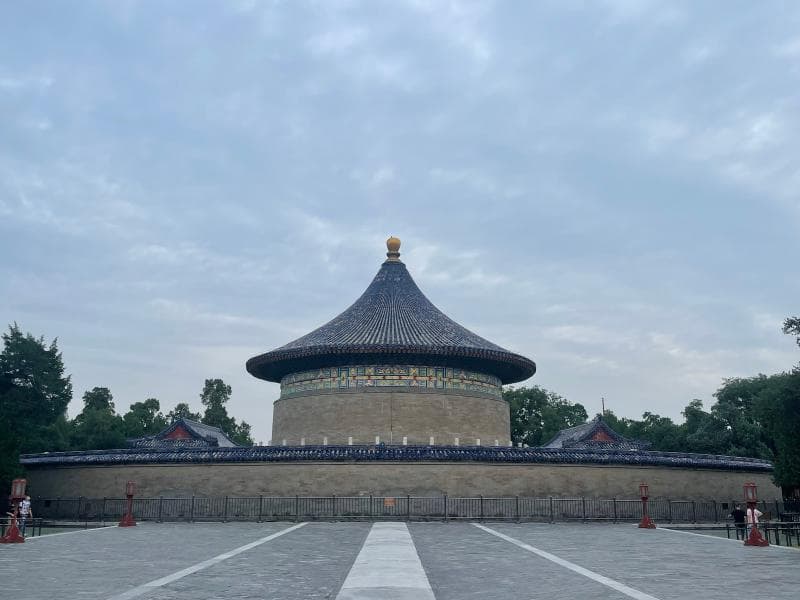
Discover Danbi Bridge in Beijing's Temple of Heaven, China – a sacred imperial pathway symbolizing the emperor's ascent to heaven.
Overview
Nestled within the sprawling and serene grounds of the Temple of Heaven in Beijing, China, lies the enigmatic Danbi Bridge. Far more than a mere pathway, this impressive structure, also known as the Vermilion Steps Bridge or Red Stairway Bridge, served as a critically sacred route for the emperors of the Ming and Qing dynasties. It spans approximately 360 to 400 meters in length and measures around 29 to 30 meters wide, connecting the Hall of Prayer for Good Harvests in the north with the Imperial Vault of Heaven and the Circular Mound Altar in the south. Its design is imbued with profound cosmological symbolism, reflecting the ancient Chinese belief in the connection between heaven and earth. For centuries, only the emperor and his most esteemed retinue were permitted to tread upon its hallowed surface during the solemn ceremonies held to pray for bountiful harvests and cosmic harmony. Today, it stands as a testament to China's rich imperial history and a pathway into understanding ancient ritual and belief.
History & Cultural Background
The Danbi Bridge was constructed as part of the Temple of Heaven complex, which itself was built between 1406 and 1420 during the reign of the Yongle Emperor of the Ming Dynasty. The Temple of Heaven was originally known as the Temple of Heaven and Earth, but its functions were separated in 1530 during the Jiajing reign, when it was renamed the Temple of Heaven. The Danbi Bridge's initial length was over 420 meters, but it was shortened in 1538 during an expansion of the Imperial Vault of Heaven. This sacred walkway was central to the annual ceremonies where emperors, acting as the 'Son of Heaven,' would offer prayers to Heaven, mediating between the celestial and earthly realms. These rituals were not just symbolic; they were believed to be crucial for ensuring good harvests and maintaining cosmic balance, with imperial legitimacy often tied to the success of these prayers. The entire Temple of Heaven complex, including the Danbi Bridge, was inscribed as a UNESCO World Heritage site in 1998, recognized for its architectural and landscape design illustrating a cosmogony significant for the evolution of one of the world's great civilizations.
What Makes It Special
What truly sets the Danbi Bridge apart is its intricate design and the symbolism woven into every aspect. The bridge features a gradual slope, rising from one meter high at its southern end to approximately three to 4.5 meters at its northern end. This deliberate ascent symbolizes the emperor's 'stepping upward toward heaven' and visually represents the long path from earth to the celestial realm. The bridge deck itself is divided into three distinct paths. The central path, slightly raised and known as the 'Deity Way,' was exclusively reserved for the Spirit of Heaven or divine gods, meaning no human was permitted to walk on it. The path on the east side was for the emperor, while the west path was used by court officials. This hierarchical separation underscored the emperor's unique position as an intermediary between heaven and humanity. Furthermore, a remarkable tunnel, known as Jin Sheng Gate or the 'Gate of Hell,' passes beneath the bridge. This innovative underpass was used to herd sacrificial animals to the Butchery Pavilion, ensuring they did not desecrate the sacred path walked by the emperor and the spirits. Some even refer to it as China's first 'cloverleaf junction' due to its sophisticated design.
Stories, Fun Facts & Local Details
The name 'Danbi Bridge,' or Red Stairway Bridge, is rooted in ancient Chinese palace protocols where steps before the emperor's palace were painted with red cinnabar, symbolizing supreme authority. A fascinating detail surrounds the emperor's reverence for the divine: tradition dictates that the emperor would walk on the eastern path, not the central one, out of humility, not wishing to 'outshine Heaven.' It's also said that in earlier times, during the Ming Dynasty, emperors would remove their shoes and walk barefoot on the bridge, sometimes on a brown carpet, to avoid carrying dust onto the sacred altar. Another intriguing anecdote involves Emperor Qianlong; at 62 years old, finding the long walk across the bridge physically taxing, the 'Gate of Sixty' was constructed in 1772 at the bridge's northwest end, allowing him direct access to the Hall of Prayer for Good Harvests and bypassing the full length of the bridge.
Visitor Perspective
Today, visitors to the Temple of Heaven can experience the Danbi Bridge firsthand, tracing the same path once traversed by emperors, albeit without the ancient restrictions. Walking from the southern end towards the Hall of Prayer for Good Harvests, one can still feel the subtle upward incline, offering a tangible connection to the symbolic journey towards heaven. The bridge provides a unique perspective on the grand scale and thoughtful design of the Temple of Heaven complex, allowing a moment to reflect on the historical significance and the profound beliefs that shaped imperial China. While the rituals are no longer performed, the bridge remains a powerful historical artifact, inviting contemporary travelers to immerse themselves in a rich cultural tapestry.
Coordinates: 116.4066, 39.8822
View on Google Maps💬 How Travelers Describe This Place
Based on community votes
Photogenic
846Must See
564Beautiful
201Unique
121Interesting
87
Traveler Stories
Discover memorable experiences shared by travelers who have visited this place.
No traveler stories yet.
Be the first traveler to share what made this place memorable.

Tour
By
Spot
Discover amazing places around the world. Your journey starts here.
Explore
© 2026 TourBySpot. All rights reserved.