Curia Julia
Rome, Italy
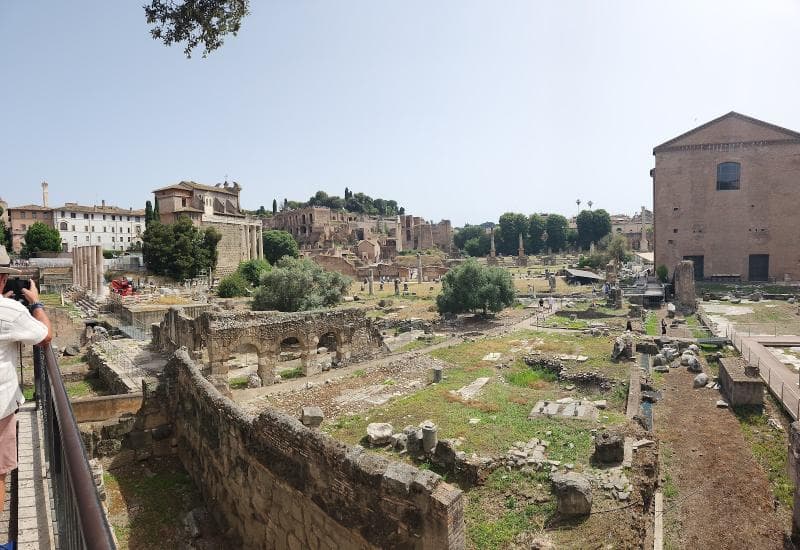
Explore the Curia Julia in Rome, Italy, the remarkably preserved ancient Roman Senate House within the Roman Forum. Discover its rich history.
Overview
Nestled within the monumental expanse of the Roman Forum in Rome, Italy, stands the Curia Julia, a structure that once served as the official meeting place for the Roman Senate. Its enduring presence, remarkable for an ancient building, offers a tangible link to the political heart of one of history's most influential empires. Commissioned by Julius Caesar and completed by Augustus, this building has witnessed millennia of transformation, from the seat of senatorial debate to a Christian church, before its modern restoration.
History & Cultural Background
The story of the Curia Julia begins in 44 BCE when Julius Caesar initiated its construction. His vision was to replace earlier Senate houses, such as the Curia Hostilia and the Curia Cornelia, and to redefine the political landscape of the Roman Forum itself. However, Caesar's assassination meant he never saw his ambitious project completed. It was his adopted heir, Augustus Caesar, who finished the work in 29 BCE, dedicating the new Senate House to Victory.
The Curia Julia's existence was not without peril. In 283 CE, a devastating fire under Emperor Carinus heavily damaged the structure. Emperor Diocletian undertook a significant rebuilding effort between 284 and 305 CE, and it is largely his version of the building that stands today. A pivotal moment in its preservation came in the 7th century CE when Pope Honorius I converted the Curia into the Basilica of Sant'Adriano al Foro. This transformation, a common practice in early Christian Rome, inadvertently protected the ancient edifice from the fate of many other pagan structures, which were often stripped for materials or left to ruin.
In the 1930s, under Benito Mussolini, the Curia Julia underwent extensive restoration to strip away its Baroque church additions and return it to its presumed ancient Roman appearance, specifically to its Diocletianic form. This effort, while driven by a desire to link Fascist Italy with the grandeur of its imperial past, ultimately preserved much of the building's original Roman character.
What Makes It Special
What truly sets the Curia Julia apart is its extraordinary state of preservation. Unlike many ruins in the Roman Forum, much of this brick-faced concrete structure remains intact, thanks to its repurposing as a church. Stepping inside, visitors are greeted by the impressive *opus sectile* floor, a beautifully intricate pattern of colored marble and stone that dates back to Diocletian's restoration. Fragments of the original marble wall veneers also hint at the building's former grandeur.
The original bronze doors of the Curia Julia, monumental and significant in their own right, were moved in the 17th century to adorn the Basilica of San Giovanni in Laterano, where they can still be seen. The doors seen today at the Curia are meticulous replicas, maintaining the historical integrity of the building's façade. The building's interior, a single large hall with a high ceiling, was designed with a precise orientation, a departure from earlier Senate houses, reflecting the shifting political power dynamics from the Republic to the Empire.
Stories, Fun Facts & Local Details
Imagine the spirited debates and critical decisions that unfolded within these very walls. During the Republican era, becoming a Senator was the pinnacle of a Roman's career, an honor reserved for prominent figures over 32 who had already held important offices. While the Senate's power waned significantly during the Imperial period, becoming largely a body that ratified the Emperor's decisions, it remained a symbol of Roman tradition and governance for centuries.
A fascinating detail within the Curia's history is the Altar of Victory. Augustus placed a statue of Victoria, the personification of victory, inside to commemorate his triumph at the Battle of Actium. This altar was a constant reminder of Rome's military might, but it was controversially removed in 384 AD as Christianity rose to prominence and pagan traditions were suppressed. The building itself adhered to architectural principles laid out by Vitruvius, whose writings suggested specific dimensions for meeting houses to ensure optimal acoustics.
Visitor Perspective
The Curia Julia is an unmissable highlight for any traveler exploring the Roman Forum. Its distinctive red-brick exterior stands out amidst the more ruinous surroundings, making it easy to spot, especially near the Arch of Septimius Severus. Entry to the Curia Julia is typically included with a combined ticket for the Roman Forum, Palatine Hill, and the Colosseum, offering a comprehensive journey through ancient Roman history.
Inside, visitors can walk on the ancient floors and observe the preserved architectural elements, gaining a profound sense of the space where Roman senators once gathered. While the Curia follows the general opening hours of the Roman Forum, it's always a good idea to check for any specific opening restrictions, as ongoing conservation work or special exhibitions might occasionally affect access. For example, some periods have seen limited visiting hours due to restoration efforts on internal elements like the Trajan's Plutei. It truly provides a window into the administrative heart of ancient Rome, inviting contemplation on the echoes of power and influence that shaped the Western world.
Coordinates: 12.4854, 41.8929
View on Google Maps💬 How Travelers Describe This Place
Based on community votes
Must See
950Beautiful
287Photogenic
255Unique
231Interesting
86
Traveler Stories
Discover memorable experiences shared by travelers who have visited this place.
No traveler stories yet.
Be the first traveler to share what made this place memorable.

Tour
By
Spot
Discover amazing places around the world. Your journey starts here.
Explore
© 2026 TourBySpot. All rights reserved.