Crypt
Marseille, France
Explore the Crypt of Basilique Notre-Dame de la Garde in Marseille, France, a Romanesque, rock-hewn lower church offering solemn history.
Overview
Deep within the revered Basilique Notre-Dame de la Garde, perched majestically atop a hill overlooking Marseille, France, lies a hidden gem: the Crypt. Often overshadowed by the dazzling mosaics and gilded splendor of the upper basilica, the Crypt offers a stark, yet equally profound, experience. Carved directly from the natural rock of the hill, this lower church was conceived in a robust Romanesque style, providing a fascinating architectural counterpoint to the Neo-Byzantine grandeur above. It's a space of solemnity and quiet contemplation, where visitors can connect with the ancient spiritual roots of this iconic landmark.
History & Cultural Background
The history of Notre-Dame de la Garde stretches back to the 13th century, with a small chapel first established on this strategic hilltop in 1214. Over centuries, the site evolved, becoming both a place of worship and a military stronghold. The current basilica, designed by architect Henri-Jacques Espérandieu, began construction in 1853, replacing earlier structures. Uniquely, the Crypt was the first part of the new basilica to be completed, hewn from the very rock of the ancient fort. It was consecrated, alongside the still-unfinished upper church, in 1864. In 1884, a fire unfortunately damaged an altar and mosaic within the Crypt, but these were swiftly restored, and the Crypt was reconsecrated in 1886, reaffirming its enduring spiritual significance.
What Makes It Special
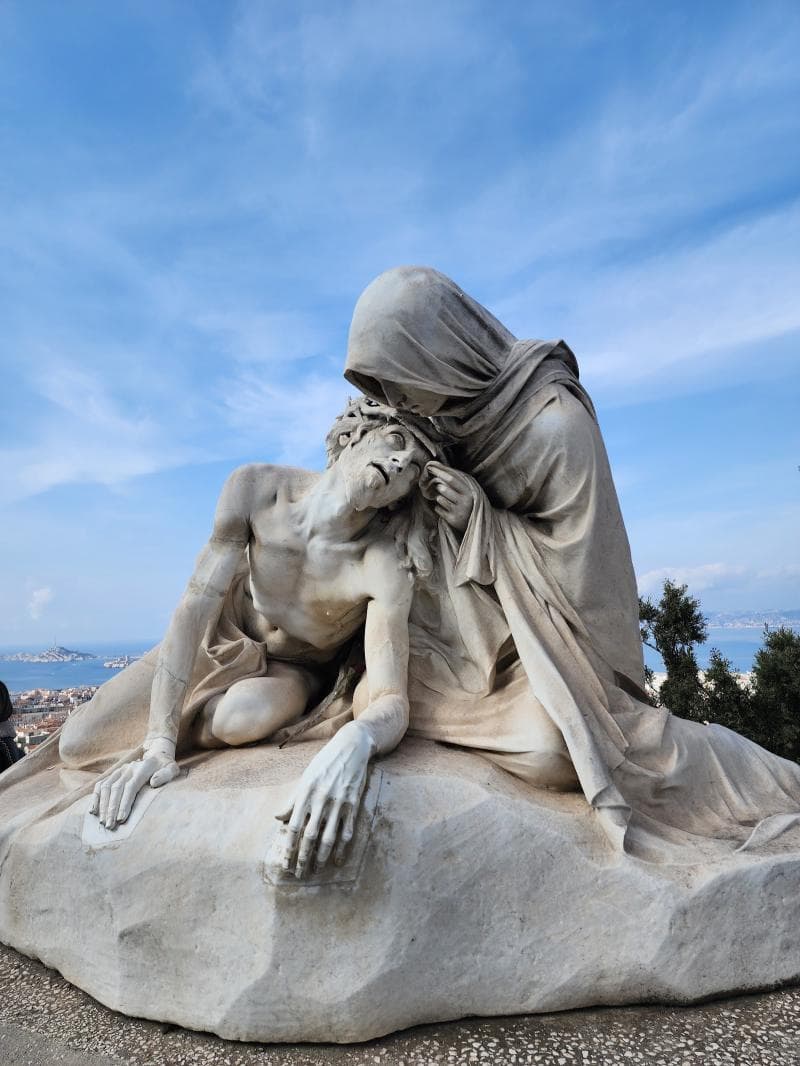
The Crypt's distinctiveness lies primarily in its architectural style and atmosphere. While the upper church bursts with vibrant Neo-Byzantine mosaics and rich ornamentation, the Crypt embraces a simpler, more austere Romanesque aesthetic. This deliberate contrast provides a unique journey through different periods and expressions of sacred art within a single edifice. Its construction directly into the rock gives it an ancient, earthy feel, making the stone walls themselves a testament to the site's long history. Inside, visitors can discover a nave with low barrel vaults and six side chapels, each dedicated to a particular saint. Among its treasured artifacts are a striking multi-coloured crucifix dating from the 16th-century church that once stood here and a 'Mater Dolorosa' marble sculpture by Carpeaux. Furthermore, the Crypt serves as a repository for older ex-votos, votive offerings from grateful individuals, spilling over from the extensive collection found in the upper basilica.
Stories, Fun Facts & Local Details
The Crypt of Notre-Dame de la Garde whispers stories of centuries past. It is a space where the devotion of countless pilgrims and seafarers has left an indelible mark. The plaques acknowledging donors within its chapels speak of a community deeply invested in its sacred spaces. While the main basilica is often bustling, the Crypt frequently remains a more tranquil, less crowded space, even during peak season. This offers a rare opportunity for quiet reflection amidst the grandeur of Marseille's most famous landmark. The simple, robust Romanesque design, devoid of the lavish gold and intricate patterns found upstairs, creates an atmosphere of profound introspection. The natural coolness of the rock-hewn chamber and the remarkable acoustics, where footsteps create a low, resonant echo, transport visitors to another time, fostering a deep connection to the enduring spiritual heritage of Marseille. The presence of eternally burning candles, casting a warm glow on the stone and sparse mosaic details, underscores its role as a place of continuous prayer and remembrance, especially for the protection of fishermen and sailors, a tradition deeply embedded in Marseille's identity.
Visitor Perspective
For the curious traveler, a visit to the Crypt offers a deeply contrasting and complementary experience to the main basilica. Stepping down into this lower level, one immediately notices the change in ambiance—a drop in temperature and a shift to a more subdued light. The Romanesque architecture, with its sturdy forms and lack of ostentatious decoration, encourages a different kind of appreciation, focusing on structure, history, and a raw sense of reverence. It is a space that allows for a moment of quiet solitude, away from the often-lively upper church. Visitors can ponder the transition from a fortified watchtower to a sacred sanctuary, feeling the weight of history in the ancient stones. Experiencing both the bright, ornate upper church and the solemn, rock-hewn Crypt provides a fuller understanding of Basilique Notre-Dame de la Garde's spiritual depth and architectural evolution, making the journey to Marseille's 'Good Mother' truly unforgettable. The Crypt is generally accessible during the basilica's operating hours, welcoming those who seek a moment of peace and historical insight.
Coordinates: 5.371, 43.2841
View on Google Maps💬 How Travelers Describe This Place
Based on community votes
Must See
836Beautiful
797Photogenic
695Interesting
396Unique
286
Traveler Stories
Discover memorable experiences shared by travelers who have visited this place.
No traveler stories yet.
Be the first traveler to share what made this place memorable.

Tour
By
Spot
Discover amazing places around the world. Your journey starts here.
Explore
© 2026 TourBySpot. All rights reserved.