Courtyards
Barcelona, Spain
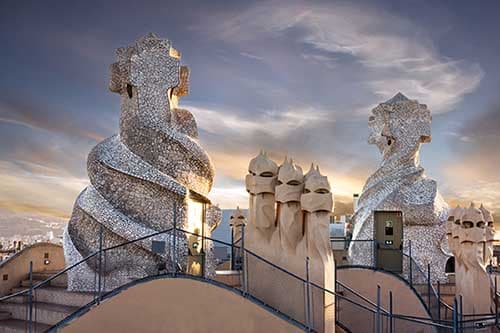
Discover the innovative Courtyards of Casa Milà (La Pedrera) in Barcelona, Spain, designed by Gaudí for light, ventilation, and beauty.
Overview
Stepping into the Courtyards of Casa Milà, often affectionately known as La Pedrera, is to enter a world where architectural genius meets natural inspiration in the heart of Barcelona, Spain. These two magnificent internal spaces are far more than mere lightwells; they are integral to Antoni Gaudí's revolutionary design, serving as vibrant, open-air arteries that breathe life into the entire building. Conceived to maximize natural light and ventilation, these courtyards stand as a testament to Gaudí's forward-thinking approach to urban living at the turn of the 20th century. Their organic forms and colorful details create a captivating visual experience, seamlessly blending functionality with profound aesthetic beauty, surprising visitors at every turn.
Casa Milà, a UNESCO World Heritage site, is famous for its undulating stone façade and unique architectural solutions. The courtyards, nestled within its iconic structure, reveal Gaudí's commitment to creating habitable and healthy living environments. The building's innovative design, which uses columns instead of load-bearing walls, allowed Gaudí the freedom to sculpt these expansive inner spaces. This departure from conventional architecture resulted in a layout that is both practical and profoundly artistic, reflecting Gaudí's deep affinity for nature and his desire to bring the outside in.
History & Cultural Background
Commissioned by Pere Milà and Roser Segimon in 1906 and completed in 1912, Casa Milà was Antoni Gaudí's last residential project before he dedicated himself entirely to the Sagrada Família. The era in which it was built saw growing concerns about urban hygiene and the need for improved living conditions in burgeoning metropolises. Gaudí responded to these needs by designing a building that prioritized natural light and direct ventilation, an innovative concept that challenged traditional architectural norms. While small interior courtyards for kitchens and bathrooms were common, Gaudí expanded this idea dramatically, creating large, central voids.
The cultural context of Catalan Modernisme, Spain's version of Art Nouveau, heavily influenced Gaudí. This movement embraced organic forms, craftsmanship, and a synthesis of various arts. The courtyards are a prime example of this philosophy, evolving beyond mere utilitarian shafts into richly decorated areas. The interior walls feature elaborate mural paintings by symbolist artist Aleix Clapés, depicting mytho-botanical motifs and scenes inspired by classical mythology, such as the love of Vertumnus and Pomona. These artistic additions elevated the courtyards to interior facades, as important and visually engaging as the building's exterior.
What Makes It Special
The courtyards of Casa Milà are exceptional for several reasons, primarily their innovative functionality and stunning aesthetics. Gaudí’s structural system, using a self-supporting stone facade and internal columns, meant that internal walls were not load-bearing, allowing for highly flexible floor plans and the creation of these vast interior spaces. This engineering feat enabled him to 'puncture' the building, ensuring that all 20 apartments across the nine stories received ample natural light and cross-ventilation, a radical improvement for urban residences of the time.
Aesthetically, the courtyards are a marvel of color and form. The larger elliptical courtyard, accessed from Carrer de Provença, showcases a remarkable 'floating' bridge staircase, supported by an iron structure, connecting the Milà family's mezzanine and main floor. The circular courtyard, entered from Passeig de Gràcia, complements this design. Both spaces are adorned with vibrant oil paintings and intricate window grilles, turning utility into art. The varying sizes of windows on different floors—larger at lower levels to capture more light—further demonstrate Gaudí's meticulous attention to detail and his understanding of natural light dynamics.
Stories, Fun Facts & Local Details
Known informally as the 'Flower Courtyard' (Passeig de Gràcia side) and the 'Butterfly Courtyard' (Carrer de Provença side), these names hint at the organic inspiration Gaudí drew from. The 'Butterfly Courtyard' even features a subtle, butterfly-like form on a lintel, embodying Gaudí's biomimetic design philosophy. The overall layout of the building around these two courtyards creates an asymmetrical 'figure-eight' shape when viewed from above, a playful and functional deviation from rigid geometric norms.
One fascinating detail is how Gaudí viewed the courtyards with the same importance as the street-facing façade, integrating similar ornamental elements and large windows. This holistic approach ensured that the interior of Casa Milà was as captivating and thoughtfully designed as its famous exterior. The ramps connecting the courtyards to the basement garage were revolutionary, anticipating the widespread use of motor vehicles and demonstrating Gaudí's foresight in urban planning. Gazing upwards from the base of the courtyards provides a unique perspective, revealing the sculptural qualities of the architecture and how every detail contributes to a cohesive, naturalistic whole.
Visitor Perspective
For visitors to Casa Milà, the courtyards offer a moment of serene beauty and architectural awe amidst the bustling city. Entering these open-air spaces provides a dramatic shift from the wavy stone exterior, revealing the inner workings of Gaudí’s genius. The ability to look up through the building's core, observing the interplay of light and shadow on the painted walls and organic shapes, is a highlight of the experience. It truly illustrates how Gaudí conceived architecture as a complete environment, not just an external shell.
The courtyards are fully integrated into the visitor's path, allowing for an immersive experience of Gaudí's innovative use of space, light, and natural forms. They serve as a transition point and a central hub, from which one can appreciate the intricate details of the interior facades, the clever placement of windows, and the sheer scale of the building's internal volume. Observing the artistic details and understanding their dual purpose—both aesthetic and functional—deepens one's appreciation for Casa Milà as a masterpiece of Modernisme. The courtyards are part of an accessible route, ensuring that many can enjoy this unique aspect of Gaudí's final civil work.
Coordinates: 2.157, 41.3905
View on Google Maps💬 How Travelers Describe This Place
Based on community votes
Beautiful
931Photogenic
670Interesting
655Must See
491Unique
266
Traveler Stories
Discover memorable experiences shared by travelers who have visited this place.
No traveler stories yet.
Be the first traveler to share what made this place memorable.

Tour
By
Spot
Discover amazing places around the world. Your journey starts here.
Explore
© 2026 TourBySpot. All rights reserved.