Courtyard Of Michelozzo
Florence, Italy
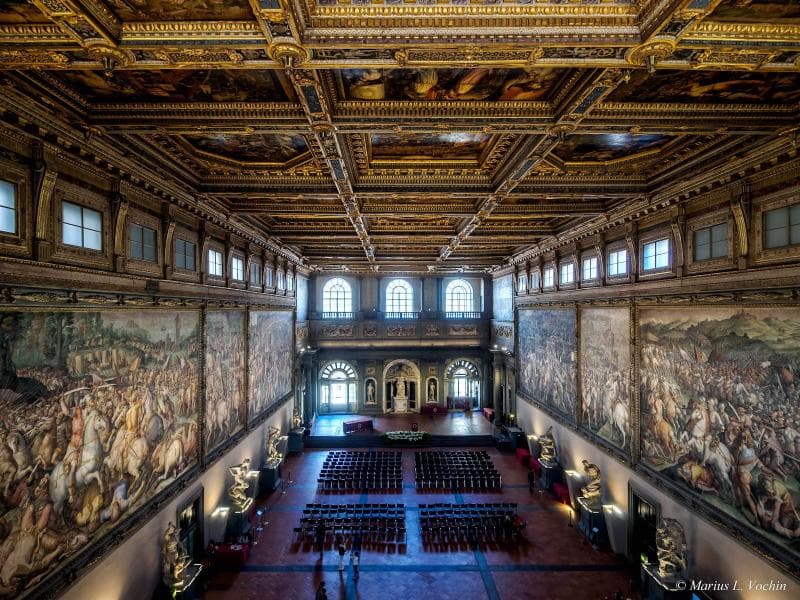
Discover the stunning Courtyard of Michelozzo in Palazzo Vecchio, Florence, Italy. Explore its rich history, intricate frescoes, and unique artistic details.
Overview
Stepping into the Courtyard of Michelozzo, nestled within the imposing walls of Palazzo Vecchio in Florence, Italy, is like entering a vibrant tapestry woven with centuries of art and history. This magnificent space, also known as the First Courtyard, serves as the grand welcoming hall for visitors to Florence's historic town hall. Its beauty is immediately striking, a harmonious blend of Renaissance elegance and rich decorative artistry that foreshadows the treasures held within the larger palace.
Designed by the renowned architect Michelozzo di Bartolomeo in 1453, the courtyard was later transformed into a spectacular display of Mannerist art under the direction of Giorgio Vasari. Every arch, column, and fresco tells a part of Florence's story, inviting curious travelers to pause and absorb the atmosphere of a bygone era. It's a place where the past feels incredibly present, an open-air museum hinting at the power and patronage of the Medici family.
History & Cultural Background
The genesis of the Courtyard of Michelozzo dates back to the mid-15th century, conceived by Michelozzo as part of the then-reigning Florentine republic's civic heart, Palazzo Vecchio. However, its most significant transformation occurred over a century later in 1565. This was a pivotal moment in Florentine history, marking the lavish wedding of Francesco I de' Medici, son of Cosimo I, and Johanna of Austria, the sister of Emperor Maximilian II.
Cosimo I de' Medici commissioned Giorgio Vasari, a leading artist and architect of the era, to redecorate the courtyard to appropriately celebrate this grand dynastic union. Vasari, along with his workshop, meticulously adorned the space, reflecting the political and cultural ambitions of the Medici. This redecoration imbued the courtyard with a festive and celebratory air, creating an elaborate 'foyer' for the palace that showcased Medici wealth and influence.
What Makes It Special
What truly sets the Courtyard of Michelozzo apart is its breathtakingly intricate decoration, a testament to High Renaissance and Mannerist artistry. The courtyard's white and gold stucco work immediately captures the eye, adorning the elegant arches and cylindrical and octagonal columns.
Look upwards, and you'll discover a stunning series of frescoes in the lunettes (semi-circular spaces) above the portico. These depict the coats of arms of the churches of Florence and the symbols of the city's powerful guilds of arts and crafts, proudly proclaiming Florentine heritage. Perhaps most uniquely, in honor of the bride Johanna of Austria, Vasari's team also painted detailed views of Austrian cities, such as Prague, Vienna, and Innsbruck. These unexpected northern European cityscapes offer a fascinating cultural juxtaposition within a quintessential Italian Renaissance setting.
At the very heart of the courtyard stands a magnificent porphyry fountain. This fountain is crowned by a captivating sculpture: a copy of Andrea del Verrocchio's 'Angel with Dolphin' (also known as 'Putto with Dolphin'). The original bronze masterpiece, crafted around 1470, now resides on the second floor of Palazzo Vecchio, protecting it from the elements.
Stories, Fun Facts & Local Details
The 'Angel with Dolphin' sculpture by Verrocchio has a delightful story. Legend suggests that the young Leonardo da Vinci, a pupil in Verrocchio's workshop, may have even contributed to its creation. The fountain itself replaced an earlier well and was part of Vasari's grand 1565 redesign.
Another fascinating detail is the Latin inscription on the east wall, which was placed to welcome Johanna of Austria to Florence, emphasizing the significance of her marriage to Francesco I de' Medici. The meticulous details, from the plant motifs and cherubs on the columns to the grotesque motifs on the cross vaults, showcase the incredible skill of artists like Pier Paolo Mincio of Forlì and Marco da Faenza, transforming a functional space into a visual marvel.
Visitor Perspective
For many visitors, the Courtyard of Michelozzo provides the initial, indelible impression of Palazzo Vecchio. It's often free to enter, offering a glimpse into the palace's grandeur even for those not exploring the full museum. The visual richness of the frescoes, stuccoes, and the central fountain creates an immersive experience, transportive to a time of artistic flourishing and powerful dynasties. It serves as a perfect introduction to the history, art, and ambition that define Florence's Renaissance legacy. Visitors can freely admire the exquisite artwork and decorative details, making it a must-see stop on any Florentine itinerary.
Coordinates: 11.2562, 43.7693
View on Google Maps💬 How Travelers Describe This Place
Based on community votes
Photogenic
958Unique
743Interesting
719Must See
629Beautiful
176
Traveler Stories
Discover memorable experiences shared by travelers who have visited this place.
No traveler stories yet.
Be the first traveler to share what made this place memorable.

Tour
By
Spot
Discover amazing places around the world. Your journey starts here.
Explore
© 2026 TourBySpot. All rights reserved.