Courtyard
Jakarta, Indonesia
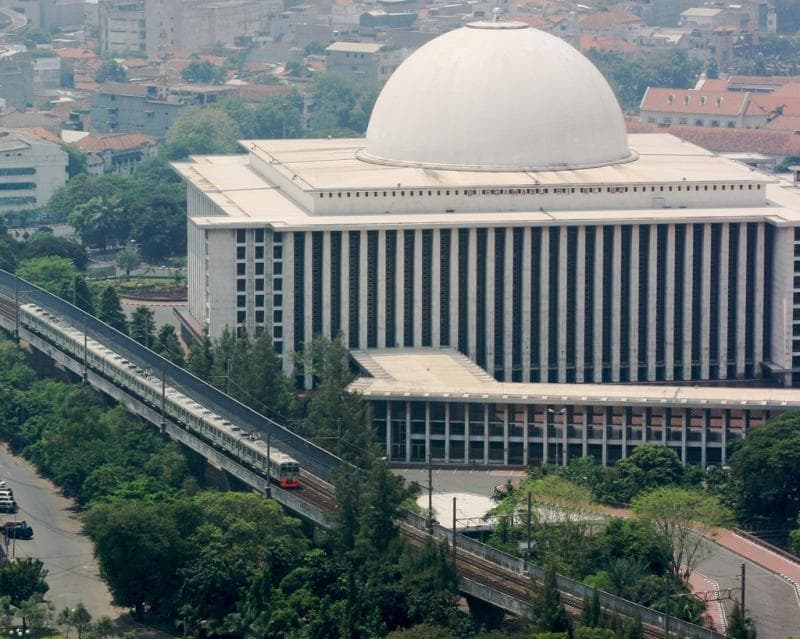
Explore the Courtyard of Istiqlal Mosque in Jakarta, Indonesia, Southeast Asia's largest mosque, a symbol of independence and religious harmony.
Overview
The Courtyard, or 'sahn', of the Istiqlal Mosque in Jakarta, Indonesia, serves as a grand and serene open-air space within Southeast Asia's largest mosque. This expansive area is integral to the mosque's design, connecting the main prayer hall through a series of arcades. It is meticulously designed to offer a peaceful retreat from the bustling city, providing worshippers and visitors alike with a sense of calm and spiritual reflection. With its terracotta tiled floor and towering pillars, the courtyard is not just an architectural feature but a functional space for prayer, gathering, and quiet contemplation.
Situated strategically in Central Jakarta, the Istiqlal Mosque, whose name fittingly means 'Independence' in Arabic, stands as a profound symbol of Indonesia's sovereignty. The mosque, including its vast courtyard, reflects the nation's rich Islamic heritage and its commitment to religious harmony, prominently located near the Jakarta Cathedral.
History & Cultural Background
The vision for a national mosque emerged after Indonesia gained independence, intended to be a monument of gratitude for Islamic blessings and freedom. The construction of the Istiqlal Mosque began in 1961 and was completed 17 years later, inaugurated in 1978. A remarkable aspect of its history is that the mosque was designed by Frederich Silaban, a Christian architect from North Sumatra, underscoring Indonesia's spirit of religious tolerance from its very inception.
President Sukarno, Indonesia's first president, personally supervised the mosque's construction and insisted on its location near the Merdeka Palace and, significantly, near the Jakarta Cathedral and Immanuel Church. This deliberate placement was to symbolize religious harmony and tolerance, a core tenet of Pancasila, Indonesia's national philosophy. The courtyard's alignment to the National Monument further reinforces its symbolic weight, marking the Istiqlal as the National Mosque.
What Makes It Special
The Courtyard of the Istiqlal Mosque is a masterpiece of functional and symbolic design. Architect Frederich Silaban conceived this 'sahn' as an intimate patio, offering a crucial refuge from Jakarta's tropical sun and rain for worshippers. Its vastness is striking, an open-air expanse that accommodates thousands during major Islamic celebrations, such as Eid prayers and Ramadan's night prayers. Individual rectangular prayer spaces are thoughtfully laid out across the courtyard, all oriented towards Mecca, allowing for communal prayer under the open sky.
Beyond its sheer scale, the courtyard is characterized by its towering pillars and the arcades that seamlessly connect it to the main prayer hall. In its southern corner, visitors will find a serene fountain and pool, which becomes a vibrant display, projecting water during important Islamic ceremonies. The design ensures that even amidst the largest gatherings, the space maintains a sense of order and tranquility.
Stories, Fun Facts & Local Details
One of the most compelling stories woven into the fabric of the Istiqlal Mosque, and observable from its courtyard, is the profound statement of religious coexistence. The mosque stands directly opposite the Jakarta Cathedral, symbolizing the nation's 'unity in diversity' ('Bhinneka Tunggal Ika'). An underground 'Tunnel of Friendship' even connects these two monumental structures, facilitating movement and symbolizing peaceful interfaith relations.
Every element of the mosque, including features visible from or within the courtyard, is imbued with symbolic meaning. The 45-meter diameter of the main dome, for instance, commemorates Indonesia's Proclamation of Independence in 1945. The mosque's single, towering minaret, at 66.66 meters tall, symbolizes the divine oneness of God and traditionally alludes to the 6,666 verses of the Quran. The five levels of the mosque, including the courtyard and prayer hall, represent the Five Pillars of Islam.
The mosque has hosted numerous world leaders, including former US President Barack Obama and First Lady Michelle Obama in 2010, highlighting its international significance as a beacon of moderate Islam and interfaith dialogue.
Visitor Perspective
For a curious traveler, stepping into the Courtyard of Istiqlal Mosque offers an immediate contrast to Jakarta's energetic pulse; a serene atmosphere envelops you. Non-Muslim visitors are warmly welcomed and can often benefit from free guided tours, which provide invaluable insights into the mosque's history, architecture, and cultural significance. It is advisable to visit during non-prayer times for a quieter and more comprehensive exploration.
The vastness of the courtyard and its clean, minimalist design invite contemplation and offer numerous vantage points for photography, especially with its towering pillars. While access to the main prayer hall may be restricted to Muslims during certain times, non-Muslims can typically observe from designated balconies, gaining an appreciation for the grandeur and tranquility of the interior. Modest dress is required for all visitors, and appropriate coverings are often provided at the entrance if needed.
Coordinates: 106.8309, -6.1704
View on Google Maps💬 How Travelers Describe This Place
Based on community votes
Beautiful
836Unique
797Photogenic
396Interesting
286Must See
255
Traveler Stories
Discover memorable experiences shared by travelers who have visited this place.
No traveler stories yet.
Be the first traveler to share what made this place memorable.

Tour
By
Spot
Discover amazing places around the world. Your journey starts here.
Explore
© 2026 TourBySpot. All rights reserved.