Courtyard
Podgorica, Montenegro
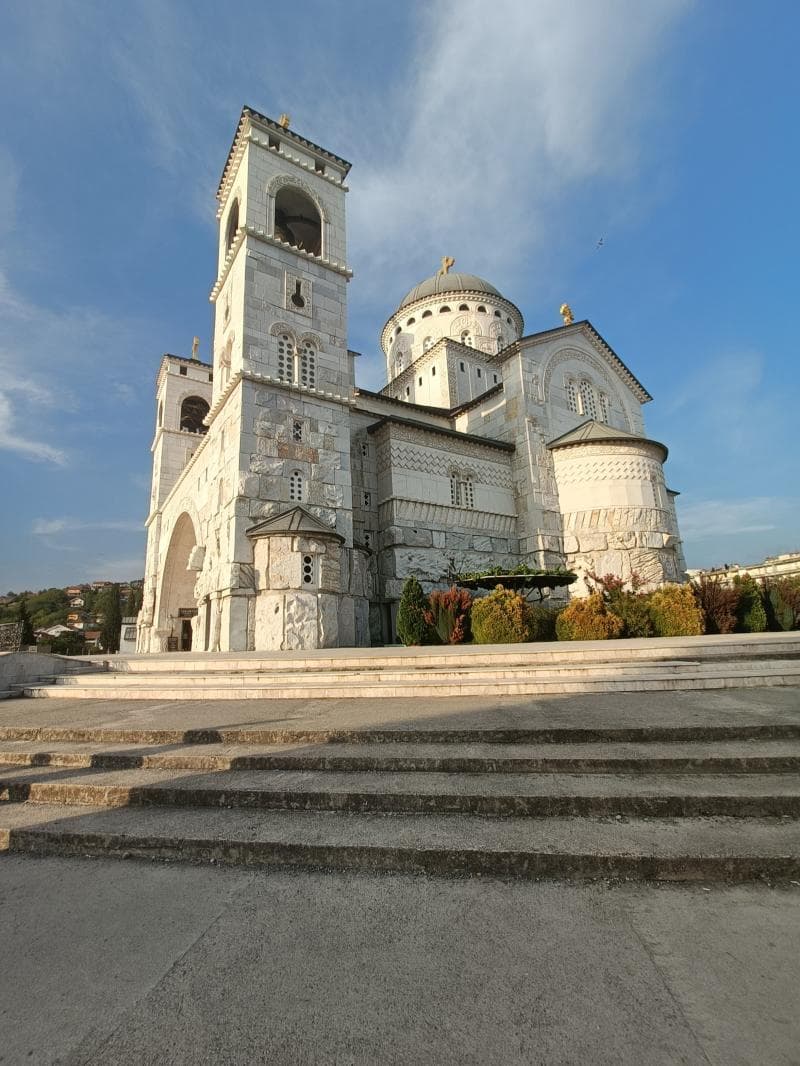
Explore the Courtyard and grand architecture of the Cathedral of the Resurrection of Christ in Podgorica, Montenegro. Discover its history and unique art.
Overview
The Cathedral of the Resurrection of Christ, nestled in the heart of Podgorica, Montenegro, stands as a relatively new yet profoundly significant landmark of Eastern Orthodoxy. Consecrated in 2013, after two decades of meticulous construction, this monumental edifice serves as the cathedral church for the Metropolitanate of Montenegro and the Littoral of the Serbian Orthodox Church. Its imposing presence, marked by two grand pyramidal towers and gleaming stonework, makes it an unmissable feature of the city's skyline. The surrounding grounds, often simply referred to as the 'Courtyard' by visitors, offer a spacious and contemplative prelude to the cathedral's interior, providing an opportunity to admire its unique exterior architecture and spiritual ambiance before stepping inside. This external space acts as an essential component of the cathedral experience, allowing guests to appreciate the building's scale and intricate detailing from various perspectives.
History & Cultural Background
The journey to create the Cathedral of the Resurrection of Christ began in 1993, conceptualized by the esteemed architect Predrag Ristić. The foundation was consecrated in 1994, with construction continuing for two decades until its grand consecration in 2013. This momentous occasion coincided with the 1700th anniversary of the Edict of Milan, a historical decree granting religious freedom, and was attended by prominent heads of Eastern Orthodox Churches globally. The cathedral's design masterfully blends traditional Orthodox elements with architectural influences drawing from Romanesque, Italianate, and Byzantine styles, reminiscent of medieval structures like the Cathedral of St. Tryphon in Kotor. This fusion creates a unique aesthetic that, while newly built, evokes a sense of ancient heritage and deep spiritual roots. The cathedral quickly became the spiritual heart of the Orthodox community in Montenegro, embodying centuries of faith and cultural identity.
What Makes It Special
What truly sets the Cathedral of the Resurrection of Christ apart is its distinctive architectural character and lavish artistry. The exterior features an unusual contrast: rough-hewn stone at its base gradually gives way to exquisitely carved details higher up, creating a visually compelling texture that defies typical Byzantine perfection, earning it a reputation as a 'charming and eccentric design'. Dominating the structure are two impressive pyramidal towers, each standing 26.7 meters high, housing a total of 17 bells. Among these is a colossal bell weighing 11 tons, reportedly the largest on the Balkan Peninsula. At the foot of these towers are smaller chapels, known as 'paraklis', dedicated to Saint Simeon Mirotočiv and Saint John Vladimir, adding further spiritual depth to the external facade. Inside, the cathedral is an overwhelming expanse of artistic splendor. Vast frescoes, many with gilded backgrounds, adorn the walls and domes, depicting biblical stories, saints, and pivotal events in Orthodox Christianity. The intricate iconography, complemented by marble floors and furnishings, creates a deeply immersive and awe-inspiring environment.
Stories, Fun Facts & Local Details
Beyond its aesthetic grandeur, the cathedral holds several intriguing stories and cultural nuances. One of the most talked-about elements is a controversial fresco located in the apse above the front door. This particular mural is said to depict figures resembling historical communist leaders, specifically Marshal Tito, Karl Marx, and Friedrich Engels, burning in hell. This bold artistic statement is seen by some as an emancipation from past oppressions and a commentary on Montenegro's complex history under communism. Another significant detail is the resting place of Metropolitan Amfilohije Radović. A prominent figure in the Serbian Orthodox Church who served as Metropolitan of Montenegro and the Littoral for thirty years, he was, by his own request, buried in the cathedral's crypt in 2020. This connection further cements the cathedral's role not only as a place of worship but also as a repository of contemporary spiritual and historical memory.
Visitor Perspective
For any traveler to Podgorica, a visit to the Cathedral of the Resurrection of Christ is an experience that transcends mere sightseeing. Walking across its expansive exterior grounds, the sheer scale and architectural detail of the building command attention, offering a peaceful space for reflection before entering. The juxtaposition of modern construction techniques with ancient stylistic influences is immediately evident. Once inside, visitors are often struck by the overwhelming richness of the interior, with its vibrant, gold-backed frescoes and intricate mosaics that cover almost every surface. The ambiance is one of profound reverence and artistic mastery, inviting a contemplative pace to truly appreciate the spiritual narrative told through its art. It is a place where one can feel the pulse of Montenegrin Orthodox faith and witness a truly unique expression of religious architecture.
Coordinates: 19.24825, 42.445694
View on Google Maps💬 How Travelers Describe This Place
Based on community votes
Unique
915Photogenic
873Beautiful
123Must See
74Interesting
53
Traveler Stories
Discover memorable experiences shared by travelers who have visited this place.
No traveler stories yet.
Be the first traveler to share what made this place memorable.

Tour
By
Spot
Discover amazing places around the world. Your journey starts here.
Explore
© 2026 TourBySpot. All rights reserved.