Courtyard
Marseille, France
Explore the historic Abbaye Saint-Victor in Marseille, France, discovering its ancient crypts, fortified architecture, and rich cultural heritage.
Overview
Stepping into the Abbaye Saint-Victor in Marseille, France, offers a profound journey through time. While many historic abbeys boast a meticulously preserved central courtyard or cloister, the Abbaye Saint-Victor, with its tumultuous past, presents a more nuanced experience. The space within the abbey walls that once served as its vibrant heart – a monastic courtyard – has undergone significant transformations over centuries. Today, visitors explore the imposing church and its profound crypts, but the essence of this central gathering place, though altered, remains a poignant element of the abbey's story, inviting contemplation on the monastic life that once thrived here.
History & Cultural Background
The origins of Abbaye Saint-Victor stretch back to the 5th century, founded by John Cassian, a Christian monk and theologian, on what was once an ancient quarry and necropolis outside the then-city walls of Marseille. This sacred ground was believed to be the resting place of Saint Victor, a 4th-century Roman soldier martyred for his faith. Early Christians sought burial here, believing Saint Victor could intercede for their salvation.
Over the centuries, the abbey faced destruction, notably by Saracens in the 8th or 9th century, before being rebuilt and expanded in the Romanesque style between the 11th and 13th centuries. It was fortified with massive walls by Pope Urban V, himself a former abbot of Saint-Victor, transforming it into a formidable fortress that became integral to Marseille's port defenses. The monastic complex, which would have included a cloister or courtyard as its functional and spiritual core, flourished, exerting immense influence across the Mediterranean.
However, the French Revolution brought radical change. The abbey's treasures were plundered, and its convent buildings, including any traditional cloister, were largely destroyed. The church itself was spared demolition by being repurposed as a warehouse, prison, and barracks. Subsequent restorations in the 19th and 20th centuries focused primarily on the church structure, leaving the interior spaces, particularly where the cloister once stood, as open ground or rebuilt areas that hint at their former arrangement.
What Makes It Special
What makes the internal spaces of Abbaye Saint-Victor truly special is their resilience and layered history. While a classic, intact medieval cloister courtyard may no longer exist, the spirit of such a space endures within the abbey's fortified embrace. The sheer age of the site, built upon a necropolis dating back to the 2nd century BC, imbues every stone with stories.
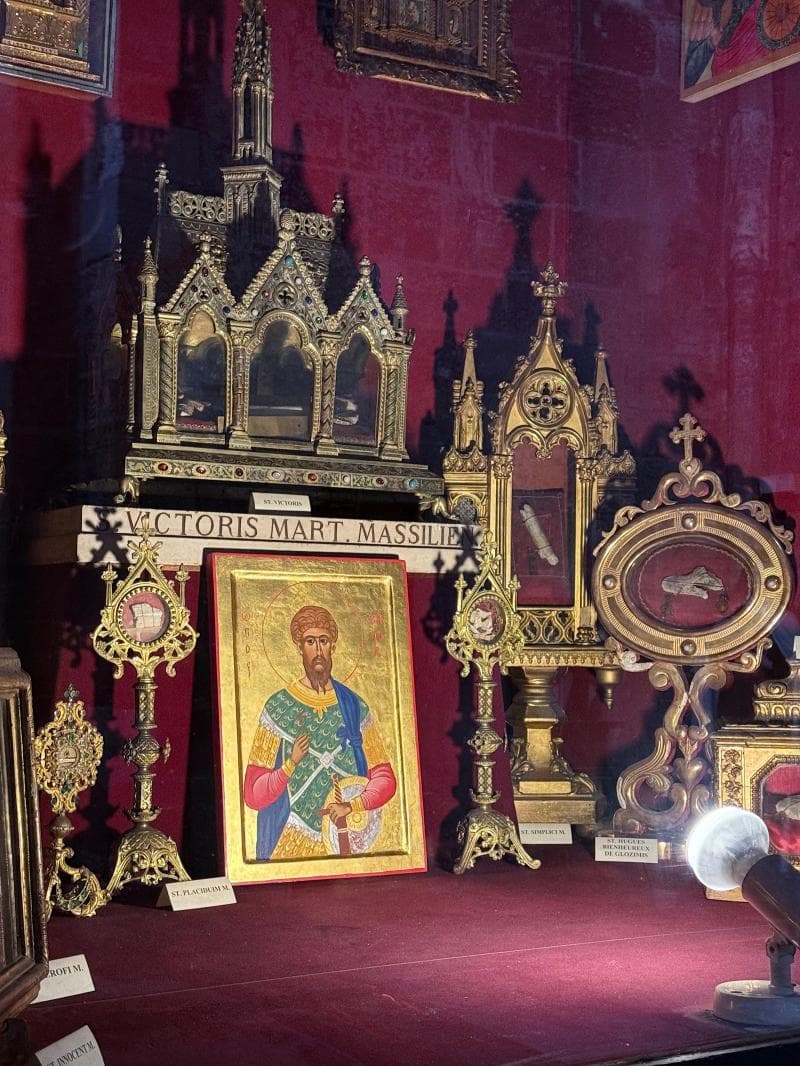
The abbey's crypts, an extraordinary network beneath the main church, offer the most tangible connection to its ancient past, housing early Christian sarcophagi and remnants of the 5th-century basilica. These subterranean chambers are a treasure trove of early Christian art, unparalleled outside the Louvre and the Museum of Ancient Arles. Standing within the central area of the abbey, one can almost visualize the monks moving through a once-enclosed courtyard, a place of quiet contemplation and daily ritual, now perhaps an open expanse reflecting the profound passage of time and historical upheaval.
Stories, Fun Facts & Local Details
The Abbaye Saint-Victor is deeply woven into the fabric of Marseille's identity, rich with fascinating traditions. Each year on Candlemas (February 2nd), a vibrant procession departs from the Old Port, making its way to the abbey. The Black Madonna, an ancient statue housed in the crypts, is draped in a green cloak, blessed by the archbishop, and presented to the crowds. This is followed by the blessing of the city and the traditional 'navettes,' boat-shaped biscuits symbolic of Marseille.
Another intriguing detail is the story of Blessed Guillaume Grimoard, who served as an abbot here before being elected Pope Urban V in 1362. His influence helped fortify the abbey, making it a powerful spiritual and physical landmark. The thought of a future Pope walking the very grounds where a courtyard once facilitated monastic life adds a layer of historical gravitas to the site. The abbey’s strategic position also offers breathtaking panoramic views of the Old Port, a constant reminder of its historical connection to the city's maritime life.
Visitor Perspective
Visiting the Abbaye Saint-Victor is an immersive experience. While the abbey's original courtyard may have been lost to the tides of history and revolution, the journey through its remaining structures is no less compelling. Walking through the imposing nave and descending into the ancient crypts transports you to a different era, offering a tangible link to Marseille's foundational spiritual heritage.
Imagine the central space of the abbey, whether it's an open square today or a reconstruction, as the footprint of that lost courtyard. It's a place where you can feel the echoes of monastic life, visualize centuries of pilgrims and abbots, and appreciate the immense historical weight of this monument. The fortified exterior and the dark, evocative crypts demand your attention, making the Abbaye Saint-Victor a must-visit for any traveler seeking to understand the deep historical and cultural roots of Marseille.
Coordinates: 5.36557, 43.29035
View on Google Maps💬 How Travelers Describe This Place
Based on community votes
Interesting
791Photogenic
514Unique
457Beautiful
252Must See
19
Traveler Stories
Discover memorable experiences shared by travelers who have visited this place.
No traveler stories yet.
Be the first traveler to share what made this place memorable.

Tour
By
Spot
Discover amazing places around the world. Your journey starts here.
Explore
© 2026 TourBySpot. All rights reserved.