Copernicus Statue
Warsaw, Poland
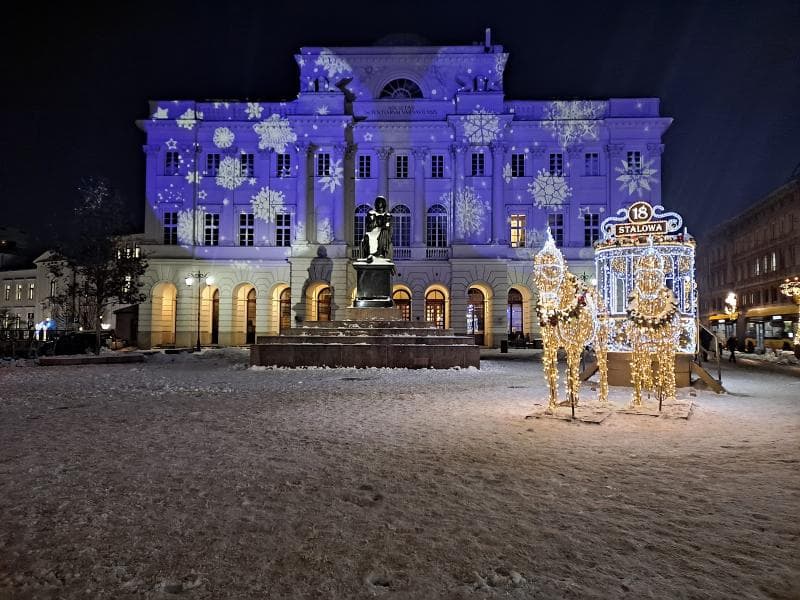
Discover the historic Nicolaus Copernicus Monument in Warsaw, Poland. Learn about its rich past, scientific significance, and cultural impact.
Overview
Nestled along the historic thoroughfare of Krakowskie Przedmieście in Warsaw, Poland, stands the revered Nicolaus Copernicus Monument. This iconic bronze statue, depicting the father of modern astronomy, is not merely a tribute to a scientific giant but also a profound symbol of Polish heritage and resilience. Situated proudly in front of the grand Staszic Palace, which houses the Polish Academy of Sciences, the monument invites visitors to pause and reflect on the immense contributions of the man who 'stopped the sun and moved the earth'.
Designed by the celebrated Danish sculptor Bertel Thorvaldsen, the monument captures Copernicus in a thoughtful, seated pose, adorned in academic robes. In his hands, he holds the instruments of his groundbreaking work: a compass and an armillary sphere. Surrounding the statue, a bronze representation of the Copernican solar system, added more recently, offers a visual complement to his heliocentric theory, further engaging the curious traveler with his revolutionary ideas. This site serves as an essential stop on any exploration of Warsaw's Royal Route, easily accessible and rich with stories waiting to be discovered.
History & Cultural Background
The story of Warsaw's Copernicus Monument began with a vision to honor one of Poland's most brilliant minds. The renowned scientist and philosopher Stanisław Staszic championed the idea, initiating public fundraising efforts to bring the statue to life. While Staszic initially envisioned the monument gracing Copernicus's birthplace of Toruń, the shifting political landscape of the early 19th century ultimately led to its placement in Warsaw.
Bertel Thorvaldsen, one of Europe's most prominent sculptors of the era, was commissioned to design the statue in 1822, with the bronze casting completed and the monument officially unveiled on May 11, 1830. The unveiling, however, was not without its controversies. Reflecting historical tensions, the Polish clergy conspicuously abstained from the ceremony, a silent protest stemming from the Church's earlier condemnation of Copernicus's heliocentric theories in 1616.
The monument's presence gained even deeper cultural significance during World War II. After the Nazi German occupation of Warsaw in 1939, German authorities removed the original Latin and Polish inscriptions from the pedestal and affixed a plaque proclaiming Copernicus as German. This act of cultural appropriation sparked an audacious act of 'minor-sabotage' by the Polish underground. In February 1942, Maciej Aleksy Dawidowski, a member of the 'Grey Ranks,' daringly removed the German plaque. This bold defiance led to retaliatory actions from the Germans, but the statue itself became a powerful symbol of Polish identity and resistance. Tragically, the monument was damaged during the Warsaw Uprising in 1944, and the Germans attempted to melt it down. Fortunately, it was recovered from a scrap yard in Nysa and triumphantly returned to Warsaw, restored, and re-unveiled in 1949, cementing its place as a monument to perseverance.
What Makes It Special
Beyond its striking artistic merit, the Copernicus Statue stands out for several compelling reasons. It represents a rare blend of scientific reverence and historical drama. The statue itself, a masterwork by Thorvaldsen, captures the contemplative genius of Copernicus, presenting him not just as a scientist but as a profound thinker who reshaped humanity's understanding of its place in the cosmos. His academic gown and the precision instruments he holds — the compass and armillary sphere — symbolize his dedication to empirical observation and intellectual pursuit.
What truly makes this site special is the layer of interactive learning added in the early 21st century. The bronze model of the solar system inlaid in the pavement directly in front of the statue allows visitors to visualize the very principles Copernicus championed. It transforms a static monument into an educational experience, inviting curious minds, especially younger ones, to engage directly with the heliocentric concept. This thoughtful addition bridges the gap between historical figure and scientific legacy, making complex ideas tangible.
Stories, Fun Facts & Local Details
- The Clergy's Absence: The initial unveiling ceremony was notable for the absence of the Polish clergy, a poignant reflection of the historical conflict between scientific discovery and established dogma. It serves as a reminder of the courage it took for Copernicus to challenge prevailing views.
- Wartime Heroism: The story of Maciej Aleksy Dawidowski removing the German plaque is a testament to the bravery of the Polish underground during WWII, highlighting how even a monument could become a battleground for national identity. The underground's subsequent prank, leaving a new plaque saying 'For removal of the Kiliński statue, I am extending the winter by two months. Kopernik,' adds a touch of defiant humor to a dark period.
- The Armillary Sphere's Travels: The armillary sphere held by Copernicus has, on at least two occasions (2008 and 2011), been stolen by vandals. Each time, it has been recovered and restored, adding another layer to the monument's turbulent yet resilient history.
- A Global Presence: While this monument is uniquely imbued with Warsaw's history, faithful replicas stand in Montreal, Canada, and Chicago, USA, demonstrating Copernicus's universal impact and the monument's widespread recognition.
Visitor Perspective
Visiting the Copernicus Statue offers more than just a photo opportunity; it's an encounter with history, science, and the enduring spirit of Warsaw. As you stand before the Staszic Palace, you're not just observing a bronze figure; you're tracing the footsteps of countless Poles and visitors who have admired, defended, and learned from this monument. Its location on Krakowskie Przedmieście makes it an integral part of a leisurely stroll along Warsaw's most elegant street, connecting it to other significant landmarks. You'll find it's a popular meeting spot, a testament to its prominence and ease of access.
Take a moment to examine the details: the compass pointing to new discoveries, the armillary sphere representing the heavens, and the quiet dignity of Copernicus himself. Don't forget to look down at the intricate solar system model at its base, a perfect spot for children and adults alike to visualize the heliocentric theory. The experience is both educational and emotionally resonant, offering insights into scientific progress and the steadfast determination of a nation to preserve its cultural heroes. It's a place where the past speaks to the present, reminding us of the power of ideas and the resilience of the human spirit. Expect to spend about 10-20 minutes appreciating this historical gem, a small but mighty beacon on Warsaw's vibrant landscape.
Coordinates: 21.01797, 52.23816
View on Google Maps💬 How Travelers Describe This Place
Based on community votes
Interesting
623Photogenic
343Unique
302Must See
250Beautiful
88
Traveler Stories
Discover memorable experiences shared by travelers who have visited this place.
No traveler stories yet.
Be the first traveler to share what made this place memorable.

Tour
By
Spot
Discover amazing places around the world. Your journey starts here.
Explore
© 2026 TourBySpot. All rights reserved.