Columbus Monument
Barcelona, Spain
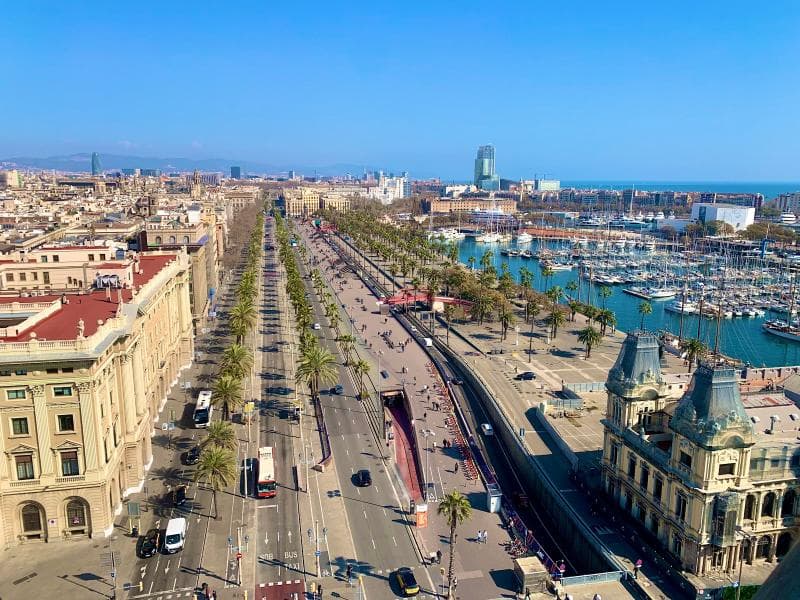
Explore Barcelona's Columbus Monument at La Rambla's end. Discover its history, unique architecture, and panoramic city views in Spain.
Overview
At the bustling intersection where Barcelona's iconic La Rambla meets the shimmering Mediterranean Sea, stands the colossal Columbus Monument, locally known as Mirador de Colom. This imposing landmark, reaching approximately 60 meters in height, commands the Plaça del Portal de la Pau, serving as a dramatic gateway between the city's vibrant promenade and its historic port, Port Vell. Crowned by a striking bronze statue of Christopher Columbus himself, the monument commemorates the explorer's first voyage to the Americas and his significant return to Barcelona in 1493, where he reported his discoveries to the Spanish monarchs. Erected for the 1888 Barcelona Universal Exposition, it remains a testament to the city's rich maritime history and its enduring connection to the Age of Discovery. Visitors can ascend an internal elevator to a viewing platform, offering breathtaking panoramic vistas of the surrounding cityscape and coastline.
History & Cultural Background
The idea for a monument honoring Christopher Columbus in Barcelona first emerged in 1856, proposed by Antoni Fages i Ferrer. After several years, the project gained momentum, and construction officially began in 1882, culminating in its inauguration in 1888, perfectly timed for the Barcelona Universal Exposition. The monument was designed by the Catalan architect Gaietà Buïgas i Monravà, with the prominent 7.2-meter bronze statue of Columbus sculpted by Rafael Atché. Its creation underscored Barcelona's pride in its historical role, as it was in this very city that Columbus presented his groundbreaking findings to Queen Isabella I and King Ferdinand V after his return from the Americas. Notably, the construction was largely a Catalan endeavor, with both labor and materials sourced from the region, reflecting a strong sense of local identity and recognition of Columbus's perceived connection to Catalonia during that era. Interestingly, it was initially conceived that the statue atop the column might represent the Greek goddess Athena, symbolizing Barcelona, but this was later changed to Columbus to align with the international theme of the World Fair.
What Makes It Special
The Columbus Monument is a marvel of late 19th-century engineering and artistic collaboration. Its structure features a robust cast-iron Corinthian column, standing approximately 40 meters tall, atop a stone base. The base is intricately adorned with a wealth of sculptural details. Eight impressive lion statues guard the lower perimeter, while four bronze winged figures, known as Phemes or Victories, soar above paired griffins, symbolizing fame and strength. Additionally, portrait medallions depict key individuals associated with Columbus's endeavors, including Queen Isabella I, King Ferdinand II, Martín Alonzo Pinzón, and Father Juan Pérez. Elaborate bas-relief panels encircle the octagonal pedestal, illustrating significant moments from Columbus's first voyage, such as his departure from Palos de la Frontera and his reception by the monarchs in Barcelona. The statue of Columbus himself, holding a scroll or nautical map, stands triumphantly at the summit. Inside this grand column, an elevator, one of the first ever installed in Barcelona, transports visitors to a unique viewing platform just below the explorer's feet, offering an unparalleled 360-degree perspective of the city.
Stories, Fun Facts & Local Details
One of the most enduring and often debated 'fun facts' about the Columbus Monument is the direction in which the explorer's outstretched arm points. While many might assume he gestures towards the 'New World' of the Americas, his finger actually points generally east or south-southeast, towards the sea. Theories abound, suggesting he points towards his hometown of Genoa, Italy, or even Mallorca. More symbolically, it is believed to represent his achievements in naval exploration, forever looking out to the horizon. The socle beneath the statue is inscribed with the word 'Tierra' (Land), a poignant nod to his famous discovery. The monument has also become a subject of contemporary discussion, with ongoing debates in recent years about Columbus's colonial legacy and occasional calls for re-evaluation or removal, highlighting evolving perspectives on historical figures. A lesser-known detail is that a hidden crypt, once used to store records from the 1888 Exposition, lies beneath the monument. For those on the viewing platform on a particularly blustery day, a surprising sensation awaits: the iron column is known to flex slightly under the force of the wind, adding a tangible connection to the monument's impressive engineering.
Visitor Perspective
For a curious traveler, the Columbus Monument offers more than just a historical landmark; it provides a unique vantage point from which to appreciate Barcelona. The journey begins with a ride in a compact elevator, nestled within the monument's column, which whisks you up to the circular observation deck. Though the space at the top is intimate, the reward is a spectacular 360-degree panorama. From here, you can trace the winding path of La Rambla stretching northwards, observe the intricate rooftops of the Gothic Quarter, and take in the expansive views of Port Vell and the bustling harbor. On a clear day, distant landmarks like Montjuïc Hill, Tibidabo mountain, and even the iconic Sagrada Familia are visible, creating a comprehensive mental map of the city. At the base of the monument, visitors can find a tourist information point, a charming Catalan wine bar and cellar offering local tastes, and a gift shop. While the monument itself is a popular and accessible attraction, it's worth noting that due to stairs at its entrance, it is currently not fully accessible for people with reduced mobility. Its strategic location makes it an ideal starting or ending point for exploring nearby attractions such as the Maritime Museum and the vibrant waterfront area.
Coordinates: 2.1777, 41.3758
View on Google Maps💬 How Travelers Describe This Place
Based on community votes
Interesting
836Unique
620Must See
594Photogenic
522Beautiful
83
Traveler Stories
Discover memorable experiences shared by travelers who have visited this place.
No traveler stories yet.
Be the first traveler to share what made this place memorable.

Tour
By
Spot
Discover amazing places around the world. Your journey starts here.
Explore
© 2026 TourBySpot. All rights reserved.