Coin Cabinet
Vienna, Austria
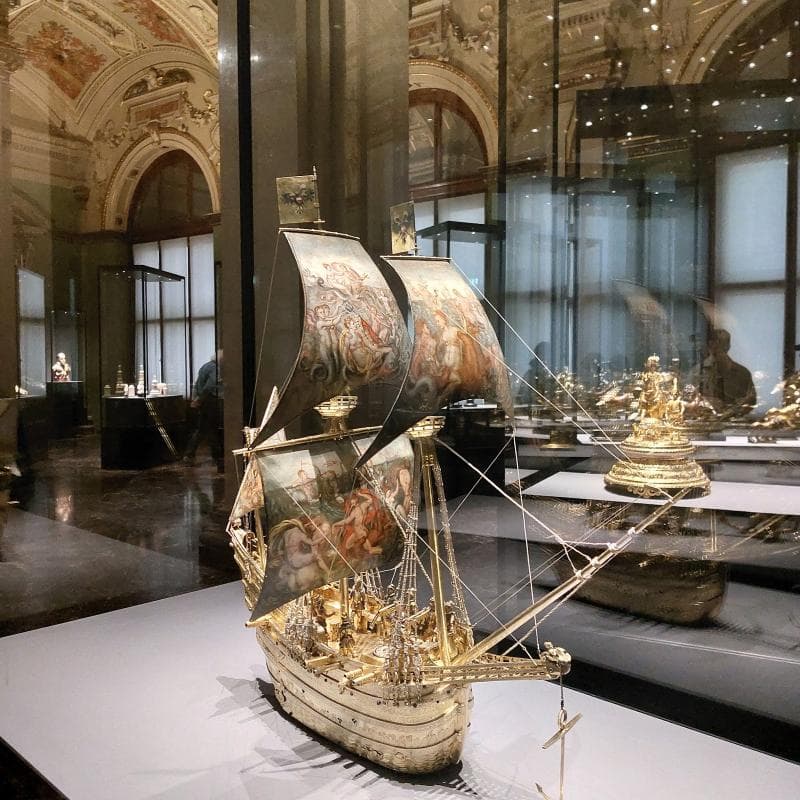
Discover the Coin Cabinet at Kunsthistorisches Museum in Vienna, Austria, a world-leading numismatic collection spanning three millennia.
Overview
Tucked away on the second floor of Vienna's magnificent Kunsthistorisches Museum, the Coin Cabinet, or Münzkabinett, stands as one of the world's largest and most significant numismatic collections. It is not merely a display of coins, but a sprawling archive of financial history, encompassing an astonishing 600,000 objects that span three millennia. Visitors are invited on a journey through time, exploring not only coins but also pre-monetary forms of currency, banknotes, shares, medals, orders, decorations, and even the intricate tools used for minting.
This impressive collection offers a unique window into the economic, political, and artistic developments of human civilization, from ancient civilizations to the modern era. Its carefully curated exhibits are presented amidst historically resonant furnishings, creating an immersive experience for anyone curious about the evolution of value and exchange.
History & Cultural Background
The Vienna Coin Cabinet's origins are deeply intertwined with the illustrious history of the Habsburg monarchy. Its foundation lies in the imperial Habsburg collection, with the earliest surviving inventory dating back to the reign of Emperor Ferdinand I in the mid-16th century. Over centuries, the collection grew through the passionate efforts of various imperial figures. Notably, the coin collections of Archduke Leopold Wilhelm and Archduke Ferdinand II of Tyrol were integrated, and Emperor Charles VI further unified these disparate treasures.
A pivotal moment in the Coin Cabinet's history arrived with Emperor Franz I Stephan, who introduced a focus on 'modern' coins, diversifying a collection previously dominated by ancient pieces. However, perhaps the most influential figure was Joseph Hilarius Eckhel, appointed director in 1774. Eckhel's groundbreaking 'Eckhel order,' a systematic classification of ancient coins based on geographical and chronological criteria, revolutionized numismatics and is still respected today. His monumental eight-volume work, 'Doctrina Nummorum Veterum,' cemented the Imperial Cabinet's international reputation as a leading center for numismatic research.
When the grand Kunsthistorisches Museum opened its doors on Vienna's Ringstrasse in 1891, the imperial collections were finally brought together under one roof. The 'Cabinet of Coins and Antiquities' was initially located on the first floor before moving to its permanent home on the second floor in 1899. By 1900, the Coin Cabinet became an independent collection, distinct from the Collection of Greek and Roman Antiquities, asserting its status as a world-class institution in its own right.
What Makes It Special
What truly sets the Vienna Coin Cabinet apart is the unparalleled breadth and depth of its holdings. It boasts a unique and comprehensive inventory of coins and medals directly tied to the House of Austria, the Archbishopric of Salzburg, and the Austrian Middle Ages. Furthermore, its collection of Roman coins is considered one of the largest and most complete globally.
The exhibition is thoughtfully arranged across three distinct rooms. Gallery I provides a captivating overview of the history and artistry of medals, tracing their evolution from early Italian examples around 1400 through to the 20th century. Here, visitors can also admire Austrian and European decorations of honor. Gallery II delves into the fascinating narrative of currency itself, showcasing the journey from rudimentary pre-monetary forms of exchange and natural money to the invention of coinage in the 7th century BC, extending all the way to contemporary banknotes. Gallery III is dedicated to dynamic special exhibitions, ensuring there is always something new and intriguing for repeat visitors.
Stories, Fun Facts & Local Details
Beyond the sheer volume of artifacts, the Coin Cabinet tells compelling stories. Imagine handling an early Austrian banknote from the era of Empress Maria Theresia, knowing that each one was individually signed by hand as a sophisticated anti-counterfeiting measure—a unique personal touch in an age before mass security printing.
Another unexpected highlight is a remarkable collection of miniature portraits initiated by Archduke Ferdinand II of Tyrol in the 16th century. Displayed alongside the coins and medals, these portraits offer a 'who's who' of historical 'celebrities,' including figures like Leonardo Da Vinci, Michelangelo, Queen Elisabeth I, and Francis Drake, providing a vivid human connection to the eras represented by the currency. Coins themselves serve as invaluable historical documents; Roman coins, for instance, might depict buildings long vanished or the faces of emperors whose reigns were too brief to leave many other pictorial records, offering rare glimpses into lost worlds. Recently, the museum acquired a rare ensemble of 22 Roman coins of the imperial couple Regalianus and Dryantilla, unique because they were minted in what is now Austria, adding another layer to Austria's rich cultural heritage.
Visitor Perspective
Exploring the Coin Cabinet is an engaging experience that typically takes around half an hour, though enthusiasts may easily spend more time delving into its intricacies. The exhibits are designed to be accessible, moving from ancient cowry shells, illustrating pre-monetary exchange, to casino chips and modern credit cards, demonstrating the continuous evolution of value.
While much of the information was historically presented in German, the museum is continuously enhancing its English-language offerings. Audio guides are highly recommended for a deeper understanding of selected items. For those who wish to prepare for their visit or explore further from home, the Coin Cabinet provides an interactive online catalog, allowing enthusiasts to research specific exhibits and plan their personal journey through this extraordinary collection.
Coordinates: 16.3616, 48.203881
View on Google Maps💬 How Travelers Describe This Place
Based on community votes
Photogenic
951Unique
748Beautiful
499Interesting
427Must See
94
Traveler Stories
Discover memorable experiences shared by travelers who have visited this place.
No traveler stories yet.
Be the first traveler to share what made this place memorable.

Tour
By
Spot
Discover amazing places around the world. Your journey starts here.
Explore
© 2026 TourBySpot. All rights reserved.