Cogwheel Railway
Lucerne, Switzerland
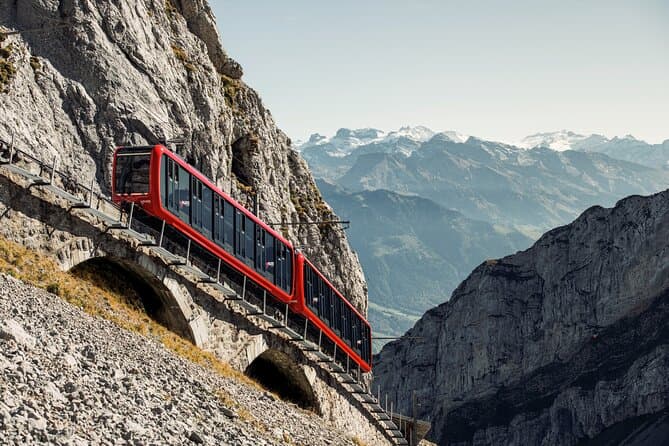
Experience the world's steepest Cogwheel Railway on Mount Pilatus in Lucerne, Switzerland. Discover its unique engineering and breathtaking views.
Overview
The Cogwheel Railway on Mount Pilatus, near Lucerne, Switzerland, holds the esteemed title of the world's steepest rack railway. This engineering marvel connects Alpnachstad at the foot of the mountain to Pilatus Kulm, the summit station, overcoming an astonishing maximum gradient of 48 percent (480‰). Opened in 1889, the railway offers a unique and exhilarating journey, traversing dramatic landscapes of alpine meadows, rugged rock faces, and tunnels carved into the mountain. It's a key part of the popular 'Golden Round Trip' that combines boat, cogwheel railway, aerial cableway, and bus for a comprehensive exploration of the region.
Operating seasonally from May to November, depending on snow conditions, the Pilatus Cogwheel Railway transports passengers approximately 1,635 meters (5,364 feet) in altitude over its 4.6-kilometer (2.86-mile) track. The ride to the summit takes about 30 minutes, providing ample time to soak in the evolving panoramas.
History & Cultural Background
The vision for a railway up Mount Pilatus dates back to 1873, but initial proposals were deemed economically unviable due to the mountain's extreme steepness. The breakthrough came with the ingenious design of engineer Eduard Locher. Conventional rack railway systems of the time could not safely manage such gradients, risking the cogwheels disengaging from the track. Locher's revolutionary solution, developed in 1882, involved a unique horizontal double rack system. This system places a horizontal rack between the two running rails, engaged by opposing twin horizontal cogwheels on the locomotive. This design not only ensured secure engagement even on the steepest sections but also guided the cars along the rails, effectively locking them to the mountainside.
Construction began in 1888 and was completed in just 400 workdays, a remarkable feat involving 600 laborers, predominantly Italian. The railway officially opened on June 4, 1889, initially operating with steam-powered trains. These early trains, capable of carrying 32 passengers, took over an hour to ascend, consuming significant amounts of water and coal for each trip. In 1937, the railway was electrified, enhancing efficiency and reducing travel time. The Pilatus Railway was built entirely with private capital and has remained financially self-sufficient throughout its history. Its innovative engineering was recognized in 2001 when it was named a Historic Mechanical Engineering Landmark by the American Society of Mechanical Engineers.
What Makes It Special
The Pilatus Cogwheel Railway's primary distinction is its status as the world's steepest, a testament to Eduard Locher's pioneering engineering. The 48 percent gradient is unlike any other public railway, making the ascent feel less like a train ride and more akin to an escalator climbing directly up the mountain face.
The Locher rack system itself is a marvel, uniquely designed to overcome the challenges of such extreme inclines. Unlike more common vertical rack systems, Locher's horizontal rack and dual horizontal cogwheels ensure that the train remains securely engaged with the track at all times, preventing derailment or disengagement even under heavy loads or high winds. This robust design means the original rack rails, installed over a century ago, are still in use today.
Furthermore, the journey offers a dramatic transformation of scenery, from the gentle shores of Lake Lucerne and the verdant lower slopes to the rugged, awe-inspiring alpine environment at Pilatus Kulm. The track itself is laid directly onto solid rock, emphasizing the scale of the construction challenge and the intimate connection between the railway and the mountain.
Stories, Fun Facts & Local Details
Mount Pilatus has long been shrouded in local legends, with tales of dragons and mythical creatures inhabiting its craggy peaks. This rich folklore adds an extra layer of mystique to the journey, inviting travelers to imagine the dragons 'flying' alongside the railway as they ascend. The modern aerial cableway to Pilatus Kulm is even named 'Dragon Ride' in tribute to these legends.
A fun fact about the original steam trains is their incredible consumption: each car needed 800 liters of water and 350 kilograms of coal for a single uphill climb. This highlights the immense power and resources required to conquer the mountain before electrification. The railway's construction was a monumental undertaking, employing hundreds of workers who, without modern machinery, painstakingly carved the path through the rock.
The Pilatus railway's success quickly inspired other mountain railway projects across Switzerland, solidifying its place not just as a tourist attraction but as a pivotal development in alpine transportation history. The initial journey was significantly slower, allowing early passengers more time to absorb the incredible panorama unfolding outside their windows.
Visitor Perspective
For visitors, the Cogwheel Railway presents an unforgettable experience, combining historical charm with breathtaking natural beauty. The ride itself is a smooth, yet thrilling, ascent that provides continuous panoramic views over Lake Lucerne and the surrounding Swiss Alps. Travelers often describe the feeling of ascending the steep incline as truly unique, almost defying gravity.
The railway is a seasonal attraction, typically operating during the warmer months, making it a perfect summer or autumn excursion. As part of the 'Golden Round Trip,' it integrates seamlessly with other modes of transport, allowing for a diverse and scenic journey up and down the mountain. Accessibility features ensure that guests with limited mobility can also enjoy this spectacular journey and the facilities at Pilatus Kulm. Upon reaching the summit, visitors are rewarded with stunning vistas, diverse hiking opportunities, and a chance to explore the various attractions at Pilatus Kulm.
Coordinates: 8.2728, 46.9533
View on Google Maps💬 How Travelers Describe This Place
Based on community votes
Unique
996Interesting
726Photogenic
717Must See
494Beautiful
193
Traveler Stories
Discover memorable experiences shared by travelers who have visited this place.
No traveler stories yet.
Be the first traveler to share what made this place memorable.

Tour
By
Spot
Discover amazing places around the world. Your journey starts here.
Explore
© 2026 TourBySpot. All rights reserved.