Clock Tower Adjacent to Pier
Hong Kong, China
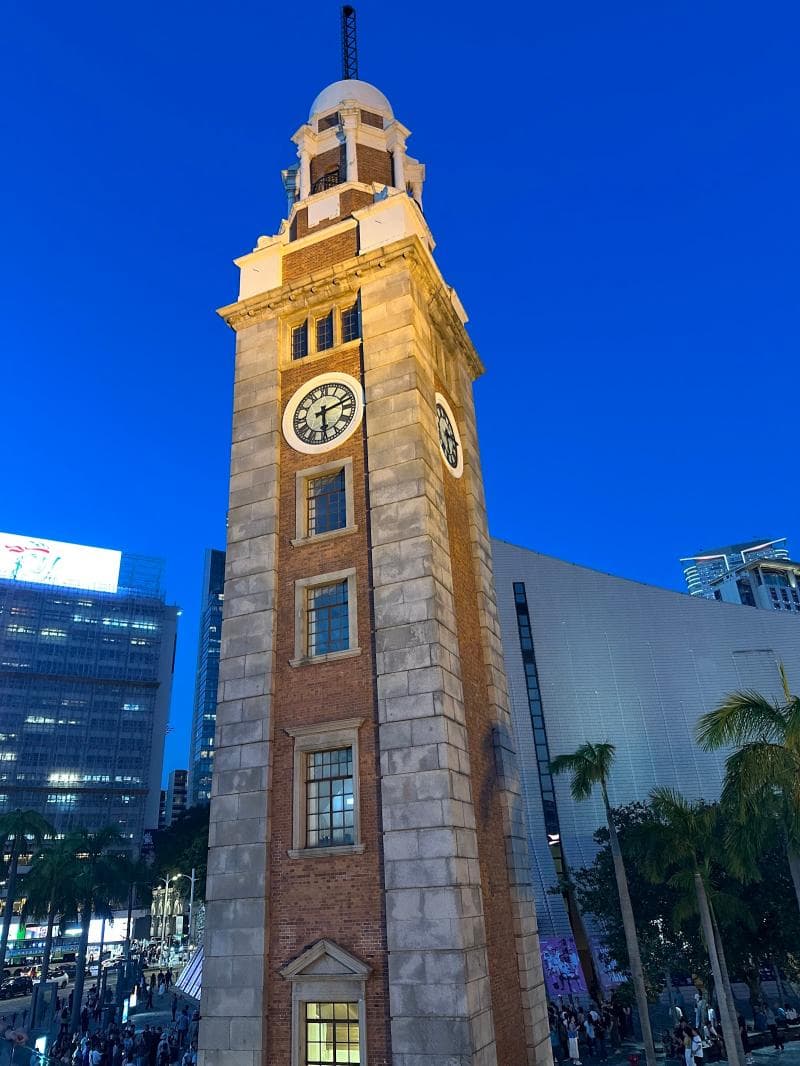

Discover the historic Clock Tower Adjacent to Pier in Hong Kong, China, a colonial landmark and remnant of the Kowloon-Canton Railway's past.
Overview
The Clock Tower, officially known as the Former Kowloon-Canton Railway Clock Tower, stands majestically on the southern shore of Tsim Sha Tsui in Hong Kong, China. This iconic landmark is a sole surviving relic of the bustling Kowloon-Canton Railway Terminus, which once served as a vital gateway for countless journeys. Its distinctive red brick and granite facade, built in the elegant Edwardian Classical Revival style, makes it a prominent feature of the Victoria Harbour waterfront. Positioned adjacent to the Star Ferry Pier, it evokes a sense of historical grandeur amidst Hong Kong's modern skyline. The tower currently stands as a declared monument, a testament to its enduring historical and cultural significance for the city.
A visit to this area offers more than just a glimpse into the past; it provides a connection to the journeys of immigrants and travelers who passed through its gates. However, for those planning a visit in the immediate future, it is important to note that the Clock Tower is undergoing maintenance works until late 2026, and is not currently visible to the public due to hoardings and scaffolding.
History & Cultural Background
The Clock Tower's story began in 1913 with its construction as an integral part of the Kowloon-Canton Railway Terminus. The terminus complex officially opened on March 28, 1916, connecting Hong Kong to Guangzhou and extending travel possibilities to mainland China, and even as far as Russia and Europe.
For decades, the tower was a beacon for arriving passengers and a symbol of hope for many Chinese immigrants who disembarked, ready to begin new lives in Hong Kong and beyond.
In 1975, the Kowloon-Canton Railway terminus was relocated to Hung Hom. Subsequently, in 1978, the main station building in Tsim Sha Tsui was unfortunately demolished to make way for urban development, including the Hong Kong Cultural Centre and Space Museum.
Fortunately, public outcry and vigorous campaigns, including a petition with 15,000 signatures, led to the preservation of the Clock Tower. This collective effort ensured that this significant piece of Hong Kong's railway heritage and colonial past remained. Consequently, the Clock Tower was officially declared a monument in 1990 under the Antiquities and Monuments Ordinance, safeguarding its future as a cherished landmark.
What Makes It Special
Standing at 44 meters tall, with its lightning rod reaching 51 meters, the Clock Tower is an architectural marvel. Its design showcases the Edwardian Classical Revival style, characterized by striking red brickwork contrasted with durable granite. The upper section is crowned with an octagonal domed belfry, further adding to its unique charm.
Interestingly, the tower's first clock face was repurposed from the demolished Pedder Street Clock Tower in Central, allowing the tradition of a public timepiece to continue. The remaining three clock faces were installed later, with the clocks becoming fully operational in March 1921.
The tower's bell, originally silenced in the 1950s due to unsynchronized chimes, made a triumphant return. To commemorate its centenary, a digital bell system was installed, and the Clock Tower's bell chimes were joyfully resumed in December 2021, ringing hourly from 8 am to midnight. These chimes now echo across Victoria Harbour, a melodious reminder of its rich past.
Stories, Fun Facts & Local Details
The Clock Tower has witnessed a century of Hong Kong's history, even surviving damage during the Japanese occupation in World War II, a period during which its clocks were notably suspended. The original bronze bell, once thought lost, was returned to the tower for display in 2010 before the digital chimes were installed.
Beyond its historical resilience, the Clock Tower has also found its place in local culture, making appearances in several Hong Kong films and becoming a popular backdrop for photography. It's common to see young couples and newlyweds capturing special moments against its historic facade, especially when it's beautifully illuminated at night.
The area surrounding the tower frequently hosts special events and festive decorations, particularly during holidays like Chinese New Year and Christmas, adding to the vibrant atmosphere of the Tsim Sha Tsui waterfront.
Visitor Perspective
The Clock Tower's prime location adjacent to the Tsim Sha Tsui Star Ferry Pier makes it incredibly accessible for visitors arriving by ferry from Central or Wan Chai. Alternatively, it is just a short walk from the Tsim Sha Tsui MTR station (Exit E) or East Tsim Sha Tsui MTR station (Exit L4).
Normally, the Clock Tower serves as a popular meeting point and offers visitors a prime viewing area for the stunning Victoria Harbour skyline. Its distinctive architecture also makes it an excellent subject for photography, particularly during the 'golden hour' and after sunset when it is floodlit.
However, as of late 2026, the Clock Tower is undergoing extensive maintenance works. During this period, the tower is obscured by hoardings and scaffolding, meaning it is not visible to the public. While its immediate view is temporarily unavailable, the surrounding area still offers a vibrant atmosphere with nearby attractions like the Hong Kong Cultural Centre, the Avenue of Stars, and the Star Ferry services still operating. Visitors can explore these areas and anticipate the Clock Tower's full reveal upon completion of its restoration.
Coordinates: 114.169365, 22.293678
View on Google Maps💬 How Travelers Describe This Place
Based on community votes
Beautiful
934Must See
741Unique
276Interesting
30Photogenic
16
Traveler Stories
Discover memorable experiences shared by travelers who have visited this place.
No traveler stories yet.
Be the first traveler to share what made this place memorable.

Tour
By
Spot
Discover amazing places around the world. Your journey starts here.
Explore
© 2026 TourBySpot. All rights reserved.