Clock mechanism
Prague, Czech Republic
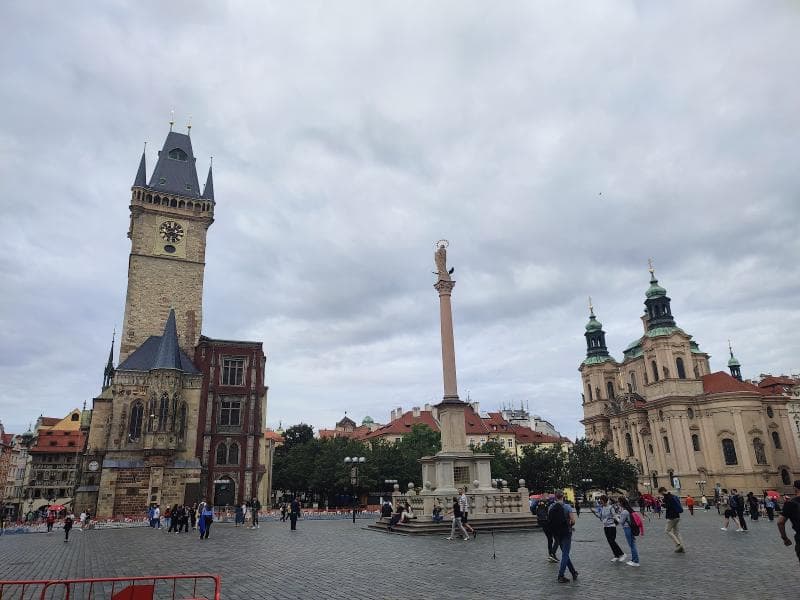
Explore the intricate 'Clock mechanism' of Prague's Astronomical Clock. Discover its history, medieval engineering, and hourly spectacle in the Czech Republic.
Overview
Deep within the Old Town Hall Tower in Prague, Czech Republic, lies the intricate 'Clock mechanism' that powers the world-renowned Astronomical Clock, or Orloj. This mechanical heart is far more than a simple timekeeper; it is a medieval masterpiece, a complex assembly of gears, dials, and figures that has captivated observers for over six centuries. It precisely tracks celestial movements, displays multiple time systems, and orchestrates an hourly spectacle, offering a profound glimpse into the scientific and artistic prowess of its creators. The mechanism seamlessly blends astronomical understanding with a deep sense of historical and cultural storytelling.
History & Cultural Background
The oldest parts of the Orloj, the mechanical clock and the astronomical dial, date back to 1410. They were ingeniously crafted by horologist Mikuláš of Kadaň, based on the design and calculations of Jan Šindel, a professor of mathematics and astronomy at Charles University. Contrary to a long-held belief, the famous Master Hanuš was not the original creator but contributed to significant renovations around 1490, including the addition of the calendar dial and Gothic sculptures. Over the centuries, the clock has undergone numerous repairs and enhancements. The animated figures, including the Apostles, were added after a major repair between 1787 and 1791, further enriching its hourly display. A significant restoration in 2018 even saw the electric mechanism, installed in 1948, replaced with a replica of the original 1860s mechanical drive, underscoring a commitment to historical authenticity.
What Makes It Special
What truly sets the Clock mechanism apart is its multifaceted functionality, acting as a mechanical astrolabe that models the universe. The astronomical dial, its most prominent feature, illustrates the position of the Sun and Moon in the sky, along with zodiac signs and other celestial details. It famously displays time in several ways: local Prague time, Old Czech time (where the day began at sunset), and sidereal time, which tracks the Earth's rotation relative to the stars. The Moon's sphere, half silver and half black, rotates to accurately depict its current phase, offering a continuous lunar calendar. Below the astronomical dial, the calendar dial, added later, features medallions depicting allegories of the months and zodiac signs, originally painted by Josef Mánes.
Stories, Fun Facts & Local Details
The Orloj is steeped in local folklore. Perhaps the most famous, though historically inaccurate, is the legend of Master Hanuš. It claims he was blinded by the Prague councillors to prevent him from replicating his masterpiece elsewhere. In revenge, he supposedly damaged the clock, and it remained inoperable for a century. Another popular tale suggests that if the clock ever stops for an extended period, dark times will befall Prague, a superstition that adds to its mystical aura. The allegorical figures surrounding the main dial—Death, Vanity, Greed, and the Turk (often associated with Lust or Extravagance)—spring to life hourly, each with symbolic movements. Death rings a bell and turns an hourglass, reminding viewers of mortality. These figures, along with the 'Walk of the Apostles' that appears in the windows above, culminate in a crowing rooster, marking the passage of the hour.
Visitor Perspective
For a curious traveler, observing the Astronomical Clock's mechanism in action is a profoundly moving experience, despite the crowds that gather hourly. The clock is a powerful reminder of medieval ingenuity and the intricate connection between science, art, and daily life in centuries past. While the inner workings of the mechanism are not directly accessible to the public, understanding its complexity and historical significance enriches the viewing of the hourly show. Witnessing the delicate dance of the dials and figures, knowing the centuries of craftsmanship and thought behind each movement, transforms a simple observation into an appreciation of a living historical artifact. It's a moment to connect with Prague's rich cultural heritage and the enduring human quest to understand time and the cosmos.
Coordinates: 14.4209167, 50.0870083
View on Google Maps💬 How Travelers Describe This Place
Based on community votes
Interesting
623Photogenic
343Unique
302Must See
250Beautiful
88
Traveler Stories
Discover memorable experiences shared by travelers who have visited this place.
No traveler stories yet.
Be the first traveler to share what made this place memorable.

Tour
By
Spot
Discover amazing places around the world. Your journey starts here.
Explore
© 2026 TourBySpot. All rights reserved.