Cliff Walkway
Bali, Indonesia
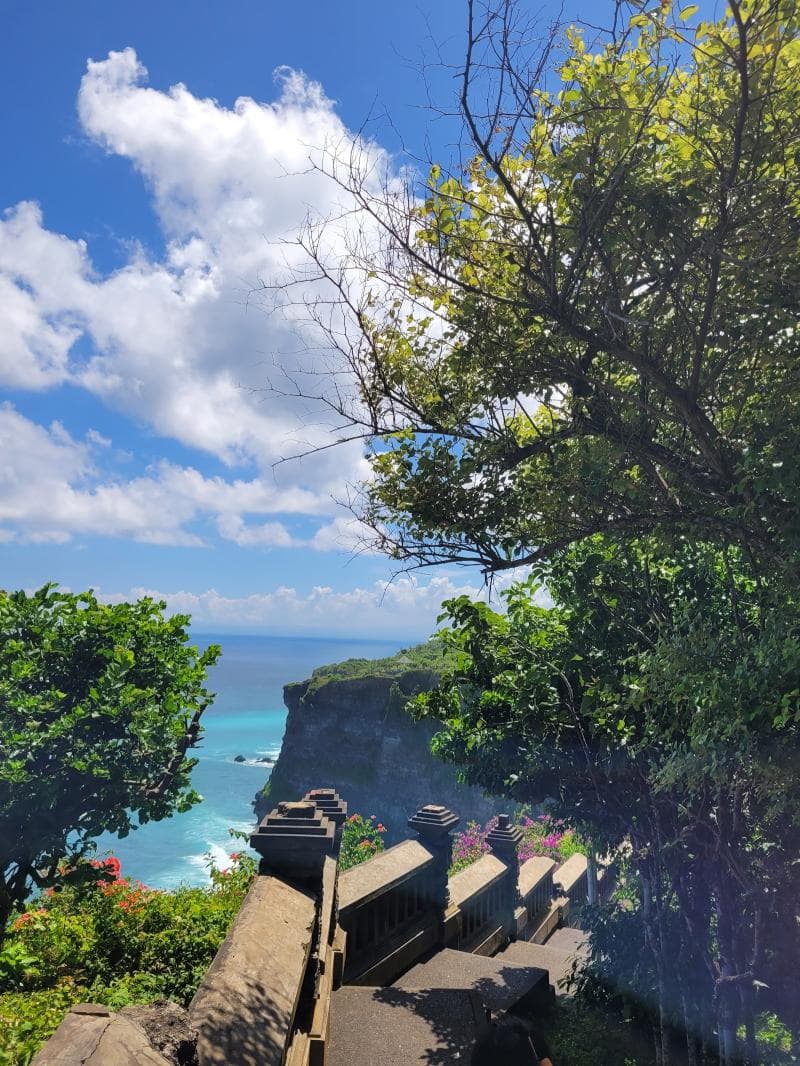
Explore the majestic Cliff Walkway at Uluwatu Temple, Bali, Indonesia. Discover ancient history, stunning ocean views, and mischievous monkeys.
Overview
Perched majestically atop a dramatic limestone cliff, the Cliff Walkway at Uluwatu Temple in Bali, Indonesia, offers visitors an unparalleled journey along the island's southwestern edge. This serpentine pathway hugs the precipice, providing breathtaking panoramic views of the Indian Ocean from approximately 70 meters (230 feet) above the crashing waves. The walkway serves as an integral part of the larger Pura Luhur Uluwatu complex, one of Bali's most revered sea temples. As you traverse this fortified concrete path, you are not merely walking; you are stepping into a realm where natural beauty, ancient spirituality, and vibrant culture converge. The constant sound of waves provides a meditative backdrop, inviting contemplation and awe at the raw power and serenity of nature.
The Cliff Walkway guides visitors through lush forest areas that eventually open up to astounding vistas, leading towards the sacred temple structure itself. It's a journey designed to immerse you in the temple's magnificent setting before reaching its spiritual heart. This path is more than just a means to an end; it's an experience in itself, promising memorable sights and a deeper connection to Bali's mystical landscape.
History & Cultural Background
Uluwatu Temple, locally known as Pura Luhur Uluwatu, boasts a rich history dating back to at least the 10th or 11th century. The temple's origins are often attributed to Empu Kuturan, a Javanese sage from the Majapahit Kingdom who significantly expanded the site in the 11th century, helping to establish a unified spiritual system across Bali. Five centuries later, in the 16th century, another revered priest, Dang Hyang Nirartha, further developed the temple, introducing the distinctive padmasana shrines. Local traditions suggest that Nirartha attained moksha, or spiritual liberation, directly on this cliff, with some legends even claiming a lightning strike marked the moment his physical body vanished, solidifying the temple's 'Luhur' (divine origin or elevated status) epithet.
The name 'Uluwatu' itself is deeply descriptive, derived from the Balinese words 'ulu,' meaning 'edge' or 'tip,' and 'watu,' meaning 'rock' or 'stone,' aptly describing its dramatic location. Pura Luhur Uluwatu is one of Bali's six key directional temples (Sad Kahyangan), believed to protect the island from negative spiritual influences and sea spirits. It is dedicated to Sang Hyang Widhi Wasa in his manifestation as Rudra, the Balinese Hindu deity of all elements and aspects of life, underscoring its profound religious significance in Balinese Hinduism.
What Makes It Special
The Cliff Walkway's allure lies in its spectacular natural setting combined with profound cultural elements. Its most striking feature is undoubtedly the sheer elevation, offering unobstructed, sweeping vistas of the Indian Ocean. As you navigate the path, the expansive ocean views and the feeling of being on the 'edge of the world' create a deeply moving experience. The path's design ensures diverse perspectives, sometimes revealing the temple dramatically from a distance, and at other times, showcasing how it's intricately nestled into the rock face.
Beyond the views, the pathway is a gateway to the temple's resident population of long-tailed macaques. These mischievous monkeys are not just wildlife; they are considered sacred guardians of the temple, believed to protect it from bad influences. Their presence adds a lively and often humorous dimension to the visit, though their notorious talent for snatching visitors' belongings is a well-known local detail.
Furthermore, the Cliff Walkway sets the stage for one of Bali's most iconic cultural performances: the Kecak fire dance. Held in an open-air amphitheater near the cliff's edge as the sun sets, the walkway leads you to this captivating spectacle. The blend of the stunning natural backdrop, the ancient temple's aura, and the vibrant dance creates an unforgettable sensory experience that truly sets this destination apart.
Stories, Fun Facts & Local Details
Many stories and local beliefs are intertwined with Uluwatu and its cliff. One of the most compelling is the legend surrounding Dang Hyang Nirartha's attainment of moksha at this site. It's said that his spiritual liberation caused his shawl to transform into the very rock upon which the temple stands, making the cliff inherently sacred. Another intriguing aspect involves the monkeys. Beyond being guardians, scientific studies suggest these macaques have learned a unique bartering behavior. They are known to snatch items like sunglasses or phones from visitors, then 'ransom' them back to temple staff for food, a learned trade passed down through generations.
The Kecak dance, a nightly spectacle here, has a fascinating history. While it appears ancient, its modern form, performed without musical instruments and relying solely on a chorus of men chanting 'cak-cak-cak,' was developed in the 1930s. It creatively combined an older trance ritual with the Hindu epic Ramayana, making Uluwatu's cliffside amphitheater its most dramatic setting. The pathway also offers a glimpse into Bali's Hindu cosmology, as the sea represents powerful, untamed energy, and the temple's location here symbolically anchors and balances that force.
Visitor Perspective
Experiencing the Cliff Walkway is a highlight for many travelers to Bali. The journey itself typically takes about an hour to traverse at a leisurely pace, allowing ample time to absorb the magnificent scenery and capture countless photographs. The paths are generally well-maintained, but visitors are advised to wear comfortable, non-slip shoes, as some sections can be uneven.
A crucial tip for visitors is to be mindful of the resident monkeys. While they are an iconic part of the experience, securing all belongings—especially loose items like hats, glasses, and phones—in zipped bags is highly recommended to prevent snatching. As a sacred site, respectful attire is required; sarongs and sashes are provided at the entrance for both men and women to ensure modesty. The late afternoon, particularly leading up to sunset, is considered the best time to visit, not only for the breathtaking views but also to coincide with the Kecak fire dance performance, offering a complete cultural and scenic immersion.
Coordinates: 115.08441, -8.82939
View on Google Maps💬 How Travelers Describe This Place
Based on community votes
Interesting
886Photogenic
564Beautiful
443Must See
310Unique
233
Traveler Stories
Discover memorable experiences shared by travelers who have visited this place.
No traveler stories yet.
Be the first traveler to share what made this place memorable.

Tour
By
Spot
Discover amazing places around the world. Your journey starts here.
Explore
© 2026 TourBySpot. All rights reserved.