Circular Mound Altar
Beijing, China
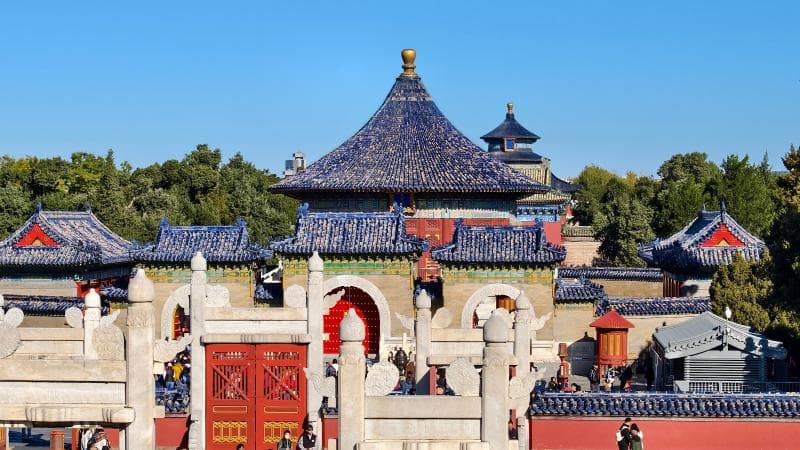
Explore Beijing's Circular Mound Altar in the Temple of Heaven, a historic site where emperors once prayed to Heaven. Discover its unique architecture and profound cultural significance.
Overview
Nestled within the vast and sacred grounds of the Temple of Heaven in Beijing, China, lies the Circular Mound Altar. This magnificent open-air platform, crafted from three tiers of pristine white marble, served as a crucial site for profound imperial rituals. It stands as a testament to ancient Chinese cosmology, where emperors would journey to perform solemn ceremonies of Heaven worship. Situated at the southernmost point along the central axis of the Temple of Heaven, its design and purpose are deeply intertwined with the spiritual beliefs of the Ming and Qing dynasties.
History & Cultural Background
The Circular Mound Altar's origins trace back to 1530 AD, during the reign of the Jiajing Emperor of the Ming Dynasty. Initially, the comprehensive Altar of Heaven and Earth encompassed all sacrificial rites. However, a significant shift in imperial practice led Emperor Jiajing to separate the worship of Heaven and Earth. Consequently, the Circular Mound Altar was specifically constructed for rituals dedicated to Heaven.
Later, in 1749, during the Qing Dynasty under the Qianlong Emperor, the altar underwent extensive enlargement and rebuilding, transforming it into the impressive white marble structure we see today. For centuries, until the fall of the imperial system, emperors, revered as 'Sons of Heaven,' would lead elaborate ceremonies here. Their primary purpose was to offer sacrifices during the Winter Solstice, expressing gratitude to Heaven for the year's bounty and imploring good harvests for the coming year. Additionally, during times of drought, urgent prayers for rain were conducted on this sacred platform.
The entire Temple of Heaven complex, including the Circular Mound Altar, symbolizes the profound relationship between the human world and the divine, with the emperor playing a pivotal role in maintaining harmony between the two.
What Makes It Special
The Circular Mound Altar is a masterpiece of symbolic architecture. Its design intricately reflects the ancient Chinese cosmic philosophy of 'heaven is round, earth is square.' This belief is embodied in the altar's layout: an inner circular wall representing heaven encloses the altar, while a square outer wall symbolizes earth. The altar itself, composed of three ascending circular tiers of white marble, was conceived to facilitate communication between the earthly realm and the heavens.
What truly sets the Circular Mound Altar apart is the pervasive use of the number nine, considered 'extremely yang' and highly auspicious in Chinese culture, often associated with the imperial dragon and authority. Every architectural detail pays homage to this sacred number. The stairways connecting the three levels each feature nine steps. On the topmost terrace, concentric circles of flagstones emanate from the center, with the first ring comprising nine stones, the second eighteen, and so on, culminating in the ninth ring with eighty-one stones. Even the balustrades encircling the tiers adhere to this pattern, with 72 on the top level, 108 on the middle, and 180 on the bottom, all multiples of nine.
Stories, Fun Facts & Local Details
One of the most captivating aspects of the Circular Mound Altar is its remarkable acoustic properties. At the very center of the top terrace lies the 'Heaven's Heart Stone' (also known as Tian Xin Shi). During imperial ceremonies, the emperor would stand upon this stone, and it was believed that his prayers and voice would be amplified and carried directly to Heaven. When a visitor stands on the Heaven's Heart Stone and speaks, their voice is noticeably amplified, creating a distinct echo. This effect is not accidental but a deliberate design, achieved by the exceptionally smooth surfaces of the marble and the strategic placement of the surrounding balustrades, which cause sound waves to reflect almost simultaneously.
During the Winter Solstice ceremonies, sacrificial offerings, often including bulls, were burned on the altar, their smoke ascending towards the heavens in a profound act of veneration and hope for prosperity.
Visitor Perspective
Visiting the Circular Mound Altar offers a deeply immersive experience into China's imperial past and its rich spiritual traditions. As you walk across the gleaming white marble tiers, you can almost envision the elaborate rituals that unfolded here centuries ago. Standing on the Heaven's Heart Stone yourself allows for a personal connection to this ancient practice, experiencing the unique acoustics firsthand. It's advisable to wear sturdy shoes, as the marble surfaces can be slippery when wet. The Circular Mound Altar is seamlessly integrated into the Temple of Heaven complex, making it an essential and easily accessible part of a comprehensive visit. Its architectural grandeur and profound historical significance truly make it a highlight of Beijing's cultural landscape.
Coordinates: 116.40647, 39.88224
View on Google Maps💬 How Travelers Describe This Place
Based on community votes
Must See
491Photogenic
443Beautiful
414Interesting
310Unique
277
Traveler Stories
Discover memorable experiences shared by travelers who have visited this place.
No traveler stories yet.
Be the first traveler to share what made this place memorable.

Tour
By
Spot
Discover amazing places around the world. Your journey starts here.
Explore
© 2026 TourBySpot. All rights reserved.