Church Plaza
Reykjavik, Iceland
Explore Church Plaza, the forecourt of Hallgrímskirkja in Reykjavik, Iceland, home to the iconic Leif Erikson statue and stunning views.
Overview
Stepping onto the forecourt of Hallgrímskirkja in Reykjavik, Iceland, immediately transports you to a space where grandeur meets profound history. This expansive plaza, often simply referred to as the church square or forecourt, serves as a magnificent entryway to one of Iceland's most iconic landmarks. Dominated by the soaring architecture of Hallgrímskirkja itself and the steadfast presence of the Leif Erikson statue, this area is more than just an approach; it's a vital part of the overall experience, offering both symbolic significance and stunning photographic opportunities. It acts as a gathering point, a place for contemplation, and a vantage for appreciating the unique Icelandic landscape reflected in the church's design.
History & Cultural Background
The history of Hallgrímskirkja and its accompanying plaza is deeply intertwined with Icelandic identity. The church, named after the 17th-century poet and clergyman Hallgrímur Pétursson, was designed by State Architect Guðjón Samúelsson in 1937. Its striking design, inspired by Iceland's dramatic basalt columns and glacial landscapes, took over four decades to construct, with work commencing in 1945 and reaching completion in 1986.
Standing proudly in the church's forecourt is the powerful bronze statue of Leif Erikson, the Norse explorer believed to have been the first European to set foot in North America, centuries before Christopher Columbus. This statue was a significant gift from the United States to Iceland in 1930, commemorating the 1000th anniversary of the Alþingi, the Icelandic parliament. Interestingly, the statue was erected on this very spot in 1932, predating the completion of Hallgrímskirkja itself. Architect Samúelsson, in a testament to its importance, designed the church to be oriented around the statue's placement, creating a harmonious dialogue between the two landmarks.
What Makes It Special
What truly sets this plaza apart is the unique interplay between the monumental Hallgrímskirkja and the Leif Erikson statue. The church's design, with its towering central spire and cascading concrete 'wings', mirrors the majestic basalt formations found in Iceland's natural environment, creating a sense of organic growth from the earth. This makes the building not just a place of worship, but an artistic representation of the land it stands upon. The statue of Leif Erikson, with its westward gaze, symbolizes Iceland's seafaring heritage and its connection to the wider world.
From the plaza, visitors can fully appreciate the scale and architectural innovation of Hallgrímskirkja, which stands as the tallest church in Iceland at 74.5 meters (244 feet). The forecourt offers an ideal vantage point for photographers, especially in the morning light when the sun illuminates the church's facade and casts Leif Erikson's shadow across the square. Ascending the church tower provides unparalleled panoramic views of Reykjavik, extending to the surrounding mountains and the North Atlantic Ocean.
Stories, Fun Facts & Local Details
One of the most captivating stories associated with the plaza is the historical fact that Leif Erikson discovered North America around the year 1000 CE, making him arguably the first European to do so, significantly before Christopher Columbus. This detail adds a profound layer of historical depth to the statue and the entire area. The statue's abstract, almost modernist style was considered revolutionary for its time, foreshadowing the clean lines that would later define Icelandic design.
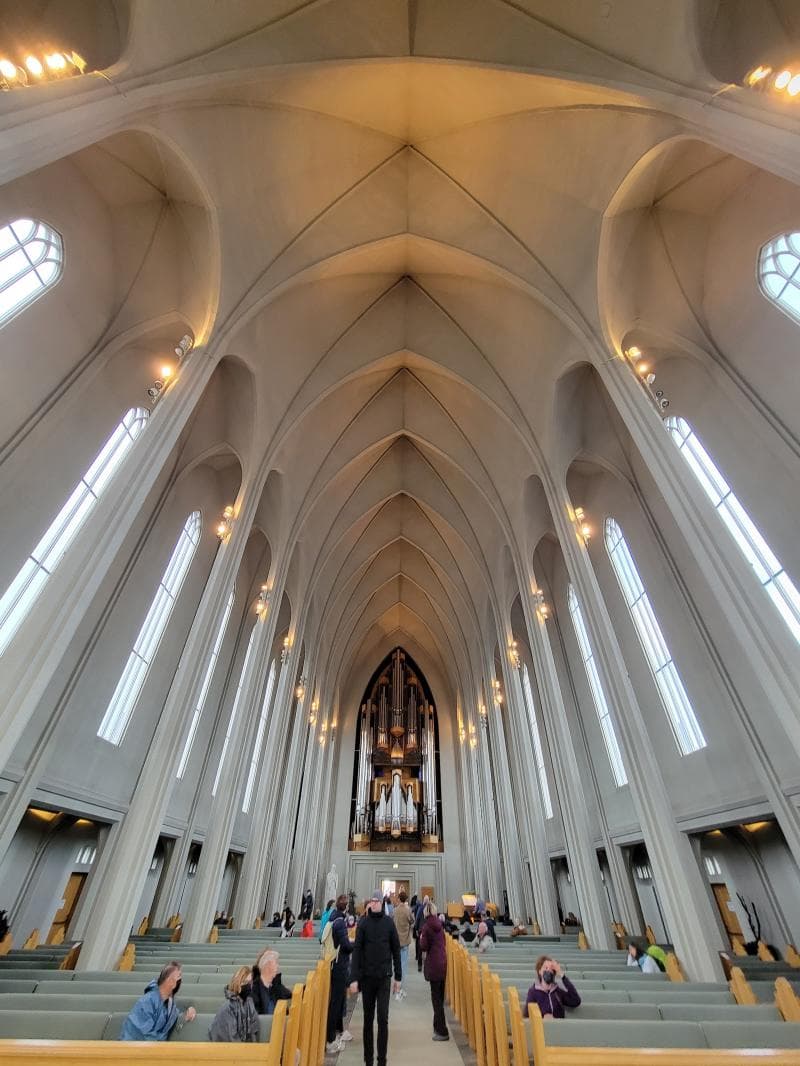
Despite its current iconic status, Hallgrímskirkja's design was not without controversy during its initial construction, with some finding its modernist approach ‘ugly’ or too old-fashioned. The surrounding pavement was not even properly laid out until the late 1990s. Inside the church, a magnificent pipe organ, crafted by Johannes Klais of Bonn, Germany, stands 15 meters (49 feet) tall and weighs 25 tons, featuring 5,275 pipes. This impressive instrument contributes to the church's vibrant musical life, with concerts often held within its walls.
Visitor Perspective
For the curious traveler, visiting the forecourt of Hallgrímskirkja is an essential Reykjavik experience. The journey up Skólavörðustígur, one of Reykjavik's vibrant streets lined with shops and cafes, builds anticipation as the church gradually comes into view. Upon arrival, the sheer scale and unique architectural style of the church are striking, inviting visitors to marvel at its basalt-inspired facade. The statue of Leif Erikson serves as a powerful focal point, prompting reflections on exploration and discovery. While entry into the church itself is free, a small fee grants access to the tower, a worthwhile investment for the breathtaking 360-degree views of the capital city, its colorful rooftops, and the distant coastline. This plaza acts as a gateway to understanding Reykjavik's history, its cultural pride, and its profound connection to the dramatic Icelandic landscape.
Coordinates: -21.9266, 64.1417
View on Google Maps💬 How Travelers Describe This Place
Based on community votes
Unique
326Must See
279Beautiful
276Interesting
270Photogenic
146
Traveler Stories
Discover memorable experiences shared by travelers who have visited this place.
No traveler stories yet.
Be the first traveler to share what made this place memorable.

Tour
By
Spot
Discover amazing places around the world. Your journey starts here.
Explore
© 2026 TourBySpot. All rights reserved.