Checkpoint Sign
Berlin, Germany
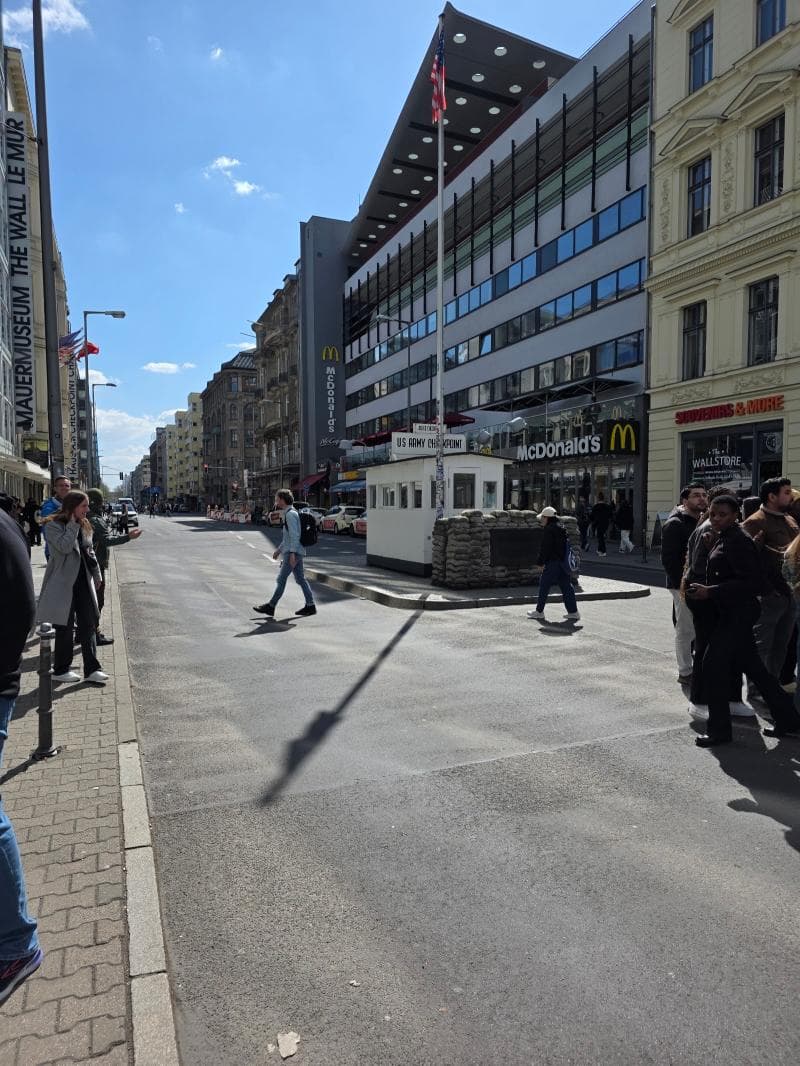
Explore the iconic Checkpoint Sign at Checkpoint Charlie in Berlin, Germany, a powerful symbol of the Cold War and a divided city.
Overview
Stepping onto the historic ground of Checkpoint Charlie in Berlin, Germany, transports visitors back to a pivotal era of the 20th century. While the Berlin Wall itself no longer stands, the site remains an enduring symbol of the Cold War and the city's painful division. Central to this powerful historical tableau is the iconic 'Checkpoint Sign', a replica of which greets travelers today. This sign, with its bold, multilingual warning, unequivocally marked the boundary between the American Sector of West Berlin and East Berlin. It served not merely as a directional marker, but as a stark visual representation of ideological divides and geopolitical tensions that once gripped the world.
Today, the replica sign, alongside a reconstructed guard booth, an American flag, and sandbags, helps visitors visualize the former border crossing. It's a poignant reminder of a time when crossing this threshold meant entering an entirely different political and social system. The original sign, a piece of profound historical significance, is preserved and displayed at the Allied Museum in Berlin-Zehlendorf, while another valuable original sign was presented to the Haus am Checkpoint Charlie Museum.
History & Cultural Background
Checkpoint Charlie, known as 'Checkpoint C' in NATO's phonetic alphabet, emerged as the most famous border crossing between East and West Berlin after the Berlin Wall's construction on August 13, 1961. It was one of three Allied checkpoints, with Alpha and Bravo located elsewhere. The sign itself was a vital component of this crossing point, proclaiming 'YOU ARE LEAVING THE AMERICAN SECTOR' (and 'YOU ARE ENTERING THE AMERICAN SECTOR' on its reverse) in English, Russian, French, and German.
This location on Friedrichstraße became a stage for high-stakes drama during the Cold War, witnessing tense standoffs between American and Soviet tanks in October 1961. These moments brought the world to the brink of conflict, underscoring the checkpoint's critical role in maintaining the fragile balance of power. For nearly three decades, until the fall of the Berlin Wall in 1989, the sign at Checkpoint Charlie was an everyday reality for Allied military personnel, foreigners, and diplomats, who were the only individuals permitted to use this crossing.
What Makes It Special
The 'Checkpoint Sign' is far more than just a piece of painted metal; it is a powerful artifact of a bygone era. Its multilingual text vividly illustrates the international nature of Berlin's division and the complex web of alliances and rivalries that defined the Cold War. The sign's blunt declaration of leaving or entering a 'sector' symbolizes the absolute ideological and physical divide that separated families, friends, and an entire city.
It encapsulates the historical weight of a divided Germany and a world polarized into East and West. The replica sign at the original site, accompanied by historical information, allows modern visitors to connect with the visceral experience of those who lived through the division. It is a visual shorthand for the strict controls, the constant surveillance, and the inherent dangers of a divided city, where freedom was often just a few meters away but impossibly out of reach for many.
Stories, Fun Facts & Local Details
The original 'Checkpoint Sign' was maintained by the U.S. Army's 6th Infantry Regiment, whose designation 'US ARMY 6' was printed at the bottom of the sign. When Checkpoint Charlie was officially dismantled on June 22, 1990, the original guard booth was lifted by a crane and transported to a military museum, while the sign itself found a new home. A fascinating detail is that one individual, Alan Wolan, a souvenir shop owner near the checkpoint, coveted the sign and, to his surprise, the Allies left it behind when they departed. He later transported it to the US.
Today, the sign continues to inspire a sense of intrigue. Near the present-day replica, visitors can explore the Mauermuseum (Wall Museum – Haus am Checkpoint Charlie), which houses an extensive collection of artifacts related to escape attempts from East Berlin, some of which were incredibly ingenious. The museum itself received a valuable original sign from the US Military Forces in Berlin in 1991. The entire area surrounding Checkpoint Charlie was a hotbed for espionage and has featured in numerous thrillers and spy novels, further cementing its legendary status.
Visitor Perspective
For many travelers to Berlin, seeing the 'Checkpoint Sign' at Checkpoint Charlie is an essential, almost pilgrimage-like, experience. It's a moment to pause and reflect on the extraordinary history that unfolded on this very street corner. Visitors often take photographs with the sign and the guard booth, creating a personal connection to a global historical event. The atmosphere is often a mix of solemn reflection and tourist curiosity, as people grapple with the reality of what this place once represented.
While the checkpoint is no longer active, the tangible elements like the sign, along with informative displays and nearby museums, offer a powerful educational experience. It encourages a deeper understanding of the Cold War's impact and the resilience of the human spirit in the face of political oppression. The replica sign stands as a silent sentinel, inviting every visitor to consider the meaning of freedom and division, and to remember the past so that its lessons are never forgotten.
Coordinates: 13.39038, 52.50743
View on Google Maps💬 How Travelers Describe This Place
Based on community votes
Beautiful
672Interesting
671Unique
356Must See
225Photogenic
220
Traveler Stories
Discover memorable experiences shared by travelers who have visited this place.
No traveler stories yet.
Be the first traveler to share what made this place memorable.

Tour
By
Spot
Discover amazing places around the world. Your journey starts here.
Explore
© 2026 TourBySpot. All rights reserved.