Chapel
Vienna, Austria
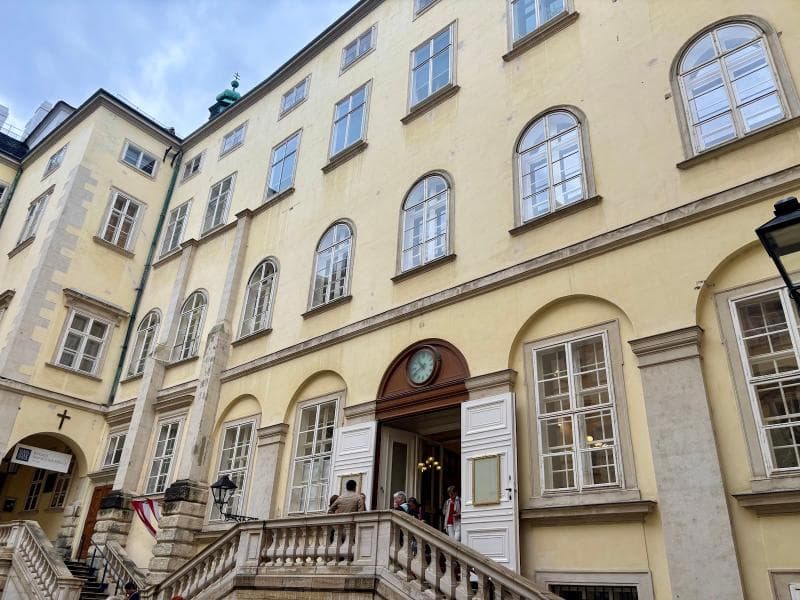
Explore the historic Hofburg Chapel in Vienna's Hofburg Palace, home to the Vienna Boys' Choir and centuries of imperial music tradition.
Overview
Tucked away within the historic Hofburg Palace in Vienna, Austria, lies the Chapel, known locally as the Burgkapelle or Hofburgkapelle. This architectural gem is far more than just a place of worship; it is a profound repository of Austrian history, imperial tradition, and world-renowned musical heritage. It has served as the private chapel for the Habsburg emperors for centuries, intimately witnessing pivotal moments of their dynastic rule. Today, it continues to draw visitors from across the globe, particularly those eager to experience the living tradition of sacred music, most notably the performances by the venerable Vienna Boys' Choir.
Situated in the Schweizerhof, the oldest part of the Hofburg complex, the Chapel's understated exterior belies the rich tapestry of stories and cultural significance held within its Gothic walls. While the sprawling Hofburg Palace evolved around it, absorbing it almost entirely, the Chapel has steadfastly maintained its spiritual and artistic heart, offering a unique glimpse into the imperial past of Vienna.
History & Cultural Background
The origins of the Hofburg Chapel trace back to the late 13th century, with its first documented mention appearing in 1296. Duke Albrecht I is credited as its founder around this period. The Chapel's current Gothic form largely emerged from significant building efforts under Duke Albrecht V in the early 15th century, with its consecration recorded in 1449 during the reign of Emperor Friedrich III.
For centuries, the Chapel stood as the spiritual epicenter of the Habsburg court, playing a crucial role in the devotional life of the imperial family. It was a place where acts of piety were observed and stylized as principal virtues of the dynasty. Over time, particularly during the 16th to 18th centuries, galleries and oratories were added, allowing the imperial family and the court to attend services from elevated, private vantage points. Further renovations in the early 19th century, influenced by Romanticism, gave it much of its present appearance, yet preserved key Gothic elements like the ribbed vaulting and original cornerstone figures.
A defining moment in its cultural history came in 1498 when Emperor Maximilian I established the Hofmusikkapelle (Court Music Chapel) here. This foundation laid the groundwork for one of the world's oldest and most revered musical institutions, which includes the Boys' Choir, the precursor to the modern Vienna Boys' Choir.
What Makes It Special
The Hofburg Chapel's unparalleled distinction lies in its unbroken tradition of sacred music. It remains the historic home of the Vienna Boys' Choir (Wiener Sängerknaben) and the Vienna Court Music Ensemble (Wiener Hofmusikkapelle). Every Sunday, from mid-September to June, these celebrated musicians perform the music for High Mass, continuing a legacy that stretches back over 500 years. This offers a rare opportunity to experience world-class musical artistry in its original historical context.
Architecturally, the Chapel is a remarkable example of Late Gothic style, with delicate ribbed vaulting and finely carved stonework that create an inspiring atmosphere. Despite being enveloped by later Baroque and Renaissance additions to the Hofburg Palace, parts of its medieval character are still evident, including late Gothic pillar figures of various saints, restored to their original coloration. The intimate setting, combined with exceptional acoustics, means that architecture and music have been inextricably linked here for generations.
Stories, Fun Facts & Local Details
The Chapel has borne witness to many historical events beyond regular worship. It served as a place of solemn repose for deceased emperors. For instance, the body of Emperor Ferdinand I lay in the Burgkapelle for a year after his death in 1564. Centuries later, visitors would pay their last respects to Archduke Franz Ferdinand here, whose assassination tragically sparked World War I.
The Hofmusikkapelle, established by Maximilian I, attracted some of Europe's greatest musical talents. Renowned composers and musicians such as Wolfgang Amadeus Mozart, Antonio Salieri, Franz Schubert (who was a choirboy himself), and Anton Bruckner were all associated with the Imperial Court Chapel, either as members, directors, or organists. This enduring musical legacy profoundly influenced Western sacred music.
Interestingly, the Chapel was so integrated into the expanding Hofburg Palace that at one point, only its apse was visible from the outside, protruding into the former moat. Restoration efforts in the 1950s revealed a richly decorated facade gable that had been hidden for centuries. Its survival as a distinct and active chapel within such a monumental complex is a testament to its profound significance.
Visitor Perspective
For many travelers, the highlight of visiting the Hofburg Chapel is attending Sunday Mass to hear the Vienna Boys' Choir and the Vienna Court Music Ensemble. It is an extraordinary auditory experience, described as magical due to the angelic voices and superb acoustics. However, it's important to note that this is a formal religious service, not a concert in the conventional sense. The musicians, including the boys' choir, typically perform from an upper balcony, meaning visibility can be limited depending on your seating.
Tickets for these services are highly sought after and should be booked well in advance, especially from mid-September to June when performances are regular. Standing room tickets are sometimes available for free on the day, but seating guarantees the best experience. While free entry to view the chapel is possible on specific days and times (check official websites), the true immersion into its living history comes with experiencing its renowned musical tradition. The Chapel is conveniently located near the Imperial Treasury, making it an easy addition to a visit to the Hofburg Palace.
Coordinates: 16.36528, 48.20639
View on Google Maps💬 How Travelers Describe This Place
Based on community votes
Interesting
800Must See
658Beautiful
589Photogenic
387Unique
90
Traveler Stories
Discover memorable experiences shared by travelers who have visited this place.
No traveler stories yet.
Be the first traveler to share what made this place memorable.

Tour
By
Spot
Discover amazing places around the world. Your journey starts here.
Explore
© 2026 TourBySpot. All rights reserved.