Chairman Mao Memorial Hall
Beijing, China
Explore Chairman Mao Memorial Hall in Beijing, China. Discover the history and cultural significance of this iconic mausoleum in Tiananmen Square, housing Mao Zedong's embalmed body.
Overview
Situated prominently at the heart of Tiananmen Square in Beijing, China, the Chairman Mao Memorial Hall, also widely known as the Mausoleum of Mao Zedong, serves as the final resting place for Mao Zedong, the founding father of the People's Republic of China. This monumental structure attracts a significant number of visitors daily, offering a unique glimpse into a pivotal period of Chinese history. Its central location within Tiananmen Square places it amidst other key national landmarks, making it an integral part of any visit to Beijing's historic core.
The Memorial Hall stands as a distinctive piece of architecture, characterized by its imposing and solemn presence. Visitors approach the Hall to pay their respects and observe the embalmed body of Chairman Mao, displayed within a crystal coffin. The experience is often described as a somber and reflective one, steeped in historical and cultural significance.
History & Cultural Background
Chairman Mao Zedong passed away on September 9, 1976. Despite his expressed wish for cremation, a decision was made by the Chinese Communist Party leadership to embalm his body and construct a memorial hall for public display. This decision was announced shortly after his death, coinciding with the arrest of the 'Gang of Four', suggesting a political impetus to solidify unity and leadership in the post-Mao era.
Construction of the Memorial Hall began in November 1976 and proceeded with remarkable speed, utilizing materials sourced from across China and involving an estimated 700,000 voluntary laborers. The building was inaugurated and opened to the public on September 9, 1977, less than a year after Mao's passing. Historically, the site of the Memorial Hall was once occupied by the Gate of China, the southern gate of the Imperial City during the Ming and Qing dynasties, underscoring its deep integration into Beijing's historical urban fabric.
While primarily dedicated to Mao Zedong, the Memorial Hall has evolved to also commemorate other significant revolutionary leaders. In 1983, it was decided that the mausoleum would share its dedication with other figures, and today, the second floor houses memorial rooms honoring the achievements of six revolutionary leaders, including Zhou Enlai, Liu Shaoqi, Zhu De, Deng Xiaoping, and Chen Yun, alongside Mao Zedong.
What Makes It Special
The Chairman Mao Memorial Hall's unique appeal lies primarily in the opportunity to view the embalmed body of Mao Zedong. His body is preserved in a crystal coffin, draped with the flag of the Communist Party of China, and guarded by military personnel, creating a powerful and poignant spectacle.
Architecturally, the Hall is a grand, Soviet-style edifice. It is a two-story rectangular building, supported by 44 square granite pillars, and topped with a double-layered golden glazed roof adorned with sunflower relief carvings. A white marble plaque with gilded Chinese characters reading 'Chairman Mao Memorial Hall' is prominently displayed above the main entrance.
Inside, the North Hall features a 3.45-meter-tall white marble statue of a seated Mao Zedong, often depicted with a gentle smile. Behind this statue, a large velvet tapestry, sometimes referred to as 'The Vast Homeland' or 'Throughout China', depicts the magnificent mountains and rivers of the motherland, symbolizing the integration of Mao Zedong Thought with the Chinese landscape. The South Hall, serving as the exit, has a marble wall engraved with a poem handwritten by Chairman Mao himself.
Stories, Fun Facts & Local Details
The construction of the Chairman Mao Memorial Hall was a massive national undertaking. It is said that materials for its construction were gathered from all corners of China, with approximately 700,000 people contributing 'symbolic voluntary labor', highlighting a collective national effort. The design itself reflects a blend of solemnity and grandeur, with 30 red flags flying at the southern entrance, representing China's provinces, municipalities, and autonomous regions.
For many Chinese, visiting the Memorial Hall is a deeply significant experience, often viewed as a pilgrimage to honor a pivotal figure in their nation's history. Long queues are a common sight, especially during peak seasons or national holidays, as people patiently wait their turn to pay respects. Visitors can sometimes purchase chrysanthemum flowers near the entrance to place at the foot of Mao's statue as a gesture of remembrance.
The preservation of Mao's body remains a subject of intrigue and discussion. Despite his known preference for cremation, the decision to embalm him was a significant political and scientific endeavor. The detailed process of preserving his body, and its ongoing maintenance, is a testament to the symbolic importance placed on his physical presence within the mausoleum.
Visitor Perspective
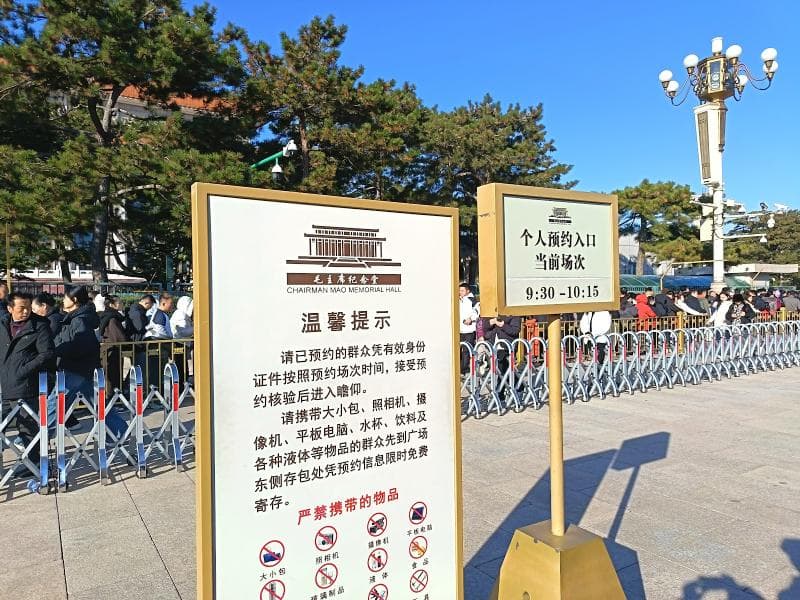
A visit to the Chairman Mao Memorial Hall is a highly regulated experience designed to maintain a solemn and respectful atmosphere. Entry is free, but visitors are required to present a valid passport or ID. Strict security measures are in place, including thorough checks, and certain items are prohibited inside the Hall. Bags, cameras, liquids, and power banks must be deposited at designated storage areas, typically located on the east side of Tiananmen Square, before entering.
Visitors are expected to adhere to a dress code, wearing neat and modest clothing; sleeveless tops, shorts, and flip-flops are generally not permitted. Hats must be removed upon entry. Photography and video recording are strictly forbidden inside the memorial. The viewing process of Mao's body is typically brief, with visitors moving through the hall in a continuous line, maintaining silence and respectful conduct.
The Memorial Hall is usually open to the public in the mornings, typically from 8:00 AM to 12:00 PM, and is closed on Mondays for maintenance. It is advisable to check current opening hours before planning a visit, as schedules can change, and the Hall may close for special events or renovations.
Coordinates: 116.39154, 39.90111
View on Google Maps💬 How Travelers Describe This Place
Based on community votes
Photogenic
996Must See
953Beautiful
658Interesting
585Unique
69
Traveler Stories
Discover memorable experiences shared by travelers who have visited this place.
No traveler stories yet.
Be the first traveler to share what made this place memorable.

Tour
By
Spot
Discover amazing places around the world. Your journey starts here.
Explore
© 2026 TourBySpot. All rights reserved.