Ceremonial Plaza
Chisinau, Moldova
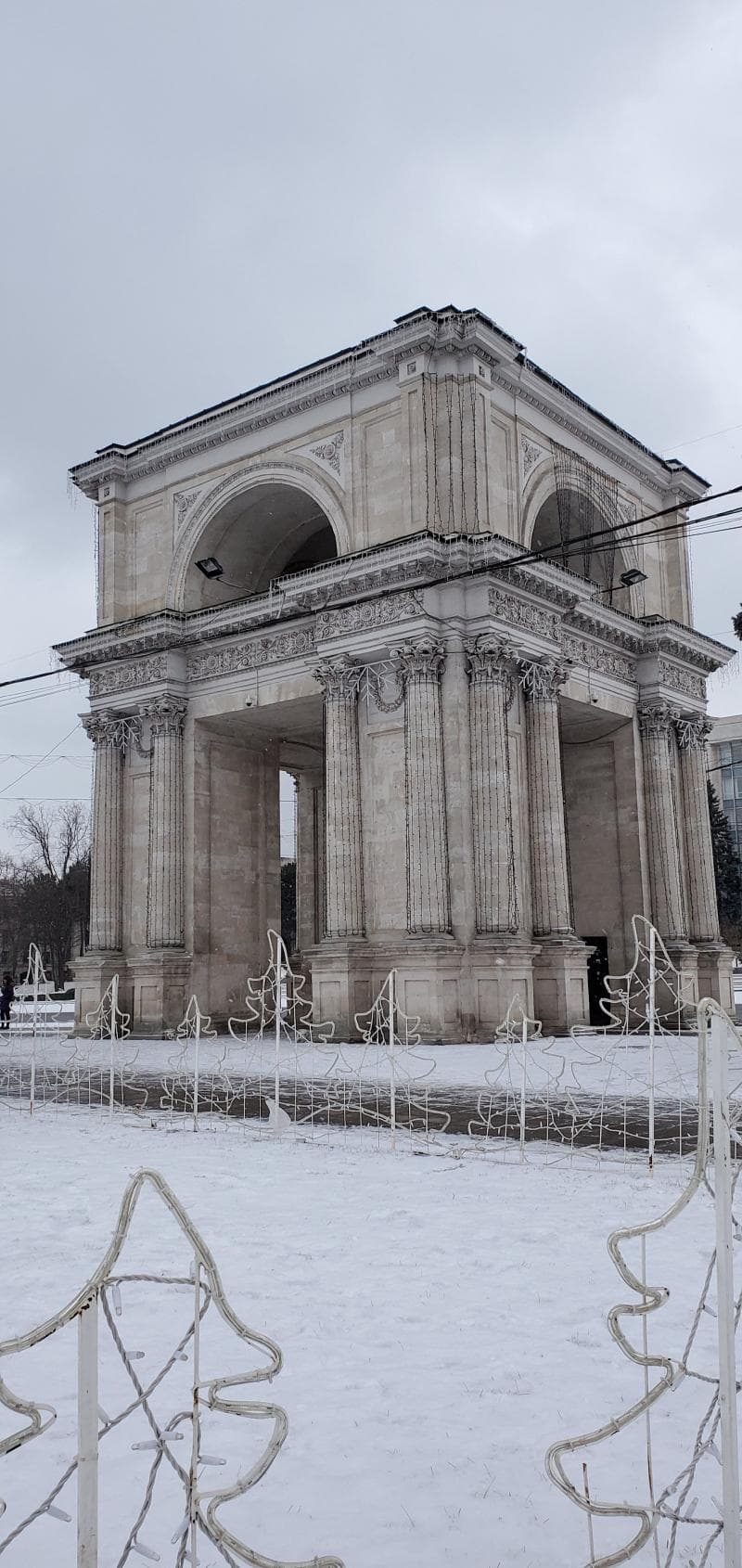
Discover the Triumphal Arch, defining the Ceremonial Plaza, in Chisinau, Moldova. Explore its unique history, iconic bell story, and central role in the capital's life.
Overview
In the heart of Chisinau, Moldova, stands the majestic Triumphal Arch, often referred to locally as the Holy Gates or Arch of Victory. This iconic neoclassical monument, constructed primarily of polished white stone, is more than just an architectural marvel; it defines a significant ceremonial space within the city's vibrant center. Standing 13 meters tall, the arch features a square plan with four distinct openings, making it both an impressive landmark and a functional passageway for pedestrians. Its design, characterized by robust Corinthian pillars and classical embellishments, integrates seamlessly with the surrounding urban landscape, particularly with the adjacent Nativity Cathedral and the Great National Assembly Square. The area encompassing and surrounding this grand structure functions as Chisinau's de facto Ceremonial Plaza, a focal point for public life, celebrations, and historical reflection. [3, 4, 5, 6, 8, 10, 11, 15, 21]
History & Cultural Background
The Triumphal Arch owes its existence to a series of significant historical events and an interesting twist of fate. It was primarily erected between 1840 and 1841 to commemorate the victory of the Russian Empire over the Ottoman Empire during the Russo-Turkish War of 1828-1829. [3, 7, 8, 10, 11, 12, 14, 21] Designed by architect Luka Zaușchevici (also spelled I. Zaushkevich or Ivan Zaushkevich), the arch’s construction was prompted by a rather unusual problem: a massive church bell, weighing approximately 6.4 tons, cast from captured Turkish cannons, was too large for the belfry of the nearby Nativity Cathedral. [3, 4, 5, 7, 8, 9, 12, 13, 15, 21] Thus, the arch was conceived not only as a monument to military triumph but also as a dedicated structure to house this colossal bell. Over its long history, the arch has witnessed various political changes, reflected in its temporary adornments. In 1945, during the Soviet era, marble memorial plaques were affixed to its walls, commemorating Soviet patriotic scenes of World War II and honoring heroes of the Soviet Union. These inscriptions were later removed in 1991, following Moldova's independence. [3, 4, 5, 8, 24]
What Makes It Special
What truly sets Chisinau's Triumphal Arch apart is its unique origin story. Unlike most triumphal arches built purely for commemorative purposes, this one was, in a sense, 'accidentally' born out of necessity to accommodate an oversized bell. [4] This blend of grand commemoration and practical solution gives it a distinctive character. Architecturally, its precise alignment with the Nativity Cathedral and the Government House creates a harmonious and visually striking central ensemble, forming a key part of Chisinau's urban identity. [3, 4, 8, 12, 15, 17, 21, 23] Another captivating feature is the mechanical clock installed on its upper level. The clock has a history of its own, with its first mechanism brought from Odessa in 1842, only to be replaced years later by one from Austria after a strong wind damaged the original. This timepiece has silently marked the hours for generations, witnessing the ebb and flow of the city's life. [4, 5, 8, 9, 11, 15, 24] The arch's beauty and historical significance have earned it recognition, being acclaimed as one of the most beautiful triumphal arches in the world by some publications. [3, 4, 24]
Stories, Fun Facts & Local Details
Known affectionately as the 'Holy Gates,' a name stemming from its close proximity and architectural alignment with the Nativity Cathedral, the arch holds a special place in the hearts of locals. [4, 5, 9, 13, 15] It stands as a silent witness to Moldova's complex past, with the changing marble plaques during and after the Soviet period telling a story of shifting national identities and historical narratives. The sheer size of the original bell, weighing 6.4 tons, is a fun fact that often surprises visitors, highlighting the scale of the challenge that led to the arch's construction. Beyond its physical attributes, the area around the Triumphal Arch truly comes alive as Chisinau's Ceremonial Plaza. It serves as a bustling hub and a traditional meeting point for residents, a backdrop for leisurely daily strolls, and crucially, a stage for significant national celebrations, public events, and even military parades. [6, 11, 17, 21, 23] This makes the arch not merely a monument, but a living part of the city's social and cultural fabric.
Visitor Perspective
For any curious traveler exploring Chisinau, the Triumphal Arch, defining the Ceremonial Plaza, is an accessible and rewarding visit. It is openly available to the public 24 hours a day, seven days a week, and there is no entrance fee, making it an easy addition to any itinerary. [6, 11, 15, 21, 23] While visitors cannot ascend or enter the arch itself, walking beneath its impressive vaults offers a tangible connection to its history and architecture. It is generally recommended to observe its intricate details during daylight hours for the best appreciation, but the arch is also beautifully illuminated at night, creating a captivating spectacle perfect for an evening stroll. [9, 11, 12, 23] Its central location makes it an ideal starting point for further exploration of Chisinau's key attractions, including the peaceful Cathedral Park, the grandeur of the Nativity Cathedral, and the impressive Government House, all within easy walking distance. [6, 8, 12, 15, 17, 18, 21, 23] The Triumphal Arch, as the heart of the Ceremonial Plaza, offers a profound glimpse into Moldova's heritage and its enduring spirit.
Coordinates: 28.8325, 47.02472
View on Google Maps💬 How Travelers Describe This Place
Based on community votes
Beautiful
915Interesting
873Photogenic
422Must See
123Unique
53
Traveler Stories
Discover memorable experiences shared by travelers who have visited this place.
No traveler stories yet.
Be the first traveler to share what made this place memorable.

Tour
By
Spot
Discover amazing places around the world. Your journey starts here.
Explore
© 2026 TourBySpot. All rights reserved.