Central Stupa
Yangon, Myanmar
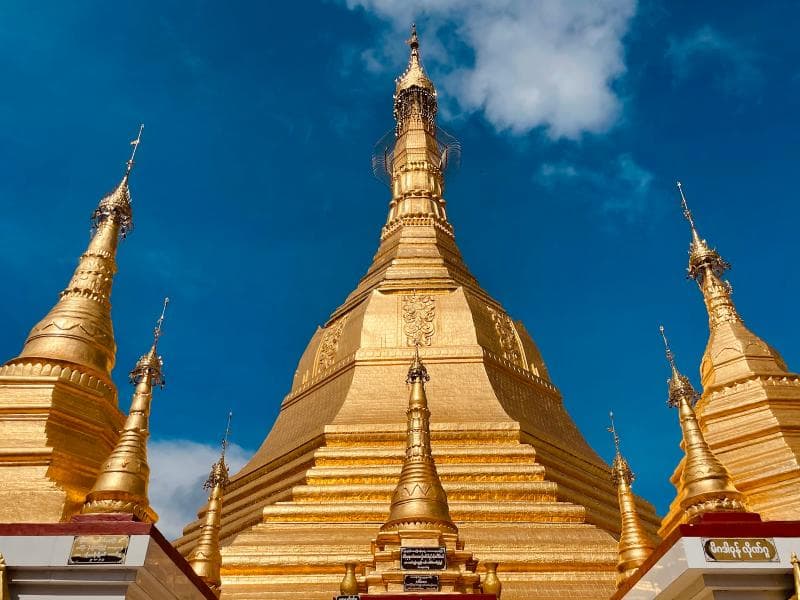
Explore the ancient Central Stupa of Sule Pagoda in Yangon, Myanmar. Discover its 2,500-year history, unique octagonal design, and cultural significance.
Overview
At the very heart of downtown Yangon, Myanmar, stands the ancient and gilded Central Stupa of the Sule Pagoda, a beacon of spirituality and history. This iconic landmark is not merely a religious site but the geographical and historical anchor of the city, positioned at the bustling intersection of Sule Pagoda Road and Mahabandoola Road. Its distinctive octagonal shape, which gracefully tapers upwards, makes it immediately recognizable amidst the surrounding colonial-era architecture and modern urban landscape. The Central Stupa, often simply referred to as Sule Pagoda, is believed to enshrine a sacred strand of the Buddha's hair, granting it profound spiritual significance for Buddhists across the globe. Its golden dome shimmers, particularly at dawn and dusk, offering a captivating sight and an oasis of calm despite the ceaseless activity outside its sacred precincts. More than 2,000 years old by legend, this stupa has witnessed and shaped centuries of Burmese life, serving as a silent guardian through changing empires and political landscapes.
History & Cultural Background
The history of the Central Stupa and the wider Sule Pagoda complex is deeply intertwined with the ancient legends of Myanmar. According to local lore, the pagoda predates the famous Shwedagon Pagoda, with its origins tracing back over 2,500 years to the time of Gautama Buddha himself. A captivating legend tells of Sularata, the 'Sule Nat' or spirit, so ancient that his eyelids had to be propped open with trees. This powerful nat is said to have revealed the location of the sacred Buddha relics to King Okkalapa, guiding him to the site for the construction of the Shwedagon Pagoda. The Sule Pagoda was then built on the very spot where this revered spirit resided.
Historically, the Central Stupa has played a pivotal role beyond its religious function. During the British occupation in the mid-19th century, Lieutenant Alexander Fraser used the pagoda as the nucleus for redesigning Yangon's street layout, making it the precise center of the city's grid pattern. Its significance as a rallying point for political movements, including the 1988 uprisings, the 2007 Saffron Revolution, and the 2021 Spring Revolution, further underscores its importance as a symbol of Burmese identity and resilience.
What Makes It Special
The Central Stupa at Sule Pagoda distinguishes itself through several unique attributes. Its remarkable age, dating back to antiquity, imbues it with an almost palpable sense of history and profound spiritual energy. Architecturally, its Mon-style design featuring a continuous octagonal shape from base to spire is considered unusual for a Burmese pagoda, setting it apart from many other stupas in the region. The belief that it houses a genuine strand of Buddha's hair makes it a venerated pilgrimage site, drawing devotees seeking blessings and spiritual solace. Furthermore, its strategic location at the confluence of major roads has cemented its status as not just a religious monument but also a vital civic and cultural hub, where spiritual devotion intersects with the everyday life and political history of Yangon.
Stories, Fun Facts & Local Details
Beyond its grand history, the Central Stupa is rich with local stories and intriguing details. The very name 'Sule' is thought to derive from 'Su-way,' a Burmese word meaning 'meeting' or 'gather around,' aptly reflecting its central location where paths converge. Surrounding the main stupa are numerous smaller shrines, each dedicated to a nat, or spirit, often associated with a specific astrological sign. Devotees often visit the Buddha image corresponding to their birth day of the week, offering prayers for health and prosperity. A fun, interactive detail for visitors is the tradition of ringing one of the ten bronze bells found around the pagoda after performing a good deed, a custom that resonates with the spiritual practices observed here. Inside, one might observe a unique pulley system used to transport gold leaf offerings to be placed on the upper reaches of the stupa, a tangible act of devotion. The pagoda complex also hosts various festivals throughout the year, transforming into a vibrant hub of traditional music, dance, and communal celebrations.
Visitor Perspective
Visiting the Central Stupa of Sule Pagoda offers a unique sensory and spiritual experience. The pagoda is open daily, typically from early morning around 4:00 AM until late evening, often 10:00 PM or 11:00 PM, allowing visitors ample time for contemplation or exploration. An entrance fee is usually required for foreign visitors, varying between 2,000 to 5,000 Burmese Kyat (approximately $2-5 USD). As with all sacred sites in Myanmar, visitors are expected to remove their shoes before entering the pagoda grounds, so wearing slip-on footwear is a practical choice. Many choose to hire a local guide, whose insights can illuminate the historical narratives and religious customs of the site. The circular pathway around the main stupa invites a meditative walk, past the various shrines and Buddha images, providing an opportunity to observe local worshippers making offerings of flowers, incense, and candles. Despite its urban setting, the sacred space of the Central Stupa offers a tranquil refuge, a place to connect with Myanmar's deep spiritual heritage and witness the enduring faith of its people.
Coordinates: 96.158741, 16.774427
View on Google Maps💬 How Travelers Describe This Place
Based on community votes
Interesting
934Must See
705Unique
449Photogenic
279Beautiful
256
Traveler Stories
Discover memorable experiences shared by travelers who have visited this place.
No traveler stories yet.
Be the first traveler to share what made this place memorable.

Tour
By
Spot
Discover amazing places around the world. Your journey starts here.
Explore
© 2026 TourBySpot. All rights reserved.