Central Fire Altar
Baku, Azerbaijan
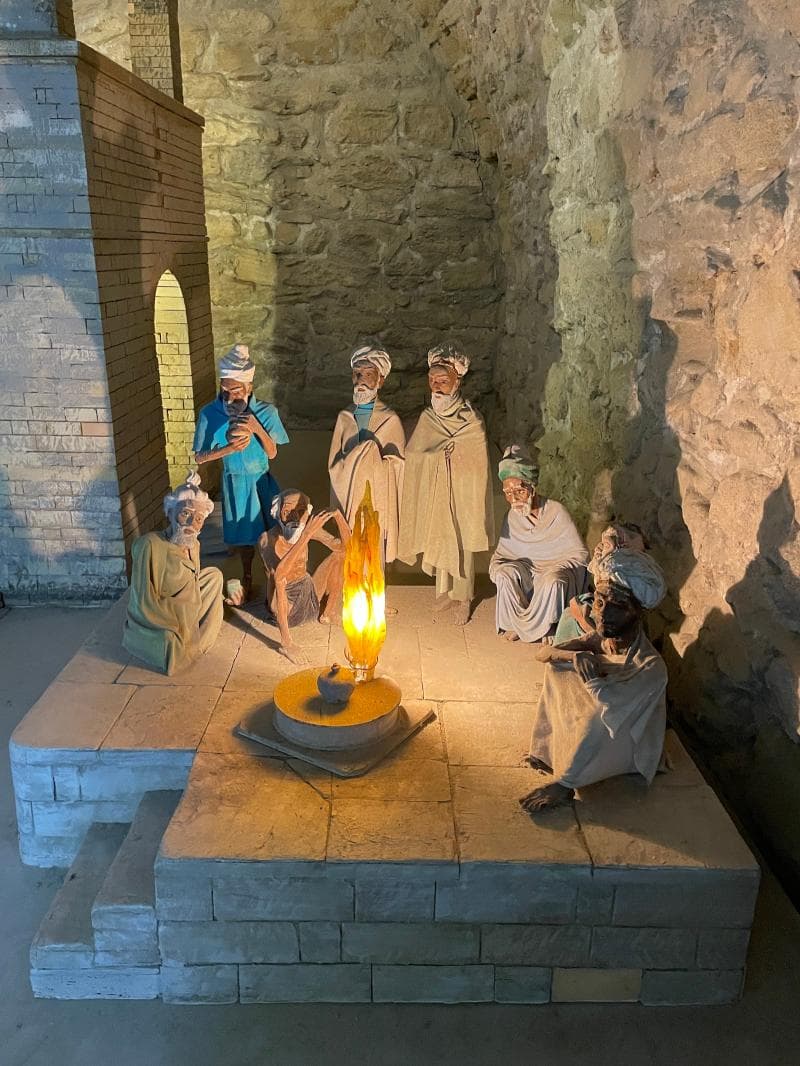
Explore the Central Fire Altar within Ateshgah of Baku, Azerbaijan – a historic fire temple and ancient pilgrimage site for Zoroastrians, Hindus, and Sikhs.
Overview
Nestled on the Absheron Peninsula, a short journey from Azerbaijan's vibrant capital, Baku, lies the Ateshgah – often referred to as the 'Fire Temple of Baku'. This unique historical and architectural complex houses the revered Central Fire Altar, a site of profound spiritual significance for centuries. The Ateshgah complex, a pentagonal fortress-like structure, stands as a testament to the region's ancient connection with fire, deeply rooted in its natural gas reserves. While the natural flames that once spontaneously ignited from the earth's vents have since diminished, the essence of the sacred fire is preserved, now maintained by a piped gas supply, allowing visitors to witness the enduring legacy of fire worship.
Today, the Ateshgah of Baku functions as an open-air museum, offering a compelling glimpse into the diverse religious and cultural tapestry that once flourished along the ancient Silk Road. It attracts tens of thousands of visitors annually, drawn by its fascinating history and unique blend of architectural styles.
History & Cultural Background
The history of fire worship on the Absheron Peninsula stretches back to antiquity, making Azerbaijan known as the 'Land of Fire'. While rituals date to at least the 10th century, the current Ateshgah complex was constructed primarily between the 17th and 18th centuries. It emerged as a significant pilgrimage site for Zoroastrians, Hindus, and Sikhs, particularly merchants and ascetics from the Indian subcontinent who traveled along the trade routes connecting the Caspian Sea region.
The temple's origins are intertwined with the presence of vast underground natural gas reservoirs that allowed flames to burn continuously from subterranean vents. For centuries, these 'eternal' fires fueled devotion and attracted pilgrims seeking spiritual solace. However, by the late 19th century, the natural gas supply dwindled, largely due to extensive oil and gas exploitation in the area, leading to the extinction of the natural flames by 1969. Subsequently, the complex was converted into a museum in 1975, and in 2007, it was officially declared a State Historical-Architectural Reserve by presidential decree, solidifying its preservation for future generations.
What Makes It Special
The Central Fire Altar is the undeniable heart of the Ateshgah, standing majestically within the pentagonal courtyard. This stone pavilion, supported by four columns and topped with a dome, was specifically built directly over a natural gas vent, ensuring the perpetual presence of fire. Beyond the central flame, four smaller flames traditionally burned from rooftop corners of the pavilion, adding to its mystique.
What truly sets Ateshgah apart is its testimony to a rare form of religious coexistence. Within the courtyard, 24 to 26 cell-like rooms provided quarters for hermits and pilgrims. Many of these cells bear inscriptions in Sanskrit, Punjabi (Gurmukhi script), and Persian, reflecting the diverse religious communities—Hindus, Sikhs, and Zoroastrians—who worshipped side by side at this sacred site. The architectural elements themselves, blending Persian and Indian styles, further underscore its multicultural heritage, creating a tangible symbol of shared spiritual reverence for fire.
Stories, Fun Facts & Local Details
The very name 'Ateshgah' translates from Persian as 'House of Fire', a fitting moniker for a region historically dubbed the 'Land of Fire'. One of the most fascinating aspects is the historical debate surrounding the temple's primary religious affiliation. While Zoroastrianism has deep roots in the region, many inscriptions and architectural details, such as the trident (Trishul) symbol often associated with Hinduism, suggest a predominant Hindu and Sikh influence during the temple's active period of worship. This speaks volumes about the fluidity of spiritual practices along ancient trade routes.
Pilgrims who resided in the surrounding cells sometimes engaged in severe ascetic practices, such as self-shackling or lying on limestone, as a means to atone for sins or ward off illnesses. The fact that the natural flame extinguished in 1969 due to human activity, only to be artificially rekindled, offers a poignant narrative about humanity's impact on natural wonders and our enduring desire to preserve sacred traditions.
Visitor Perspective
A visit to the Central Fire Altar at Ateshgah offers a captivating journey back in time. Travelers can explore the meticulously preserved complex, walking through the cells where monks and pilgrims once lived, reflecting on the historical inscriptions that adorn the walls. The main altar, with its continually burning flame, remains the focal point, providing a powerful visual link to centuries of devotion. The site is a compact, yet profoundly significant, museum reserve, providing clear explanations of its historical and cultural context through exhibits.
Recognized as a UNESCO World Heritage tentative site, the Ateshgah of Baku stands not merely as a relic, but as a living reminder of Azerbaijan's rich past, its natural wonders, and the historical convergence of diverse faiths. It is a destination that truly enriches one's understanding of cultural exchange and spiritual reverence for the element of fire.
Coordinates: 50.00832110763009, 40.41542789956181
View on Google Maps💬 How Travelers Describe This Place
Based on community votes
Interesting
961Must See
733Photogenic
695Beautiful
404Unique
336
Traveler Stories
Discover memorable experiences shared by travelers who have visited this place.
No traveler stories yet.
Be the first traveler to share what made this place memorable.

Tour
By
Spot
Discover amazing places around the world. Your journey starts here.
Explore
© 2026 TourBySpot. All rights reserved.