Cavea
Antalya, Turkey
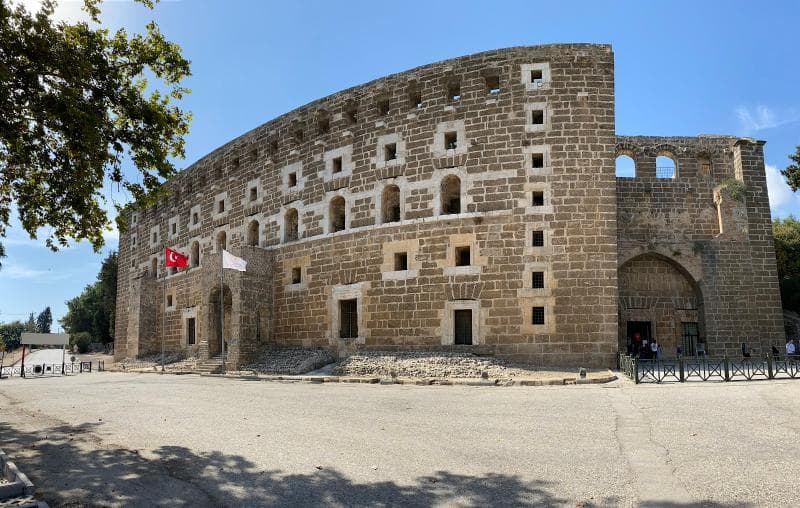
Explore the ancient Cavea of Aspendos Theatre in Antalya, Turkey. Discover its Roman history, legendary acoustics, and what makes this preserved marvel special.
Overview
Nestled amidst the picturesque landscapes of Antalya, Turkey, the ancient city of Aspendos guards one of the world's most remarkably preserved Roman theatres. Within this architectural marvel lies the 'cavea', the heart of the audience experience. The Aspendos Theatre, dating back to the 2nd century AD, stands as a testament to Roman engineering and aesthetic prowess, drawing visitors from across the globe to witness its grandeur. Located approximately 45 to 50 kilometers east of Antalya city center, it remains an accessible and awe-inspiring destination that transports you back to the days of gladiatorial contests and dramatic performances.
The cavea itself, a semi-circular expanse of tiered seating, was meticulously designed to accommodate thousands of spectators, all while ensuring optimal sightlines and, famously, unparalleled acoustics. Constructed primarily from local limestone, its robust structure has defied centuries of natural wear and human intervention, offering today's traveler an almost intact glimpse into ancient entertainment venues.
History & Cultural Background
The Aspendos Theatre was constructed during the reign of the Roman Emperor Marcus Aurelius, between 161 and 180 AD. Its creation was spearheaded by the local Greek architect, Zenon, a native of Aspendos. Funding for this colossal project came from two wealthy brothers, Curtius Crispinus and Curtius Auspicatus, who dedicated the theatre to the gods of the region and the imperial household. This dedication underscores the cultural significance and the Roman practice of using grand architecture to express civic pride and imperial allegiance.
Despite being built during the Roman period, the theatre subtly incorporates certain Greek architectural characteristics, particularly in its seating structure which, unlike fully free-standing Roman amphitheatres, partially rests against the natural slope of a hillside. For centuries, this theatre served as a vibrant hub for social events, theatrical plays, and musical performances. Its continuous use through different eras, including its conversion into a caravanserai by the Seljuks in the 13th century, played a crucial role in its exceptional preservation.
What Makes It Special
The Cavea of the Aspendos Theatre is special due to its remarkable preservation and ingenious design. It is typically semi-circular, a characteristic of Roman theatres, and is divided horizontally by a walkway known as a 'diazoma', separating the lower and upper seating sections. The rows of limestone seats rise steeply, providing every one of the estimated 12,000 to 15,000 spectators an unobstructed view of the stage. This thoughtful arrangement highlights the sophistication of Roman urban planning and audience management.
Beyond its sheer scale, the theatre's acoustic perfection is legendary. It is famously said that a coin dropped on the stage or a whisper spoken there can be heard clearly even from the highest rows of the cavea, without any modern amplification. This acoustic phenomenon is a direct result of Zenon's brilliant architectural design, which leveraged the semi-circular shape and the towering stage building (scaenae frons) to channel sound effectively.
Stories, Fun Facts & Local Details
One popular legend surrounding the construction of the Aspendos Theatre tells of a competition held by the ruler of Aspendos, who promised his daughter's hand in marriage to the man who could create the most beneficial work for the city. Two architects emerged as finalists: one who designed a complex aqueduct system, and Zenon, who built the theatre. During the final judgment, the ruler, while inspecting the theatre from the highest seats of the cavea, was reportedly captivated by Zenon's whispered plea from the stage below. So impressed was he by the theatre's perfect acoustics that Zenon won the competition and the hand of the princess.
Another fascinating detail is the role the Seljuks played in the theatre's survival. In the 13th century, they adapted the stage building into a palace and used the theatre as a caravanserai, a roadside inn for travelers. This repurposing, rather than destruction, inadvertently ensured its structural integrity for centuries. Furthermore, in the 1930s, Mustafa Kemal Atatürk, the founder of modern Turkey, visited Aspendos and, recognizing its immense historical value, famously ordered its preservation, declaring that 'such a magnificent structure must not be wasted.'
Visitor Perspective
Stepping into the cavea of the Aspendos Theatre today is an immersive journey through time. As you climb the ancient, worn steps, perhaps imagining the murmurs of thousands of Roman citizens or the applause for a celebrated actor, you gain a profound sense of connection to history. The sheer scale is breathtaking; the towering stage building, still standing almost entirely intact, creates a powerful backdrop, while the sweeping curve of the seats invites contemplation.
Experiencing the renowned acoustics is often a highlight for visitors. Many test it by speaking or clapping from various points, amazed at how sound carries across the vast space. From the upper rows, the panoramic views of the surrounding countryside, including the nearby Köprüçay River, are magnificent, offering a moment of serene reflection alongside the historical wonder. Today, the theatre continues its legacy by hosting the annual International Aspendos Opera and Ballet Festival, allowing modern audiences to experience world-class performances in an authentically ancient setting.
Coordinates: 31.17251, 36.93903
View on Google Maps💬 How Travelers Describe This Place
Based on community votes
Beautiful
963Photogenic
925Unique
814Interesting
697Must See
246
Traveler Stories
Discover memorable experiences shared by travelers who have visited this place.
No traveler stories yet.
Be the first traveler to share what made this place memorable.

Tour
By
Spot
Discover amazing places around the world. Your journey starts here.
Explore
© 2026 TourBySpot. All rights reserved.