Cathedral Of Saint Domnius
Split, Croatia
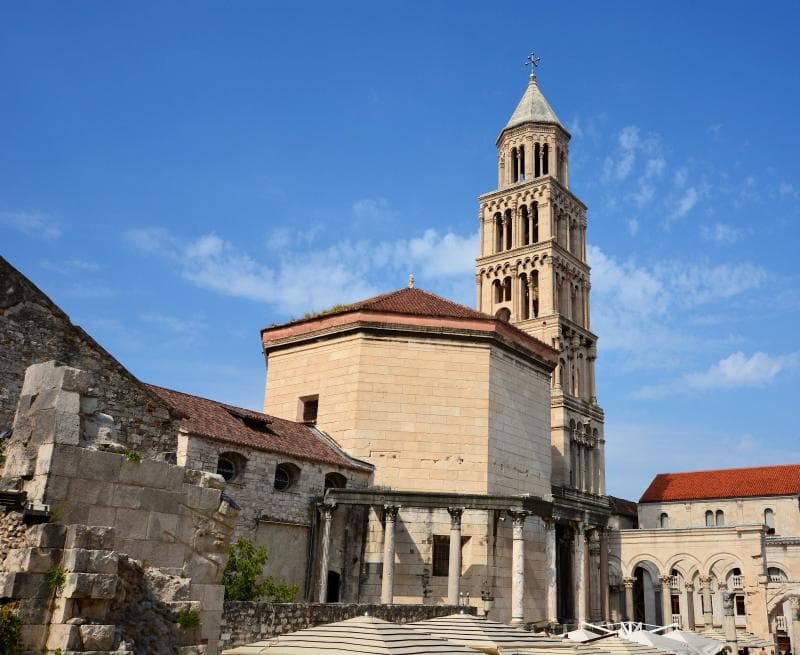
Explore Split's Cathedral of Saint Domnius, originally Emperor Diocletian's mausoleum, now the world's oldest Catholic cathedral in continuous use. Discover its rich history, unique architecture, and panoramic bell tower views in Split, Croatia.
Overview
Nestled within the ancient walls of Diocletian’s Palace in Split, Croatia, stands the Cathedral of Saint Domnius, a truly extraordinary monument. More than just a church, it is a living testament to millennia of history, initially conceived not as a place of Christian worship, but as the opulent mausoleum for the Roman Emperor Diocletian in AD 305. Today, it holds the distinction of being the oldest Catholic cathedral in the world that remains in continuous use within its original structure. Its striking Romanesque bell tower, a prominent feature of Split's skyline, beckons visitors to discover the layers of history contained within this remarkable edifice.
History & Cultural Background
The story of the Cathedral of Saint Domnius begins with Emperor Diocletian, who, after his abdication, retired to his grand palace in Split. His final resting place was an imposing octagonal mausoleum, built to reflect imperial power and grandeur. However, history took an ironic turn. In the 7th century, as Christianity gained prominence and after the nearby city of Salona fell, refugees sought sanctuary within Diocletian's Palace. They transformed the very tomb of the emperor who once persecuted Christians into a cathedral, dedicating it to Saint Domnius (Sveti Duje), the Bishop of Salona who was martyred under Diocletian's reign. This act symbolically reconciled pagan antiquity with the nascent Christian tradition, creating a profoundly significant sacred space.
What Makes It Special
The Cathedral of Saint Domnius is a unique architectural marvel, an intricate blend of Roman imperial design and later medieval additions. Its original octagonal Roman core, supported by 24 columns, still dominates, featuring an interior adorned with Corinthian columns and friezes that date back to Diocletian's time. The dome, once covered in glittering mosaics, showcases an ingenious fan-like brick arrangement. One of its most celebrated features is the monumental wooden main door, crafted by the medieval Croatian sculptor Andrija Buvina around 1214. These two wings depict 28 intricate scenes from the life of Jesus Christ, a masterpiece of Romanesque sculpture. Adjacent to the main structure is the impressive bell tower, built predominantly in the Romanesque style from the 12th to the 16th century, though it underwent significant reconstruction in the early 20th century.
Stories, Fun Facts & Local Details
The most compelling 'fun fact' about the Cathedral of Saint Domnius lies in its profound historical irony: it is the mausoleum of a persecutor of Christians repurposed as a cathedral dedicated to a Christian martyr, Saint Domnius, who suffered during that very persecution. Locals affectionately refer to the cathedral as 'Sveti Duje' and annually celebrate the feast day of Saint Domnius with a solemn procession, reaffirming the city's enduring spiritual connection to its patron saint. Inside the cathedral, visitors can explore the treasury, which houses relics of Saint Domnius, along with other valuable artifacts. Beneath the cathedral lies the atmospheric Crypt of St. Lucy, offering another layer of historical intrigue. The blend of a Roman emperor's likeness on a cornice alongside hunting erots and masks, within a Christian sacred space, offers a captivating glimpse into the cultural shifts that shaped this region.
Visitor Perspective
For the curious traveler, visiting the Cathedral of Saint Domnius offers an immersive journey through time. The interior provides a powerful sense of antiquity, with Roman architectural elements seamlessly integrated into a living church. A highlight for many is the ascent of the bell tower. While the climb can be steep, the reward is an unparalleled panoramic view of Split, Diocletian's Palace, and the glistening Adriatic Sea. This experience offers a unique vantage point to appreciate the city's layout and the palace's integration into modern life. Consider visiting earlier in the morning or later in the afternoon to avoid peak crowds, especially during the busy summer months, ensuring a more contemplative and enjoyable experience. Exploring the Cathedral, its treasury, and the crypt allows visitors to truly grasp the monumental historical and cultural significance embedded within Split's very heart.
Coordinates: 16.44046, 43.50803
View on Google Maps💬 How Travelers Describe This Place
Based on community votes
Beautiful
853Interesting
639Photogenic
569Must See
190Unique
93
Traveler Stories
Discover memorable experiences shared by travelers who have visited this place.
No traveler stories yet.
Be the first traveler to share what made this place memorable.

Tour
By
Spot
Discover amazing places around the world. Your journey starts here.
Explore
© 2026 TourBySpot. All rights reserved.