Cathedral Interior
Florence, Italy
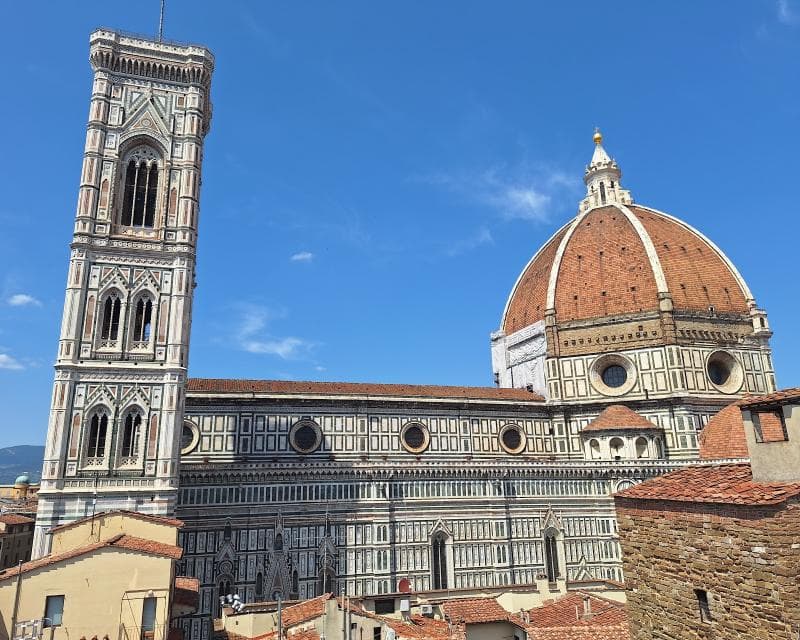
Explore the magnificent interior of Florence Cathedral in Florence, Italy, home to Brunelleschi's Dome frescoes, historic art, and serene grandeur.
Overview
Stepping inside the Florence Cathedral, formally known as the Cattedrale di Santa Maria del Fiore, offers a profound experience distinct from its vibrant exterior. While the outside dazzles with polychrome marble, the interior often surprises visitors with its vast, serene, and historically austere grandeur. This iconic landmark, a symbol of Florence, Italy, embodies centuries of artistic and spiritual dedication, inviting quiet contemplation amidst its monumental scale.
The Cathedral’s interior is a testament to Florentine ingenuity and spiritual ideals. Its immense size—measuring 153 meters in length and 90 meters at the transept—was designed to awe, making it one of the largest churches in the world at the time of its completion. Free to enter, the nave provides a unique perspective on the evolution of Italian Gothic and early Renaissance architecture.
History & Cultural Background
Construction of the Cathedral began in 1296, initiated by Arnolfo di Cambio in the Gothic style, on the foundations of the ancient church of Santa Reparata. The project aimed to create the largest church in the world, reflecting Florence's growing power and ambition. Over decades, other architects like Francesco Talenti continued its development, significantly enlarging the initial design. The interior's initial sobriety was a conscious choice, reflecting the austere spiritual ideals prevalent in medieval Florence.
A pivotal moment arrived in the 15th century with Filippo Brunelleschi's revolutionary engineering of the dome, completed in 1436. This architectural marvel transformed the Cathedral into a symbol of Renaissance innovation. The entire structure, including the dome, was officially consecrated by Pope Eugene IV in 1436. Later, during the 16th century, grand ducal patronage led to the enrichment of the interior with features like colored marble floors, a contrast to its earlier simplicity.
What Makes It Special
The interior of Florence Cathedral holds a treasure trove of art and architectural wonders. The undisputed highlight is the magnificent fresco cycle of 'The Last Judgment' that adorns the inner surface of Brunelleschi's Dome. Begun by Giorgio Vasari in 1572 and completed by Federico Zuccari after Vasari's death, this monumental work covers 3,600 square meters and features approximately 700 figures, creating a breathtaking visual narrative visible during the ascent to the dome.
Beyond the dome, the Cathedral features exquisite stained-glass windows, many created between 1434 and 1455 from designs by masters such as Donatello, Lorenzo Ghiberti, Andrea del Castagno, and Paolo Uccello. On the counter-facade, Paolo Uccello's unique 24-hour liturgical clock from 1443, with its backwards-moving hands and four mysterious heads of saints in the corners, is a remarkable sight. Along the nave walls, visitors can admire significant frescoes, including the equestrian monuments to 'Condottiero Giovanni Acuto' (John Hawkwood) by Paolo Uccello (1436) and 'Niccolò da Tolentino' by Andrea del Castagno (1456), alongside Domenico di Michelino's notable painting of Dante.
The archaeological crypt of Santa Reparata, located beneath the Cathedral, offers a journey through Florence's past, revealing remnants from early Christian, Roman, and Carolingian eras, and is the final resting place of Brunelleschi himself.
Stories, Fun Facts & Local Details
The stark contrast between the Cathedral's elaborately decorated exterior and its relatively unadorned interior often surprises first-time visitors. This simplicity was a deliberate choice by the Florentines, emphasizing spiritual focus over decorative extravagance during its initial construction phases. However, the sheer scale of the space itself was intended to impress and symbolize the city's power.
A fascinating detail is the burial of Filippo Brunelleschi, the genius behind the dome, within the crypt of Santa Reparata. This was an exceptional honor for an architect of his time, reflecting his immense contribution and the high esteem in which he was held. The dome's construction itself is full of legendary tales, including a story that Michelangelo, upon seeing a proposed drum design by Baccio d'Agnolo, quipped that it looked like a 'cricket cage,' leading to the drum being left unfinished as it stands today. The Cathedral's artwork also served a civic purpose, honoring 'illustrious men' of Florence, such as the aforementioned military commanders and Dante Alighieri, reflecting the city's pride in its citizens.
Visitor Perspective
Upon entering, visitors are immediately struck by the vastness and impressive height of the nave. While entry to the main cathedral area is free, it typically involves queuing, especially during peak seasons. Inside, a respectful dress code is enforced: shoulders and knees must be covered, as it remains an active place of worship.
Viewing the dome's frescoes from the floor of the cathedral is one perspective, but climbing the 463 steps to the top of Brunelleschi's Dome offers an unparalleled, up-close experience of Vasari and Zuccari's detailed artwork. This climb also provides insights into the dome's innovative double-shell construction. It's an opportunity to appreciate not only the art but also the engineering marvel that continues to define Florence's skyline.
Coordinates: 11.25694, 43.77306
View on Google Maps💬 How Travelers Describe This Place
Based on community votes
Photogenic
836Must See
287Interesting
255Beautiful
231Unique
86
Traveler Stories
Discover memorable experiences shared by travelers who have visited this place.
No traveler stories yet.
Be the first traveler to share what made this place memorable.

Tour
By
Spot
Discover amazing places around the world. Your journey starts here.
Explore
© 2026 TourBySpot. All rights reserved.