Cathedral Interior
Lviv, Ukraine
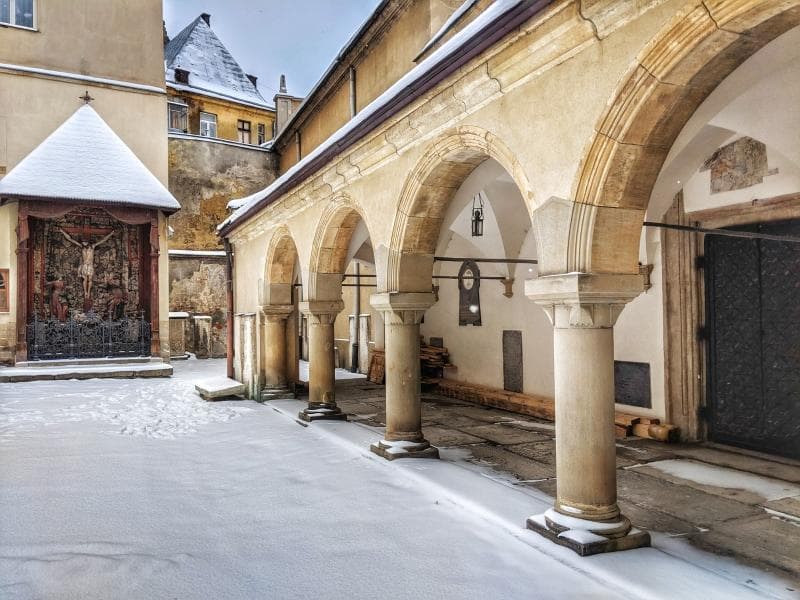
Explore the stunning Cathedral Interior of the Armenian Cathedral of Lviv, Ukraine. Discover Art Deco frescoes, Venetian mosaics, and ancient khachkars.
Overview
Step inside the Armenian Cathedral of Lviv, and you enter a space that transcends time, a captivating blend of centuries of history, faith, and artistic expression. The interior, known as ‘Cathedral Interior’, is a testament to the enduring spirit of the Armenian community in Lviv, Ukraine, reflecting diverse architectural and artistic influences from its 14th-century origins to its significant 20th-century artistic renovations. This sacred space is particularly renowned for its striking Art Deco frescoes by Jan Henryk Rosen and the exquisite Venetian mosaics crafted by Józef Mehoffer, offering a truly unique spiritual and aesthetic experience. It is a place where Eastern tradition beautifully converges with Western artistic styles, inviting contemplation and wonder.
History & Cultural Background
The Armenian Cathedral, formally known as the Armenian Cathedral of the Assumption of Mary, began its construction between 1363 and 1370, modeled after the Cathedral of Ani, the ancient Armenian capital. This initial phase established a structure that fused Armenian architectural elements with Byzantine and Gothic influences, marking it as one of the oldest surviving churches in Lviv. Over the centuries, the cathedral underwent numerous reconstructions and additions, adapting to changing times and artistic trends. The 15th century saw the addition of an arcade, and the main nave was extended in 1630 and further rebuilt in 1723, incorporating Baroque features. A pivotal period for the interior's current appearance was the early 20th century, particularly between 1908 and 1927. During this time, Polish artists Jan Henryk Rosen and Józef Mehoffer were commissioned to redefine its internal aesthetics. The cathedral served as the spiritual center for the Armenian Catholic Archeparchy of Lviv until 1945. After being closed during the Soviet era and used for storing plundered sacred art, it was returned to the Armenian community in 2000 and reconsecrated in 2003, now serving the Armenian Diocese of Ukraine.
What Makes It Special
The ‘Cathedral Interior’ is distinguished by its seamless integration of ancient Armenian forms with early 20th-century modern art. The most celebrated features are the vibrant frescoes by Jan Henryk Rosen, created between 1926 and 1929. These Art Deco murals cover vast sections of the walls, depicting religious scenes with a distinctly contemporary, almost mystical, flair. One of the most famous is 'The Funeral of St. Odilon', known for its ethereal depiction of a funeral procession with children, monks, and shadowy figures. The dome of the cathedral, particularly the altar part, is adorned with exquisite Venetian mosaics designed by Józef Mehoffer in 1912. The dome's 'Holy Trinity' mosaic is particularly noteworthy for its bold iconographic innovation, portraying God the Father holding the body of Christ, supported by angels. Throughout the interior, one can also find ancient Armenian carved stone crosses, known as khachkars, some dating back to the 14th and 15th centuries, embedded in the walls and pillars, representing a deeply rooted Armenian sacred art tradition.
Stories, Fun Facts & Local Details
Jan Henryk Rosen's creative process brought intriguing details to the cathedral. For his monumental fresco, 'The Last Supper', located behind the altar, it is said that the artist invited celebrities and actors from Lviv to pose as models for the figures, adding a layer of local character to the sacred narrative. Another compelling detail is found in 'The Funeral of St. Odilon', where ghosts are depicted participating in their own funeral, adding a unique, almost surreal, element to the spiritual imagery. The interior also preserves a carved wooden ceiling from the 17th century, providing a contrast to the 20th-century modern art. The blend of styles from different eras means that visitors are constantly discovering new facets, from ancient Byzantine-style frescoes on window frames to the rich ornamental paintings based on old Armenian prints. The cathedral's courtyard, visible from within some parts, features old Armenian tombstones, some of which were moved from ancient cemeteries, connecting the interior's spiritual space with the history of the Armenian community's presence in Lviv.
Visitor Perspective
Entering the Armenian Cathedral's interior is often described as stepping into an ‘extraordinary fairy-tale world of the East’, offering a profound sense of peace and historical depth. The interplay of light on the vivid frescoes and shimmering mosaics creates an atmosphere that is both grand and intimately spiritual. Visitors are encouraged to take their time, observing the intricate details of Rosen's murals, from the dramatic narratives to the subtle expressions of the figures. The artistry invites close inspection, revealing layers of meaning and technique. The cathedral is an active church, offering a chance to witness living history and faith. It is also quite accessible; while the address is 7-13 Virmenska Street, the entrance to the courtyard is often from Krakivska Street, and the interior is largely accessible for those with reduced mobility, allowing free movement within the church. The experience is not just about viewing art; it is about immersing oneself in a space that has been a spiritual and cultural beacon for Armenians in Lviv for over six centuries.
Coordinates: 24.03083, 49.84333
View on Google Maps💬 How Travelers Describe This Place
Based on community votes
Unique
710Must See
448Beautiful
156Photogenic
102Interesting
87
Traveler Stories
Discover memorable experiences shared by travelers who have visited this place.
No traveler stories yet.
Be the first traveler to share what made this place memorable.

Tour
By
Spot
Discover amazing places around the world. Your journey starts here.
Explore
© 2026 TourBySpot. All rights reserved.