Cathedral Facade
Ho Chi Minh City, Vietnam
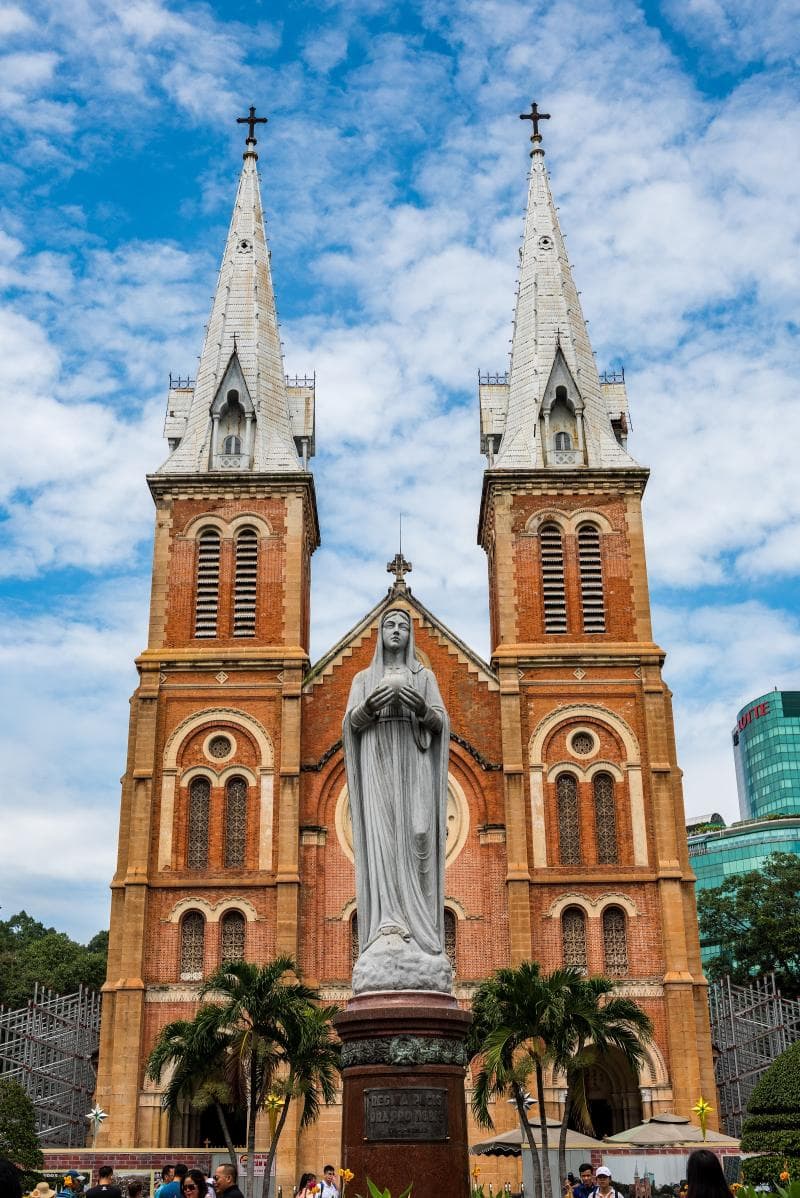
Explore the iconic Cathedral Facade of Saigon Notre-Dame Cathedral in Ho Chi Minh City, Vietnam. Discover its French colonial architecture, red bricks, and twin bell towers.
Overview
Nestled in the bustling heart of Ho Chi Minh City, formerly known as Saigon, stands the magnificent Saigon Notre-Dame Cathedral. Officially christened the Basilica of Our Lady of the Immaculate Conception, this architectural marvel is a enduring symbol of French colonial heritage in Vietnam. Its distinctive red brick facade and imposing twin bell towers immediately capture the eye, making it an iconic landmark in District 1. Constructed between 1877 and 1880, the cathedral showcases a captivating blend of Neo-Romanesque and subtle Gothic architectural styles, offering a serene counterpoint to the city's vibrant energy.
History & Cultural Background
The story of the Saigon Notre-Dame Cathedral begins in the late 19th century during the French colonial era. Following their establishment in Saigon, French administrators sought to build a grand church to serve the growing Catholic community and colonial officials. An initial wooden church, erected in 1863, unfortunately succumbed to termite damage. This led to the commissioning of a new, more enduring structure in 1877. French architect J. Bourard's design was chosen, and construction commenced, culminating in its completion in 1880. The ambitious project cost approximately 2.5 million French francs, funded by the French Cochinchine government, leading to its initial designation as the 'State Cathedral'. Remarkably, all construction materials, from the distinctive red bricks sourced from Toulouse or Marseille, to the cement, steel, tiles, screws, and even stained glass, were meticulously imported directly from France, ensuring the highest European standards. In 1895, architect Gardes further enhanced its silhouette by adding the striking iron spires atop the twin bell towers, raising their height significantly. The cathedral received its current popular name, Notre-Dame Cathedral, in 1959, following the installation of the 'Our Lady of Peace' statue in its forecourt. Its religious significance was further elevated in 1962 when Pope John XXIII conferred upon it the status of a Basilica.
What Makes It Special
The facade of the Saigon Notre-Dame Cathedral is its most striking feature, a testament to enduring French craftsmanship. Its Neo-Romanesque style, characterized by rounded arches, solid symmetry, and balanced proportions, is elegantly fused with subtle Gothic elements, creating a solemn yet graceful appearance. The vibrant red brick exterior is particularly noteworthy; these bricks, imported from France, have maintained their rich hue for over a century without needing any coating, showcasing their exceptional quality. Soaring to impressive heights of approximately 57 to 60.5 meters, the twin bell towers, crowned with elegant iron spires, dominate the city skyline. These towers house six magnificent bronze bells, cast in France in 1879, with a combined weight of around 30 metric tons, and are electrically operated. Furthermore, the cathedral's foundation was engineered with remarkable foresight, designed to support ten times the building's actual weight. Unlike many other churches of its time, the Saigon Notre-Dame Cathedral stands openly, without surrounding fences or walls, allowing its intricate exterior to be admired from every angle by passersby.
Stories, Fun Facts & Local Details
Beyond its architectural grandeur, the Saigon Notre-Dame Cathedral holds several intriguing stories and local details. The serene 'Our Lady of Peace' statue, a 4.6-meter-tall, 8-ton carving from Italian white granite by sculptor G. Ciocchetti, stands prominently in the forecourt. This statue gained international attention in October 2005 when numerous witnesses claimed to have seen tears streaming down its right cheek, an event that drew thousands to the cathedral in hopes of witnessing what some considered a miracle. The cathedral's bells, specifically the three smallest, ring twice daily on weekdays at 5:00 AM and 4:15 PM, and all six bells are rung on Sundays and holidays, their deep tones echoing through the city. It is also proudly recognized as one of the world's 19 most majestic cathedrals, holding the distinction of being the sole representative from Southeast Asia on this esteemed list. Its prime location on Paris Commune Square, directly opposite the historic Saigon Central Post Office, creates a picturesque ensemble of French colonial architecture amidst a bustling Asian metropolis.
Visitor Perspective
For the curious traveler, visiting the Cathedral Facade of the Saigon Notre-Dame Cathedral offers a profound experience. The cathedral has been undergoing a long-term restoration since 2017, and while this means interior access is often restricted, the exterior, courtyard, and surrounding square remain fully accessible and free to explore. The best times to visit are early mornings or late afternoons. During these hours, the weather is cooler, the light is softer for photography, and the crowds are generally smaller, allowing for a more reflective experience. While there is no entrance fee to admire the exterior, visitors wishing to enter for mass should check the schedule, as masses continue to be held, including an English mass on Sundays. When visiting, it is always recommended to dress modestly, covering shoulders and knees, out of respect for its sacred nature. Its central location makes it an ideal starting point for exploring other nearby historical landmarks such as the Saigon Central Post Office, Reunification Palace, and the Ho Chi Minh City Opera House, all within comfortable walking distance.
Coordinates: 106.69917, 10.77972
View on Google Maps💬 How Travelers Describe This Place
Based on community votes
Unique
980Must See
712Beautiful
288Photogenic
247Interesting
130
Traveler Stories
Discover memorable experiences shared by travelers who have visited this place.
No traveler stories yet.
Be the first traveler to share what made this place memorable.

Tour
By
Spot
Discover amazing places around the world. Your journey starts here.
Explore
© 2026 TourBySpot. All rights reserved.