Castle Courtyard
Tallinn, Estonia
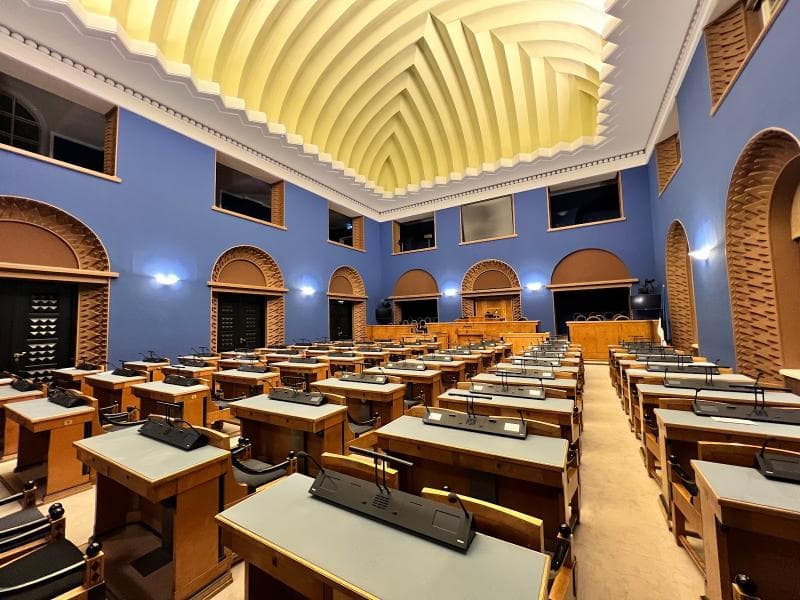
Discover the unique Castle Courtyard within Toompea Castle in Tallinn, Estonia, home to the world's only Expressionist parliament building.
Overview
Perched majestically atop Toompea Hill in Tallinn, Estonia, Toompea Castle is a storied landmark that has served as the seat of power for centuries. Within its ancient walls lies the Castle Courtyard, an area transformed over time to house the Riigikogu, Estonia's Parliament. Unlike a typical open-air medieval courtyard, this space evolved to accommodate modern governance, yet it retains echoes of its layered past. The castle complex itself is a remarkable blend of architectural styles, reflecting the various rulers and eras that have shaped Estonian history. Visitors approaching the castle will first notice the distinctive pink Baroque façade facing Lossi plats, a striking contrast to the rugged limestone walls of the older fortress sections.
The Castle Courtyard, while housing the functioning parliament, is an intrinsic part of this historical tapestry, inviting curious travelers to discover the unique juxtaposition of medieval fortitude and 20th-century design. While the external appearance might suggest a purely Baroque palace, the courtyard reveals a significant architectural shift from the early 20th century, making it a compelling spot for those interested in history and design.
History & Cultural Background
The origins of Toompea Castle trace back to at least the 9th century AD, when an ancient Estonian stronghold stood on this strategic limestone hill. Over centuries, various foreign powers—including the Danes, the Order of the Brethren of the Sword, the Teutonic Order, Swedes, and Russians—conquered and rebuilt the fortress, each leaving an indelible mark on its architecture and character.
The medieval structure, featuring powerful western walls and towers like Tall Hermann, represents the castle's defensive past. However, a significant transformation occurred in the 18th century under Catherine the Great, who ordered the eastern part of the medieval castle to be replaced with a pastel-pink Baroque and early Classicist palace to house the Governorate of Estonia. This grand facade, visible from the Castle Square, aimed to project imperial elegance.
The Castle Courtyard itself witnessed a remarkable change following Estonia's declaration of independence in 1918. Instead of demolishing the existing structures, architects Eugen Habermann and Herbert Johanson constructed a new Parliament building (Riigikogu) within the courtyard of the old fortress between 1920 and 1922. This bold move created a unique architectural ensemble, where the modern seat of government was intentionally integrated into the historical fabric.
What Makes It Special
What makes the Castle Courtyard truly special is its unexpected architectural marvel: the Expressionist Parliament building nestled within the ancient castle complex. While the castle's exterior boasts a Baroque façade, stepping inside the courtyard reveals a masterpiece of 1920s Expressionism. The Parliament's assembly hall is renowned for its striking, unconventional color palette, featuring lemon yellow, rust brown, and electric blue, along with zig-zagging motifs and sharp geometric angles. This makes it the only Expressionist parliament building in the world, a testament to Estonia's burgeoning national identity after gaining independence.
This innovative design choice demonstrates a commitment to integrating new purpose with old foundations, allowing the historic essence of Toompea to persist while embracing a forward-looking vision. The combination of Gothic, Baroque, and Expressionist styles within one complex offers a fascinating architectural journey through Estonia's history.
Stories, Fun Facts & Local Details
The entire Toompea Hill, including the castle and its courtyard, is steeped in legends. One popular Estonian legend attributes the creation of Toompea Hill itself to a mythical figure named Linda, the mother of the epic hero Kalevipoeg. She is said to have built the hill boulder by boulder with her bare hands as a burial mound for her husband, Kalev.
A notable daily tradition involving the castle is the raising and lowering of the Estonian flag atop the Tall Hermann tower, one of the four original corner towers of the medieval fortress. This ceremony, accompanied by the national anthem at sunrise (or 7:00 AM in winter) and a patriotic song at sunset, symbolizes Estonia's enduring independence and sovereignty. The Tall Hermann tower, reaching 45.6 meters, has proudly flown many flags throughout history, reflecting the various powers that have ruled the land, but it now stands as a powerful symbol of Estonian nationhood.
Visitor Perspective
Exploring the Castle Courtyard offers visitors a chance to engage directly with Estonia's political heart. While the Parliament building functions as an active government office, free guided tours are often available, providing an insightful look into the Riigikogu's work and the castle's rich history. These tours typically highlight the unique Expressionist interiors of the Parliament's assembly hall, a true hidden gem.
Visitors can also appreciate the architectural diversity of the complex by walking around its exterior. The contrast between the 18th-century pink Baroque facade, the medieval curtain walls, and the 20th-century Parliament building within the courtyard tells a compelling story of transformation. Remember to check the official Riigikogu website for tour schedules and booking requirements, as advance registration and a valid ID are usually necessary.
Coordinates: 24.737, 59.4357
View on Google Maps💬 How Travelers Describe This Place
Based on community votes
Interesting
1.0kBeautiful
869Unique
309Photogenic
100Must See
33
Traveler Stories
Discover memorable experiences shared by travelers who have visited this place.
No traveler stories yet.
Be the first traveler to share what made this place memorable.

Tour
By
Spot
Discover amazing places around the world. Your journey starts here.
Explore
© 2026 TourBySpot. All rights reserved.