Casa Manila
Manila, Philippines
Explore Casa Manila in Intramuros, Manila, Philippines, a living museum showcasing 19th-century Spanish colonial elite lifestyle and architecture.
Overview
Step back in time within the historic walled city of Intramuros, Manila, and discover Casa Manila, a meticulously recreated 19th-century colonial house. More than just a museum, Casa Manila serves as a living testament to the opulent lifestyle of affluent Filipino-Spanish families during the Spanish colonial period. It offers a unique window into the domestic life, architectural grandeur, and cultural fusion that defined elite society in old Manila.
Situated within the Plaza San Luis Complex, Casa Manila invites visitors to wander through its fully furnished rooms, which are adorned with antique pieces sourced from Europe, China, and the Philippines. Every detail, from the intricate carvings to the period-appropriate fixtures, aims to transport you to an era of refined elegance and tropical adaptation, offering a multi-sensory journey through Philippine history and identity.
History & Cultural Background
Casa Manila's existence is a tale of restoration and remembrance. Much of Intramuros, including its magnificent houses, was devastated during the Battle of Manila in World War II, leaving only fragments of its colonial core.
As part of the Intramuros Restoration Project in the 1980s, Casa Manila was conceived and built to revive the architectural flavor and elegance of the era. It was specifically constructed between 1981 and 1983, under the initiative of then-First Lady Imelda Marcos, to showcase the lifestyle of a wealthy Filipino family during the final century of Spanish rule.
The house's design is not an exact reconstruction of a specific existing house but rather a faithful replica modeled after an 1850s 'bahay na bato' (stone house) that once stood on Jaboneros Street in Binondo, Manila. The 'bahay na bato' is a hybrid Filipino-Spanish architectural style characterized by a sturdy stone ground floor and elegant wooden upper floors, designed to withstand both tropical climate and seismic activity.
What Makes It Special
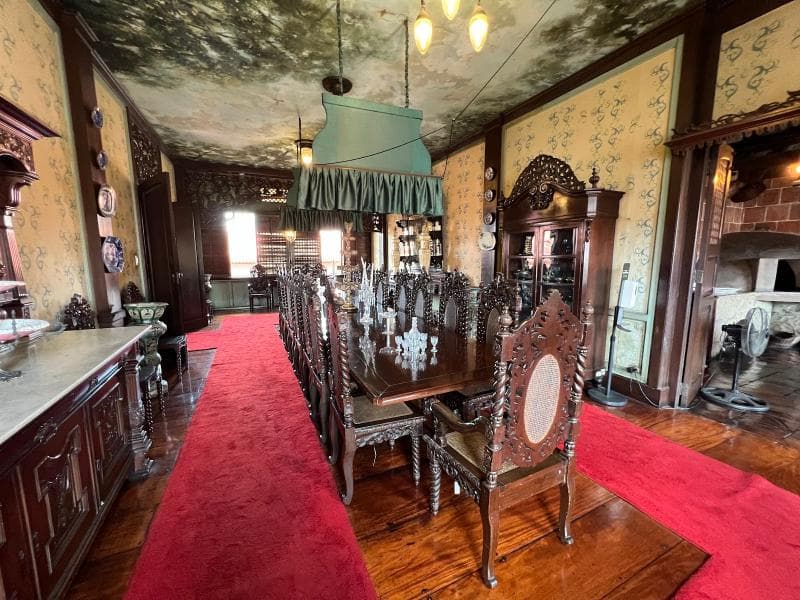
What truly sets Casa Manila apart is its immersive quality. It's designed as a 'lifestyle museum,' allowing guests to experience colonial domestic life firsthand. The museum's grandeur is evident in its meticulously recreated period rooms, which include the 'sala' (main living room), 'comedor' (dining room), bedrooms, kitchen, and 'azotea' (roof terrace).
Walking through Casa Manila reveals a rich tapestry of cultural influences. You'll observe a blend of Spanish aesthetics, Chinese craftsmanship, and indigenous Filipino elements. The interiors boast antique furniture from Europe, imported Chinese ceramics, crystal chandeliers, and intricately carved wooden details. Architectural features such as wide 'ventanillas' (sliding panels under windows), 'capiz' shell windows (used instead of glass for light and ventilation), and 'persianas' (wooden louvers) demonstrate practical adaptations to Manila's tropical climate.
The ground floor features thick stone walls and a 'zaguan,' a wide stone-paved passageway leading to the central courtyard or 'patio.' This patio, often paved with 'Piedra China' (Chinese granite used as ballast in trading junks), served to cool the house. The layout also subtly reflects the colonial social hierarchy, with luxurious guest rooms dominating upper floors and more discreet service areas for household staff.
Stories, Fun Facts & Local Details
Beyond its architectural beauty, Casa Manila holds fascinating historical nuances and a touch of local folklore. The 'volada,' a cantilevered walkway along the window side of the house, allowed servants to move discreetly between rooms without disturbing guests in the main halls.
A popular local detail, though rooted in fiction, revolves around 'ghost stories' associated with Casa Manila. While the building itself is a modern reconstruction, the antique furniture and artifacts within are said to carry an 'imprint' of their past owners, leading to tales of unexplained footsteps or movements heard by staff. These stories, often published in the 'Gaceta de Intramuros,' were originally crafted to generate interest in the newly built museum, adding a layer of mystique to the historical experience.
The integration of Chinese elements, such as ceramics and 'Piedra China' paving, highlights Manila's historical role as a vibrant trading hub where East and West converged. Even the 'letriña,' the old version of a toilet room, features unique designs, and the kitchen with its stony structure provides a glimpse into 19th-century domestic practices.
Visitor Perspective
Visiting Casa Manila is like stepping onto a meticulously preserved stage where history comes alive. Guests can freely explore the various rooms, allowing for an intimate look into the daily routines and social customs of the 'ilustrados' – the educated elite of 19th-century Philippines.
The museum is typically open from Tuesday to Sunday, from 9:00 AM to 6:00 PM, with Mondays closed for maintenance. It is conveniently located in the Plaza San Luis Complex, directly across from the historic San Agustin Church, making it an accessible and integral part of any Intramuros walking tour.
Casa Manila is a key stop for students, history enthusiasts, and international travelers seeking a deeper understanding of Filipino identity, art, and colonial urban living. While there are generally no guided tours included, the detailed displays and the authentic ambiance provide a comprehensive educational and cultural experience, making it an essential destination for those wishing to connect with Manila's rich colonial past.
Coordinates: 120.97517, 14.58966
View on Google Maps💬 How Travelers Describe This Place
Based on community votes
Beautiful
934Must See
741Unique
276Interesting
30Photogenic
16
Traveler Stories
Discover memorable experiences shared by travelers who have visited this place.
No traveler stories yet.
Be the first traveler to share what made this place memorable.

Tour
By
Spot
Discover amazing places around the world. Your journey starts here.
Explore
© 2026 TourBySpot. All rights reserved.