Casa de la Panadería
Madrid, Spain
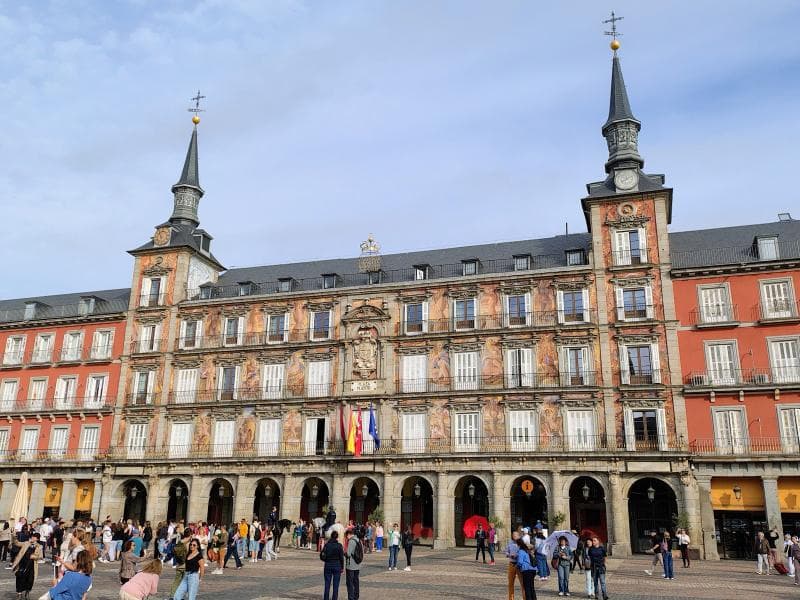
Discover Casa de la Panadería, a historic Baroque building in Madrid's Plaza Mayor. Explore its rich history, stunning frescoes, and cultural significance.
Overview
Standing proudly on the north side of Madrid's iconic Plaza Mayor, the Casa de la Panadería is a visual feast and a historical anchor. This emblematic Baroque building, whose name translates to 'Bakery House', has witnessed centuries of Madrid's vibrant life unfold in the grand square it overlooks. With its distinctive frescoes, arcaded ground floor, and corner towers, it immediately captures attention amidst the uniform red buildings of the Plaza Mayor. Today, while its initial purpose as a bakery is a distant memory, it serves as a central hub for visitors, housing Madrid's main Tourist Information Centre and exhibition spaces, inviting curious travelers to delve into the city's rich past and present.
History & Cultural Background
The story of the Casa de la Panadería is intrinsically linked to the very foundation and evolution of Plaza Mayor itself. Its origins trace back to 1590, when construction began on what would be the first building in the newly conceived square, designed by Diego Sillero and Francisco de Mora. Juan Gómez de Mora further integrated the structure into the square's design, completing it in 1619. The building's original purpose was to house the town's principal bakery, hence its name, and its significance was tied to the Bakers' Guild, an organization that wielded considerable economic and political power through its control over grain pricing.
However, the Casa de la Panadería, like the Plaza Mayor, has endured a tumultuous history marked by devastating fires. The original wooden structure was destroyed in a fire in 1670 (some sources say 1672) and subsequently rebuilt by Tomás Román, with interior and facade decorations by artists Claudio Coello and José Jiménez Donoso. Another major fire ravaged the square in 1790, but this time the Casa de la Panadería remarkably survived, serving as a reference for Juan de Villanueva's reconstruction of the surrounding plaza. Over the centuries, the building has served many roles beyond a bakery. It housed the offices of the Royal Standard Weights and Measures, the Royal Academy of Fine Arts of San Fernando, the Royal Academy of History, and later, the Municipal Library and Archives.
What Makes It Special
What truly sets the Casa de la Panadería apart are its captivating facade frescoes. While the building itself is a masterpiece of Baroque architecture, it's the vibrant, colorful murals that draw the eye and spark the imagination. The current frescoes, designed by artist Carlos Franco and completed in 1992, replaced earlier, deteriorated versions. Franco's work is a rich tapestry of mythological figures, such as Cybele, Bacchus, and Cupid, intertwined with symbolic representations of Madrid's history, traditions, and identity. These murals are not merely decorative; they tell a story, celebrating the city's past and the Baroque essence of the square.
Furthermore, the Casa de la Panadería holds a unique position as the architectural focal point of Plaza Mayor. It stands as the grandest and most ornately decorated building on the square, with its four floors, arched ground level, and distinctive corner towers distinguishing it from the otherwise uniform residential buildings. At its very top center, the royal Spanish coat of arms from the reign of King Charles II proudly displays symbols of various kingdoms that once formed Spain, offering a subtle historical lesson in heraldry.
Stories, Fun Facts & Local Details
One fascinating detail is that the royal family once occupied rooms on the main floor of the Casa de la Panadería, using it as a prime viewing spot for the many spectacles held in the Plaza Mayor, from bullfights and theatrical performances to royal proclamations and even executions. Imagine the kings and queens observing the bustling life of the capital from these very windows!
The building's perseverance through multiple fires is another remarkable aspect. Its survival in the great fire of 1790 was particularly crucial, as its existing structure then served as a blueprint for the reconstruction of the rest of the Plaza Mayor, ensuring the square's architectural harmony. The detailed process behind the 1992 frescoes, chosen through a public competition, highlights the city's commitment to maintaining the building's artistic integrity. Carlos Franco's winning design intentionally blended classical mythology with Madrid's unique narrative, a 'castizo' (traditional Madrid style) interpretation of the ancient.
Visitor Perspective
For any traveler exploring Madrid, the Casa de la Panadería is an unmissable stop. Located directly on Plaza Mayor, it is easily accessible and forms an integral part of the square's vibrant atmosphere. The ground floor now hosts the Madrid Tourist Information Centre, making it an excellent starting point for visitors to gather maps, brochures, and insights into the city. Inside, visitors can explore the Sala de Bóvedas (Vaulted Room) in the basement, often used for exhibitions, and admire the high ceilings and frescoes in spaces like the Salón Real (Royal Hall), which today hosts civil weddings and city council receptions. Even a simple stroll around the Plaza Mayor, pausing to appreciate the intricate details of its facade, offers a deep connection to Madrid's enduring spirit and grand history. Its historical layers and artistic expressions make it more than just a building; it's a living canvas of Madrid's soul.
Coordinates: -3.7074, 40.4158
View on Google Maps💬 How Travelers Describe This Place
Based on community votes
Unique
685Photogenic
472Beautiful
446Interesting
399Must See
33
Traveler Stories
Discover memorable experiences shared by travelers who have visited this place.
No traveler stories yet.
Be the first traveler to share what made this place memorable.

Tour
By
Spot
Discover amazing places around the world. Your journey starts here.
Explore
© 2026 TourBySpot. All rights reserved.